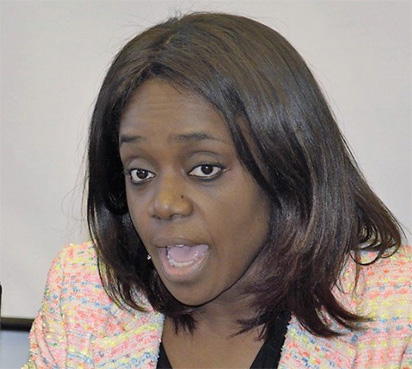
Adeosun
By Atu Ikot
SO much has been said about Nigeria’s economy, with different interests espousing differing views and pushing divergent narratives – some positive and others negative. Most of those pushing the negative, do so from a point of how they feel and what they seem to be seeing; while those pushing the positive, rely largely on the fundamentals as they continue to emerge.

the Minister for Finance, Mrs. Kemi Adeosun
Curiously, those pushing the negative started by pointing to the initially declining fundamentals and used them to support their position, but when the trend started changing, they doubted the same fundamentals which served initially as their indicators.
However, looking at the figures by January 2016 and comparing those with corresponding figures in 2018, there would be no doubts, ordinarily, as to whether something has happened and in what direction.
Nigeria’s 2017 GDP growth was published on February 27th 2018 and it provides a key milestone and benchmark for one to use to analyse progress made towards the achievement of the aims and objectives of the Economic Recovery and Growth Plan; a flagship economic compass of the present administration.
From whatever perspective one is looking at, the growth of 0.83%, which represents more than 2% improvement on the negative performance in 2016, is a by any means a positive signal. It reflects the fact that the macro-economic environment is being steadily stabilized. This was listed as the first objective of the ERGP.
Prevailing economic situation
It is believed, and indicators have shown, that stable oil production and prices, combined with a focus on improvements in key sectors and government investments in critical infrastructure, have resulted in this return to growth.
It is however necessary to make this point that growth of below 1% in an economy where population growth is over 3% is not and cannot be felt by the people. And this is where the issue is when people doubt the growth figures as against the prevailing economic situation in their households. It is a point of concern, and would remain so for some time to come if something is not done urgently about population growth.
It must not be assumed in any quarter that a return to growth automatically signals success in the strife to better the economy. It must not be assumed either that the job is close to being completed. It is not and cannot be! It is still early days in the process and at the very early stages of a journey to fundamentally re-structure the Nigerian economy. It is a journey that government and economy handlers must be disciplined about, and one that will establish the basis for competitiveness as a nation, and the ability to provide for the people, not just between now and 2020, but for decades to come.
With the news about how the global economy is changing and how the lifespan of petroleum product-powered automobiles is limited to at best a couple of decades; and how the rise of cheaper, efficient and large scale renewable energy technology threatens the hegemony of fossil fuels, an economy heavily tilted by fossil fuel, like Nigeria’s, should have great cause to worry.
Again, when we consider that the future of work will be fundamentally changed by the rise of technology, like artificial intelligence and robotics, it therefore pricks the thought this is the context within which Nigeria’s economic development must take place. Many of these developments represent opportunities for the country and the people, and must be seen from that angle. Apart from their profoundness, these also demonstrate, without a shadow of a doubt, that the country’s reliance, dependence and focus on the oil sector alone is not and cannot be sustainable. There must be a deliberate move to change.
But as the change is being worked on to deliver this structural change, it is not sufficiently well known that Nigeria’s revenue to GDP ratio is probably the lowest in the world. At 6%, it is well below the nearest contemporary, at 10%. For every percentage point that ratio can increase, there is a probability of an additional US$4 billion to spend. This revenue weakness is perhaps the most critical challenge to the economy. Almost every problem that the economy faces requires significant investment to address, and even if annual borrowing is increased, it will still not mobilise sufficient funds to deliver the pace and level of reform that we need.
There is absolutely no doubt that the investments that Nigeria must make in order to address the infrastructure deficit, and the level of spending that is needed to be able to commit annually to development sectors like education, health and social welfare are quite simply beyond the capability of the current Nigerian fiscal profile.
That is why driving revenue growth is the core objective of the Federal Government, and luckily there are improvements to show. Figures from the National Bureau of Statistics and global reports on the economy indicate that investor confidence is clearly returning, as evidenced by the substantial increase in capital inflows. There was over US$6 billion of capital inflows in the first quarter of 2018 compared to less than US$1 billion in the first quarter of 2017 – an increase of more than 600%.
A number of reform measures, such as the work being done by the Presidential Enabling Business Council (PEBEC), have resulted in the country becoming recognised by the World Bank as one of the top ten reforming countries in the world. In addition, the country has moved up 24 places in one year in the World Bank’s ease of doing business rankings. These are all indicators that the economy is rebounding, but it will take time for this to reach the levels that are required for everyone to feel that something positive is indeed happening in the economy.
This is because government’s most significant revenue generating mechanisms involve the collection of tax and excise on corporations and individuals; but government must recognise that the willingness of those groups to pay the tax that is due, is linked to their confidence in government’s accountability and ability to manage those funds and deliver value.
As government is making efforts to demonstrate to the people that it can, and will deliver on infrastructure, enabling environment and the social services that are squarely its obligation, it should also actively work to build out the partnerships that can mobilise the investments that must be made, and to accelerate them. Some visible efforts can be seen in this direction with some of the initiatives under the Economic Recovery and growth Plan (ERGP). The ERGP is acknowledged as a market driven strategy, built on the principles that must leverage the power of the private sector, and enable markets to function. It is a successor medium term plan that followed the Strategic Implementation Plan put in place to drive the 2016 expansionary budget.
On March 13, 2018 President Muhammadu Buhari formally launch the ERGP Focus Labs, which was designed to establish a forum for clear, honest and detailed discussion between the relevant stakeholders interested in six core focus sectors; agriculture, transportation, power, gas, manufacturing and processing (including solid minerals).
The ERGP labs are workshop-style closed-door investment forums between private sector and senior government officials, including cabinet ministers and heads of regulatory agencies to tackle some of the thorniest bottlenecks and inhibitors of additional business investments in the economy. Designed as business accelerators, it signaled a new direction in the business-to-government partnership as investors converged in Abuja to extract investment commitments that are reciprocal.
At the end of the six weeks duration of the labs, reports indicated that over US$22.5 billion worth of potential private investments were identified, out of which projects with an investment value of up to US$10.9 billion could be categorized as “most ready” to go. Several quick wins/early successes were reportedly recorded. It is claimed that cumulative investments from the projects identified in the first phase of the labs could rise up to as much as US$39.2 billion by 2025, if effectively followed through. That sounds encouraging.
To achieve effective partnership, government must demonstrate to investors that it is available, open and willing to collaborate to remove the perennial obstacles they face, and to partner to deliver projects that will deliver not just commercial returns but jobs and growth that Nigeria needs. That, of course has been signaled as the objective of the Labs, but it must be followed through in concrete terms.
Complex inter-agency problems
Government has however indicated willingness in addressing the complex inter-agency problems that can hinder investment, and in return is seeking investment commitments in the strategic sectors that the ERGP is focusing on. That may be reason why nine cabinet Ministers were involved in this process.
There must be trust between the public and private sectors. And it seems that trust is beginning to manifest as the foreign exchange market is resetting, with capital inflows progressively increasing in 2017 and providing a boost to the Nigerian Stock Exchange. However, while this provides the much needed liquidity, it must be supplemented with domestic and foreign direct investment in the core sectors. This is what catalyses structural change.
The potential for the Nigerian economy to grow, and deliver a sustainable base of government revenue while providing the jobs that Nigerians need, remains as strong today as it has ever been. But the threats to the traditional base of the economy have been growing, and the clock is ticking. There is no longer an excuse to delay action. All must work together now, to deliver the change that is required.
*Ikot, a commentator on contemporary issues, lives in Abuja
Disclaimer
Comments expressed here do not reflect the opinions of Vanguard newspapers or any employee thereof.