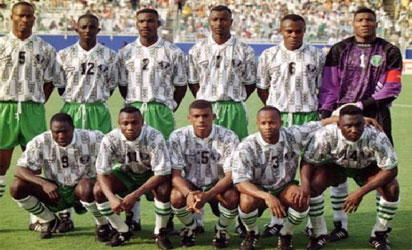
The class of ’94: The historic World Cup debut
The Class of ’94 is the latest addition to the ever-growing literature on Nigerian football; it’s rich history, heroes and villains. Published by former Vice Chairman of the defunct Nigeria Football Association, Tony Nnachetta, The Class of ’94 focuses on the exploits of the national team in Tunisia ’94 Africa Cup of Nations and USA’94 FIFA World Cup.
It did not end there. The Class of ’94 also traces the rise of Nigeria football from Algiers ’90 and Senegal ’92 AFCON tournaments and the lows of the post ’94 era. It is a must read. Excerpts:

The class of ’94: The historic World Cup debut
Nothing illustrates the character of Nigeria’s announcement of its arrival at the World Cup in 1994 than her debut goal. The Super Eagles had the ball along the touchline in midfield at the feet of support striker Daniel Amokachi. He was under some pressure, and for a moment appeared as though he was going to sweep the ball back into the comfort of the midfield, or the safety of the defence. If you blinked, you missed the magic that followed.
Winger Finidi George, spinning around from facing his own goalkeeper, was in a moment flying down his accustomed precincts on the right wing, where Amokachi found him with a perfectly timed pass coming off his left foot. George, one touch later, put a low cross that danger-man Rashidi Yekini tapped into the Bulgarian net for Nigeria’s first-ever goal in World Cup history.
What was equally impressive is that there were two other Eagles arriving out of nowhere behind and around Yekini, ready to handle the finish had he somehow stumbled, illustrating the fact that members of the team worked as one.
But Yekini, Africa’s most prolific soccer hitman, did not miss. The objective achieved, he ran into the goal, grabbing the net and shaking it maniacally with upraised hands, uttering words nobody has thus far been able to decode. Yekini’s celebration of that epochal goal was listed amongst the most iconic celebrations of goals in the history of the FIFA World Cup, and pictures of it appeared in top newspapers and magazines around the world.
It bears the hallmark of history that Nigeria made her first appearance in the FIFA World Cup in the year that the fiesta was staged for the very first time in the United States of America. The Super Eagles of Nigeria made the grand entry into America as the champions of Africa, having won the coveted African Cup of Nations in Tunisia in February 1994. The team came to the World Cup with a sparkling reputation, for in April 1994, the Super Eagles got ranked 5th in the FIFA World Rankings, the highest ranking ever achieved by an African football team.
The United States hosted with characteristic American aplomb the 1994 FIFA World, which marked the 15th edition of the competition. From June 17 to July 17, 1994, the FIFA World Cup took pride of place in nine cities across the United States, a nation where soccer had hitherto not been the most popular sport, but which was chosen as the host by FIFA on July 4, 1988.
Distinguished soccer-loving Americans such as Henry Kissinger had lobbied endlessly over the years for the United States to be granted the hosting rights to the esteemed FIFA World Cup. The US lobby turned successful with the granting of the hosting rights in 1988, and the Americans did not disappoint in hosting a hugely successful competition in 1994.
The “Adidas Questra” was the official match ball for the competition. Before the hosting of the World Cup by the US, no other FIFA World Cup had exceeded 53,000 spectators in average attendance, yet the Americans produced an eye-popping average attendance of 69,000 spectators. In the end, the total attendance of nearly 3.6 million for the final tournament broke the record for the highest spectatorship in World Cup history. The FIFA World Cup had been expanded from 24 to 32 teams in the 1998 World Cup staged in France, thus extending the number of matches played in the tournament from 52 to 64.
Millions of Nigerians who could not travel to the US to bear witness to the august World Cup watched on live television the opening ceremony which was held on June 17,at Soldier Field Stadium in Chicago. The then United States President Bill Clinton partook of the opening ceremonies alongside such eminences as the then Chancellor of Germany, Helmut Kohl, and the President of Bolivia, Gonzalo Sanchez de Lozada. Television
goddess, Oprah Winfrey served as the MC of the ceremony, and she added the hilarious drama of falling off the dais whilst introducing Diana Ross to give a musical performance. The music of the evergreen Diana Ross reverberated through the stands and across the globe via television. The arrangement, in proper American showbiz pizzazz, was that Diana Ross would end her performance by kicking the Adidas Questra ball into the goal from the penalty spot, “with the goal then splitting in two as part of a pre-orchestrated stunt.”
But soccer was hardly an American sport, and the moment would be frozen in time: Miss Ross completely mishit the ball, sending it rolling wide to the left of the empty goal. The organizers of the stunt were smart enough to collapse the goalposts anyway to tally with the original plans of Diana Ross’s penalty shot shattering the net! The other musical performances at the opening ceremonies came from Daryl Hall and Jon Secada.
The stage was then set for the Super Eagles of Nigeria to make a historic debut at the FIFA World Cup in America on June 21,1994 at the Cotton Bowl Stadium, Chicago, in an epic match against Bulgaria. Nigeria’s World Cup squad was indeed intimidating.
The captain of the Super Eagles was the leader, “Big Boss” Stephen Okechukwu Keshi, born on January 31,1962 and then starring at Molenbeek FC in Belgium. First choice goalkeeper was the legendary Peter Rufai, alias Dodo Mayana, who was born on August 24, 1963 and played his club football at Go Ahead Eagles in the Netherlands. Right wing-back was the rugged Augustine Eguavoen, born on August 19, 1965 and who plied his trade at Kortrijk FC in Belgium. Sleek Benedict Iroha, born on November 29, 1969 was the first choice player at the left wing-back position, and he was a star player at Vitesse Arnhem in the Netherlands.
“Gentle Giant” defence ace Uche Okechukwu, born on September 27, 1967 and playing for Fenerbahce in Turkey, was the star centre-back. His partner in central defence was the solid Chidi Nwanu, born on January I, 1967, who played for RSC Anderlecht in Belgium. Right midfield was manned by the flying Finidi George, horn on April 15, 1971 who manned the wing with dexterity at Ajax Amsterdam in the Netherlands. Sunday Oliseh. born on September 14, 1974 and starring at RC Liege in Belgium, took masterful charge of the defensive midfield position.
The genius of the dribble, Augustine Okocha, born on August 14, 1973 and then starring at Kintracht Frankfurt in Germany was the creative midfielder in the squad. Irrepressible Emmanuel Amuneke, born on December 25. 1970 and a star of the Egyptian giant Zamalek, took solid charge of the left midfield. “The Bull” Daniel Amokachi, born on December 30,1972 and a star player at Club Brugge in Belgium, was a crack attacker of the team. “Gangling” Rashidi Yekini, born on October 23, 1963 and playing for Vitoria Setubal of Portugal, was the star striker of the team. Samson Siasia, born on August 14, 1967 and playing for Nantes in France, was an attacking ace in the squad.
Tireless workhorse Thompson Oliha, born on October 4, 1968 and playing for Africa Sports in Cote d’Ivoire, was a midfield ace in the squad. The reserve goalkeepers in the squad were Wilfred Agbonavbare (born on October 5, 1966, playing for Rayo Vallecano in Spain) and Aloysius Agu (born July 12, 1967 and starring at RC Liege in Belgium).
The rest of the squad included: Emeka Ezeugo (December 16, 1965, Honved of Hungary); Uche Okafor (August 8, 1967, Hannover 96 of Germany); Michael Emenalo (July 14, 1965, Unattached); Mutiu Adepoju (December 22,1960, Racing Santander of Spain); Victor Ikpeba (June 12, J973, AS Monaco of France); and Efan Ekoku (June 8, 1967. Norwich City of England).
The Dutch coach of the Super Eagles, the charismatic Clemens Westerhof, had honed a squad he felt was good enough to shock the world. Born on May 3, 1940, Westerhof had led the Super Eagles to winning the silver medal at the African Cup of Nations in Algeria in 1990, only to settle for a bronze in the Cup of Nations at Senegal in 1992 before winning the coveted gold in Tunisia 1994. Thus was launched the golden age of Nigerian football with the concomitant qualification for the very first time of the Super Eagles into the elite league of the FIFA World Cup finals.
The stage was thus set for Nigeria’s first match against the Hristo Stoich-kov-inspired Bulgaria at Cotton Bowl Stadium, Dallas on June 21,1994. The Super Eagles filed out with Peter Rufai in goal. The back-four quartet was made up of stand-in captain Augustine Eguavoen, Uche Okechukwu, Chidi Nwanu and Ben Iroha. In the midfield, Sunday Oliseh was the middle pivot between Finidi George on the right and Emmanuel Amuneke on the left.
Coach Clemens Westerhof slotted Samson Siasia in the creative midfield role that was erstwhile reserved for Augustine Jay-Jay Okocha. The coach’s argument was that the urgency of the first match did not need the “showboating” of Okocha. The deadly pair of Rashidi Yekini and Daniel Amokachi formed the strike-force of the team on parade.
The match was a cagey affair, and nerves showed aplenty amongst the Nigerian debutants and the Bulgarians who had never won a World Cup match. The game somewhat opened up when the Bulgarian skipper hammered a free-kick into the Nigerian net, but his jubilation was cut short because the referee had spotted an infringement.
Then followed that sweeping move highlighted at the beginning, Finidi George feeding Rashidi Yekini to score Nigeria’s historic World Cup goal. Daniel Amokachi and Emmanuel Amuneke scored further goals to seal a 3-0 victory for the Super Eagles. Nigeria’s other Group D opponents Argentina hammered Greece 4-0 at the Foxboro Stadium, with striker Gabriel Batistuta scoring a hat-trick. Legendary Diego Maradona scored the other Argentine goal, and it made headlines all over the world.
The Super Eagles then squared up with Argentina, complete with Maradona and Batistuta, on June 25 at the Foxboro Stadium. Samson Siasia gave Nigeria an early lead which was eventually overhauled by two strikes from Claudio Caniggia, who reputedly could run the 100 meters in 10.79 seconds before the coming of Usain Bolt, and was seen as arguably the fastest footballer ever. The 2-1 victory of Argentina over Nigeria was marred by news that Argentine legend Maradona had failed a drugs test. Even so, Nigeria needed to win her last match against Greece to qualify from the group.
On June 30, 1994 at Foxboro Stadium the Super Eagles defeated Greece 2-0, with goals coming from the boots of Finidi George and Daniel Amokachi. Nigeria remarkably topped the group, thus qualifying to the next round on a very sound pedestal. Bulgaria placed second in the group ahead of world power Argentina, having defeated the Argentines 2-0.
It was indeed quite dramatic because Argentina was actually on the verge of winning the group going into injury-time until Bulgaria’s Nasko Sirakov scored in the 91st minute of added time. Nigeria, Bulgaria and Argentina all ended up with six points, but Nigeria boasted of a +4 goal difference while Argentina and Bulgaria both had +3 goal difference; the plucky Bulgarians edged past Argentina on the head-head-rule.
The epic clash of Nigeria and Italy in the last 16 of the 1994 World Cup took place at Foxboro Stadium on July 5. Nigeria’s line-up included Michael Emenalo at left wing-back in place of the regular Benedict Iroha who was out injured. Skipper Stephen Keshi who had played his only match against Greece was dropped back to the bench, and Chidi Nwanu reverted to his role in central defence, Midfielder Austine Jay-Jay Okocha started the match in his feisty element, taking the match to the rugged Italians from the first minute. Samson Siasia was on the bench, and there was news that he had a row with the coach, Clemens Westerhof.
The Super Eagles took the lead on 25 minutes with a goal from Emmanuel Amuneke. The 54,367 spectators that packed Foxboro Stadium cheered the entertaining Nigerians lustily, against the background of the pulsating music made by the Nigerian Supporters Club led by the inimitable Rafiu Ladipo. The Italians had to rely on cynical tactics, injuring Daniel Amokachi who had to be replaced by Mutiu Adepoju in the 35th minute.
Then goal-scorer Amuneke was equally injured in the 57th minute only to be replaced by Thompson Oliha. Soccer pundits had expected that Siasia who had performed creditably in the competition would come in; the revelation that Siasia had quarreled with Coach Westerhof was somehow borne out when Oliha was preferred in place of Siasia. Referee Arturo Brizio Carter of Mexico was not doing much to protect the Nigerians from the dodgy play of the Italians, save that in the 75th minute he had to expel via a red card Italy’s Gianfranco Zola.
The Nigerians were within two minutes of wrap-ping-up a historic victory when tragedy struck. The golden boy of Italy, Roherto Baggio, exploited a sudden inexplicable loss of concentration by the Super Kagles to score the equalizer in the 88th minute to save his coach Ariggo Sachi’s blushes. Extra-time was given, and Robberto Baggio scored the match-winning goal in the 102nd minute.
It was the most heartbreaking of losses. The Super Kagles had come ever so close to following the footsteps of Cameroon by becoming the second African team to qualify for the quarter-finals of the FIFA World. The more remarkable aspect of it all was that Bulgaria that Nigeria had beaten 3-0 eventually got to the semi-finals of the competition. In the end, Nigeria was adjudged as the most entertaining team in the 1994 FIFA World Cup.
Italy after beating Nigeria would march on to play the World Cup finals against the favourites, Brazil. In a pulsating final in which no quarters were given, Brazil and Italy ended the game 0-0 after extra-time. In the penalty shootout that followed to determine the world champions, Brazil became the first nation to win four World Cup titles as they beat Italy by scoring three penalty-kicks against Italy’s two. Incidentally, Italy’s talisman Roberto Baggio lost the much-needed penalty-kick. The 1994 competition achieved the record of the first World Cup final to be decided on penalties.
Disclaimer
Comments expressed here do not reflect the opinions of Vanguard newspapers or any employee thereof.