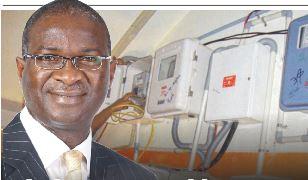
Fashola, electric meter
NIGERIANS are inundated from time to time by media reports of impending electricity tariff review to the extent that the National Assembly has had cause to invite the Minister of Works, Housing and Power to defend the purported move. Periodic tariff review is an essential part of the Electric Power Sector Reform Act 2005 which empowers the Nigerian Electricity Regulatory Commission to determine tariffs for the principal players in the sector.

Minister of Power, Works and Housing, Mr Babatunde Fashola
Pursuant to this mandate, NERC sets tariffs for GENCOs, TransysCo and DISCOs through Multi-Year Tariff Order, MYTO, for a five year period based on the need for cost recovery and reasonable return on investments.The tariffs also aim at incentivising cost reduction, improved service delivery and achievement of social goals such as universal access to electricity. Hence, retail tariffs reflect the costs of the entire value chain, beginning with natural gas on to wholesale generation, transmission, distribution/metering and institutional charges. Minor tariff reviews are undertaken semi annually to take account of variations in exchange rate while major reviews occur every five years to take account of all variables such as inflation, exchange rate, gas price and generation capacity.
Generation capacity
As of today, DISCOs do not generate electricity; they merely buy and sell electricity to the consumers. It is the GENCOs that produce electricity and sell to the Nigerian Bulk Electricity Trader, NBET, which in turn sells to DISCOs. The scenario we have today is that GENCOs have capacities to generate far more than they do on account of two major factors. Most of the thermal power plants are starved of natural gas and those who have adequate gas supply infrastructure still face evacuation constraints from the transmission grid.
The claim circulating through the media that we generate 7,000 MW of power is far from the truth. The truth is that the GENCOs can generate up to 7,000 MW but transmission capability is not more than 5,000 MW. The peak generation to date is 5,074.7 MW which occurred at 9:30 pm on February 2, 2016. In effect, the power in the distribution networks has hardly exceeded 5,000 MW. Those mistaking the GENCO capabilityof 7,000 MW for actuality can be forgiven because NBET invariably pays for the power stranded in the power plants on account of the take-or-pay obligation in the power purchase agreements with the GENCOs.
In the absence of government subsidy, the DISCOs are not charged the real price of electricity produced by the GENCOs but a price reflective of transmission constraint because, as stated earlier, DISCO tariffs are determined periodically based, inter alia, on quantum of electricity to be made available to them – a hypothetical, exaggerated guess work which is far from the reality. Hence, when a DISCO gets less electricity than factored into its tariff structure, it is bound to have shortfall in its projected revenue.
Furthermore, the efficiency of operation of the DISCOs is reflected in the aggregate technical, commercial and collection losses, ATC&C, vis-à-vis the benchmark allowed in the tariff formula. Available statistics show that, whereas allowable ATC & C losses range from 19.44 per cent to 45 per cent collated results (as at December 2016) reveal significant deviations ranging from 34 per cent to 68 per cent. Only three DISCOs have targets less than 25 per cent namely Eko 19.44 per cent, Ikeja 20.82 per cent and Jos 20.82 per cent but they could only achieve 34 per cent, 51 per cent and 51 per cent, respectively, as at December 2016. The next group are Ibadan, 30.41 per cent; Abuja, 31.54 per cent; Kaduna, 31.93 per cent and Yola 32.81 per cent with performances of 49 per cent, 48 per cent, 71 per cent and 64 per cent, respectively. In the last category are Kano, 38.2 per cent; Enugu, 38.43 per cent; Benin, 38.62 per cent and Port Harcourt 45 per cent with performances of 61 per cent, 68 per cent, 52 per cent and 66 per cent, respectively within the same period as others.
The layman interpretation of ATC & C losses is how much of the energy received is lost or simply un-accounted for in DISCO revenue. This high level of inefficiency is at the core of the clamour for tariff increase. For instance, Enugu Electricity Distribution Company with 38.43 per cent allowable and 68 per cent actual ATC & C losses recently claimed that it losses a whopping N1.9 billion monthly to energy theft. Unless and until such loopholes are plugged, you and I will be compelled to pay for DISCO inefficiency. The scale of ATC & C losses in monetary terms nationwide is better imagined from Enugu DISCO’s disclosure. Some DISCOs tackle this problem partially by curtailing supply to areas prone to energy theft but that is still begging the matter.
Energy theft results from un-metered customers who are largely connected illegally by DISCO field staff. These customers are levied various amounts monthly by DISCO field staff who simply pocket the money so collected. The DISCOs must first of all put their houses in order by working assiduously to attain the ATC & C performance targets given by NERC before they can legitimately clamour for tariff increase.
Proponents of tariff increase find it convenient to benchmark tariffs with unit cost of privately generated power. What a warped reasoning!!! By simple extension, they could jolly well argue that water tariffs where they exist as in Lagos State should match the price of sachets of pure water sold along the streets! They need to be reminded that private generation is the last resort for those engaged in it. Until Nigeria started experiencing power shortages in the post Udoji-award era, private electricity generation was a no-go area. If you wanted it, you needed to obtain a licence; worse still the energy produced must be passed through Electricity Corporation of Nigeria’s meter. What a turn-around to adversity with Nigeria being classified today as the largest generator market in the world.
Generator market
The normal thing anywhere in the world is for public utility power to be considerably cheaper than privately generated power. That is why there are special tariffs (known as feed-in-tariffs) for mini producers with surplus power to sell it to the grid at prices higher than normal tariffs. Economics of scale is on the side of large scale producers of any commodity, not just power. Today, you will find single utility power generators producing as much as 1,000 MW. How then do you compare the unit cost of such electricity with that of “I-better-pass-my -neighbour” producing 0.5 kVA i.e. 0.4 kW!!!
Admittedly, the DISCOs and, indeed, the GENCOs face enormous challenges. It is a fact that, at privatisation, the assets of the DISCOs were in deplorable condition and electricity workers’ union denied the buyers access to the facilities for meaningful technical evaluation of the assets. Nevertheless they bidded for and bought them with contractual undertaking to effect modernisation. More than five years down the line, modernisation still remains a mirage largely because the DISCOs are cash-strapped; hence the incessant clamour for tariff increase never minding the fact that tariffs have gone up 200 per cent since they mounted the saddle. Customers with 3-phase meters now pay around N25/kWh from N8/kWh prior to privatisation!
To the DISCOs, tariff increase appears to be the first recourse and presumably the path of least resistance instead of reducing ATC & C losses through provision of pre-paid meters and system upgrade. The majority of meters in service are analogueand they are hardly ever read. They also allege that customers bypass meters, a known problem which they do not seem to be tackling head-on. DISCOs need to find more creative solutions to their cash crunch instead of unending clamour for tariff reviews simply because they cannot make ends meet when they have unplugged revenue leakages.
They must also face Federal Government squarely on resolution of legacy matters particularly decrepit infrastructure & energy short supply vis-à-vis the lofty projections in the privatisation transaction memoranda. Privatisation roadmap of 2010 made medium term projections of approximately 14,200 MW; 10,000 MW and 9,000 MW available capacities for generation, transmission and distribution by December 2013. We are in 2018, none of the milestones have been reached; transmission capacity lags behind at barely 50 per cent of the projection, thus posinga bottleneck for the entire system. What this means is that the DISCOs can at best attain 50% of their projected capacity. DISCOs should therefore hold FG liable for the optimistic scenarios painted in the privatisation prospectus.
Having government as a shareholder is, of course, a liability militating against fund raising from financial and capital markets which ought to have been the most obvious benefit of privatisation.Government is no more than a sleeping partner in the enterprise; it neither injects capital nor contribute to project finance. On the other hand, it constrains the DISCOs from raising loans with DISCO assets as collateral. The earlier FG relinquishes its holding in the privatised companies the better. Government should focus on regulation ONLY.
Industry regulators need to be aware that DISCOs flagrantly continue to impose arbitrary charges on customers with analogue meters on the pretext that those meters are no longer accurate while their newly introduced smart meters appear not properly calibrated or deliberately programed to run faster than the earlier PHCN pre-paid meters all in an attempt to rake in more revenue from consumers. If you are fortunate enough to be migrated from PHCN installed pre-paid meter to the smart one, you will be awakened to the fact that your electricity “consumption” has doubled overnight, not on account of any change in load or improved regularity of supply.
Regularity of supply
The DISCOs must have looked beyond their shoulders to copy the sharp practice of some filling stations which indulge in half measures since they both operate under price control regime. In the days of yore, PHCN had a meter calibration centre in Oshodi, Lagos where meters were calibrated and proved before deployment and even after being in service if there were complaints. The newly acquired technology seems to be a tool in the hands of DISCOs to manipulate meter calibrations from the comfort of their offices. How does NERC plan to nip such malpractice in the bud? Customers must not be left at the mercy of the DISCOs who enjoy monopoly in their zones!
Finally, one wonders how long NERC will allow ATC&C losses which are significantly more than 10%. It is ethically wrong to subject consumers to tariffs based on unimaginably high level of system inefficiency.
By Dr Oye Eribake, a retired chief executive officer of a power engineering company, wrote from Lagos.
Disclaimer
Comments expressed here do not reflect the opinions of Vanguard newspapers or any employee thereof.