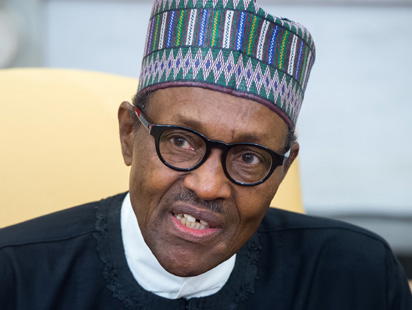
Nigeria’s President Muhammadu Buhari
By Emmanuel Aziken
President Muhammadu Buhari’s landmark meeting with President Donald Trump in Washington D.C. last Monday was a remarkable reflection of the expectations of the world on Africa’s most populous country.

Nigeria’s President Muhammadu Buhari
Despite the negative narrative of the meetings by his political traducers, the summit passed on uneventfully for the Nigerian leader who had in the past accustomed himself to making major blunders during his foreign outings.
It was remarkable that the first plaudit for the president came from a target of one of his early verbal eruptions abroad, that is Mrs. Aisha Buhari, who speaking from the other room set twitter ablaze with the commendation of her man.
Considering the controversies that had trailed President Trump’s relationship with Africa and his shithole comments about the continent, the invitation of the Nigerian leader to the White House was itself significant.
It was a practical demonstration of the efforts of the machinery of the United States government to redress the wrongs that effused from the personal foibles of President Trump, and even more; to redress the wrongs done to Africa by eight years of the Barack Obama presidency which had based its dealings with Africa on the extremist context of expansionism of homosexual rights and other culturally repugnant policies.
Even before the summit, a thaw in the frosty relationship between the two countries was shown in the agreement by the U.S. administration to sell high end defence platforms including the sophisticated A 29 Super Tucano aircraft to Nigeria. Such courtesies were denied the country by the previous U.S. administration despite the frenzy the Obama candidacy generated among some Nigerians.
The positive approach of the Trump administration to Nigeria some say, reflect the talk and do philosophy of U.S. Republican administrations to Africa.
While Democrats in the White House would show so much empathy for Africa, such emotions are often not translated to practical support for the continent as Obama showed in his eight years. Nigerians would recall that before Trump, that the George W Bush administration contributed in no small measure in stemming the spread of the AIDS pandemic on the continent and in Nigeria especially.
Presidential aides and associates of President Buhari may well be tempted to channel credit for the positive change in U.S.–Nigeria relations to Buhari. But they can only do so for the duration they are able to harness the positives from the summit, especially given the fact that Buhari is the first sub-Saharan African leader to have been invited to the White House.
However, even as the president was in the U.S., from where Nigeria’s presidential style democracy was copied, there were growing vexations to the sustainability of the presidential style of democracy as we know it in Nigeria.
While the president was away, state apparatus was deployed to checkmate internal democracy as the president’s one time cheerleader, Senator Dino Melaye was brought to two different courts in a stretcher over issues that flowed from internal differences between him and his governor, Yahaya Bello in the Kogi State chapter of the All Progressives Congress, APC.
Even more, in an act reflective of insubordination, the Inspector General of Police, Ibrahim Idris twice turned down invitations by the Senate to give account on the issue of Melaye and spate of killings in the country.
These are indeed, dangerous signs of a democracy at the precipice, and do not enhance the credibility of the president as a statesman as he was showcased in Washington D.C.
First it was the opposition leader, Olisa Metuh forced to court in a stretcher, and now, Melaye who many remember for his vitriolic comments about President Goodluck Jonathan in those days he used to be the opening act in the Buhari campaigns. Those days are long, long gone!
Disclaimer
Comments expressed here do not reflect the opinions of Vanguard newspapers or any employee thereof.