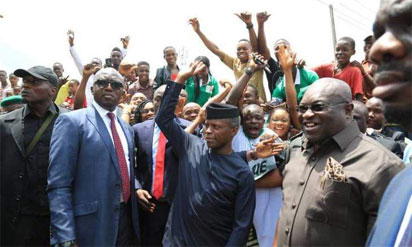
Vice President Yemi Osinbajo inaugurates the Abia state tele-health support center in Umuahia
Not since Atiku Abubakar’s first term has a vice-president since the advent of the Fourth Republic had the kind of latitude that Prof. Yemi Osinbajo is enjoying in directing policy and programmes of the Federal Government. However, concerns about his recent lamentations on alleged acts of corruption by the preceding regime is an issue.
By Emmanuel Aziken, Political Editor

Vice President Yemi Osinbajo, SAN,
His nomination to balance the All Progressives Congress, APC, 2015 presidential ticket was portrayed as a necessity to cushion perceptions of a hard Islamist in the person of Muhammadu Buhari.
A pastor and professor, Osinbajo, cut his teeth in governance as commissioner of justice and attorney general in Lagos State for eight years between 1999 and 2007 during which he spearheaded significant reforms in justice administration in the country’s commercial capital.
Though the closest to power, albeit constitutionally, vice-presidents are defined by the power and latitude that the president vests on him or her. A vice-president can be very powerful like Atiku Abubakar was between 1999 and 2003. A vice-president can also be completely locked out from the government like Atiku Abubakar was between 2003 and 2007. But whether in or out, the essential personal quotient required by a president from a vice-president is loyalty.
Osinbajo’s test of loyalty has not been scarce in the three-year span of the Buhari administration. It was especially so during the president’s three medical vacations during which otherwise adventurous political persons would have taken opportunity to advance themselves.
Whereas Osinbajo may have seemed to have passed that test of loyalty, especially with the way and manner he soothed the polity during Buhari’s absence, his recent vituperations of alleged deeds of corruption during the preceding administration have been a bother for some.
Indeed, many Nigerians perceived corruption to have been manifest during the preceding administration, but the issue for some is whether Osinbajo should have turned into a chorus. Or is he now a politician?
The vice-president was unrelenting at the recent Bola Tinbun Colloquium in Lagos.
“Every time we talk about this, every time we talk about corruption, our opponents say, “Don’t talk about it, just do your own, Don’t talk about it.”
“We will talk about it. And the reason why we will talk about it is, first, we must let our people know that we cannot afford to go this way again; never again should we allow a system where people take the resources of this country and skew the resources of this country, use the resources against the people of this country, and at the same time, they want to continue in ruler-ship.”
As a pastor, the suggestion is that Osinbajo may have been fired up by the inherent abhorrence for corruption by a true Man of God.
The inclination to speaking the truth no matter whose ox is gored may not have been wrong politics for the vice-president, but it is not something that has been much different from the stance of other officials of the ruling party.
Whether the vice-president’s chants on the alleged corruption of the past drowned out the positives of his government and his own role? That’s a question open to debate.
Remarkably, against the grain of expectations that his lack of political tact would consign him to irrelevance, Osinbajo has apparently carved a niche in the administration and is arguably the most relevant vice-president since the advent of the Fourth Republic.
His predecessors were Atiku Abubakar who apparently ran the government between 1999 and 2003 following which he was locked out in the second term. Dr. Goodluck Jonathan as vice-president to President Umaru Yar‘adua was about being invested with some authority before the cabal carved him out. Arc. Nnamadi Sambo who served under President Jonathan was largely not reckoned with any of the major policies of that administration.
It is as such remarkable that what some regard as the most impactful achievements of the Buhari administration are some of the projects that have been coordinated by the office of the vice-president. The social welfare scheme of the administration directly coordinated by the office of the Vice-President has been almost universally described as the most achievements of the administration. Osinbajo at the 10th Bola Tinubu Colloquium not too long ago gave an illustration of the impact of the administration’s social welfare scheme as he aimed to change the narrative concerning social welfare administration in Nigeria.
He said: “To address the question of the welfare of the people, we realized that if we waited for the economy to pick up and then provide jobs for the people, especially young people, many would have given up hope, and many would have ended up in all manner of illegal activities.
“So we decided on two things; one to invest heavily in Agriculture; to create jobs in the hinterlands, provide enough food locally and for all of the urban areas. In our agriculture programme, I’m sure that many would already agree that this has been a tremendous success.
Disclaimer
Comments expressed here do not reflect the opinions of Vanguard newspapers or any employee thereof.