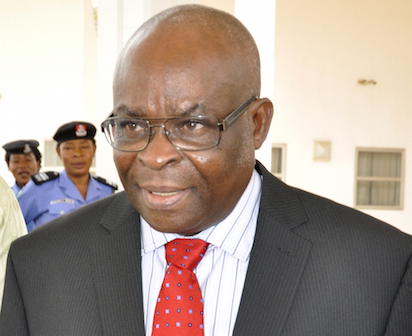
Former Chief Justice of Nigeria, Walter Onnoghen
By Innocent Anaba
Last week’s National Judicial Council, NJC, hammer, which fell on some judges, has again affirmed the determination of the Chief Justice of Nigeria, Justice Walter Onnoghen, to sanitise the judiciary and weed it of bad eggs.

Chief Justice of Nigeria, Justice Walter Onnoghen,
It must be pointed out that Justice Onnoghen took over the leadership of the judiciary at one of the most difficult periods in the history of the institution.
While past CJN got their appointments as a matter of course, Onnoghen was first appointed in an acting capacity. He was not appointed a substantive CJN until after the expiration of his acting tenure. Becoming the CJN at such a low period in the history of the nation meant that, the new CJN had his job cut out for him. The expectation on him was very high.
Having secured the position, he tactically avoided joining issues with the executive. He insisted that the rule of law must be the basis of engagement with other arms of government. While he was not opposed to investigating judges and the judiciary for corruption, Onnoghen insisted that the rule of law must be observed.
On March 7, 2017 when he was sworn in as the substantive CJN by Vice-President Yemi Osinbajo, who was then the acting president, Onnoghen renewed his promise to fight corruption in the judiciary.
He however, insisted that he would work as CJN in accordance with the rule of law, saying, “On my part as the head of the judiciary, I assure you that from the past experience, the key to everything in a democratic setting is adherence to the rule of law.
“There lies the solution to our problems. Let us try to encourage the independence of the judiciary so as to ensure the rule of law. If everyone realises that they are subject to the rule of law and that there are certain things that are tackled according to the rule of law and behave accordingly, it will benefit all of us.”
As an experienced legal practitioner before he was appointed a judge, Onnoghen knew that the bench alone could not resolve the perennial and seemingly intractable challenge of slow pace of trial in our courts.
This informed his decision to set up the National Judicial Council Committee on the Monitoring of Corruption Cases comprising lawyers, judges and the civil society.
After the retired President of the Court of Appeal, Justice Ayo Salami, rejected the chairmanship of the committee, Justice Suleiman Galadima, who recently retired from the Supreme Court was appointed to replace Salami and the committee immediately set to work.
The committee among others, has resolved to produce a new practice directions that will fast track the trial of cases involving corruption and financial crimes.
As part of the committee’s decision to engage all stakeholders, it has also concluded plans to meet with the Economic and Financial Crimes Commission, EFCC, the Independent Corrupt Practices and Other Related Offences Commission, ICPC and other agencies with powers to prosecute in furtherance of its mandate.
The practice directions sub-committee of the committee has already commenced a review of various practice directions by leveraging on both local and foreign comparative jurisdictions to meet global best practice.
The committee, after brainstorming on all the pending alleged corruption and financial crime cases submitted to it by the heads of court came to the conclusion that a new practice direction would be issued to judges handling the said cases.
With 2,306 on-going alleged corruption cases nationwide already submitted to the committee, many chief judges were yet to comply with the CJN’s directives to send such cases to him, hence no one should be left in doubt that this is a task for three men. Besides, the issues involved are multifaceted requiring different experience and expertise.
To facilitate its work, the committee was sub-divided into four sub-committees. The sub-committees are: Practice Directions, Training, Feedback and Engagement, and Awareness.
The committee also divided the country into three zones for ease of monitoring and evaluation of the said cases.
They are : Zone A, Abuja FCT, Zone B, Northern Zone and Zone C, Southern Zone. At the last count, Zone A in Abuja has 554 pending cases, Zone B has 347 cases, with Zone C having 1, 405 cases.
The biggest legacy Justice Onnoghen can leave behind is to immediately set up an ad-hoc committee to review the salaries of judiciary workers.
These workers are the engine room on which the judiciary depends to deliver an effective justice system. But for so long, they have been left out.
Many workers in the judiciary have difficulties paying their rents. This makes them vulnerable to litigants who may want to circumvent due process.
The workers’ housing allowances must be upwardly reviewed and must be done very urgently too. If this is done, the CJN will see a different judiciary.
The judiciary also need to be more proactive and should not wait for judicial officers to commit a corrupt act when it may be possible to stop the commission of that act. There is therefore, the need to establish an inspectorate department in the NJC.
This department will in turn give out direct numbers to court workers across the country and to the public to call to report verifiable acts of judges that violate their codes of conduct.
This sound radical, but the crisis in the judiciary requires a radical approach.
Disclaimer
Comments expressed here do not reflect the opinions of Vanguard newspapers or any employee thereof.