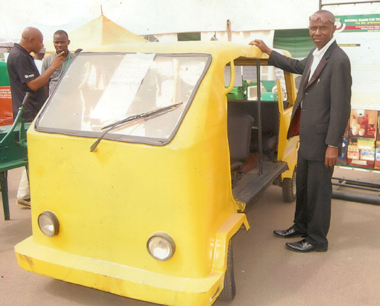
*CU’s Mini bus car. Satanding beside it (right) is Engr. Ocheja Joseph.
By Ebele Orakpo
Despite the topsy-turvy nature of things in Nigeria today, especially in the Education sector, some people are still determined to make Nigerians proud. Engr. Ocheja Joseph, a senior technologist at Covenant University (CU) Ota, Ogun State and his colleagues are among such people. In this chat with Vanguard, Joseph speaks on their latest innovation, saying the inspiration for the mini bus car ‘is actually a gift from God.’
Excerpts:

*CU’s Mini bus car. Satanding beside it (right) is Engr. Ocheja Joseph.
According to Joseph who is into automobile research and serves as technical instructor in workshops, instructing students on their projects, he is presently making impact in Nigeria “by the help of God, through CU.
Inspiration
“The inspiration for the mini bus car is actually a gift from God and for the fact that I am tied to the mission and vision of CU, God gave me that inspiration. I know that if not for God, it would not have been possible. The product came as an inspiration and I ran the design.”
Design
“I ran the design initially; I never knew it was going to come out as beautiful as it is today. By the time we started doing the work, one step after another, the design fully came out and presently, this product is making a mark in this country. We have taken it to Abuja for an exhibition organised by the Federal Ministry of Science and Technology where it won an award. Kudos to CU which is presently making mark in the area of research around the world.”
Not yet satisfied
“Although the product won an award, we are still not satisfied. We want to take it a step further for global recognition and that is why we have to meet up with the required standards to give it world class recognition. That is what we are working on now,” he said.
Impact on economy
“We are looking at stopping importation; 75 per cent of what we have in that vehicle is sourced locally. A situation where the tricycle, popularly called Keke Marwa, with 95 per cent input imported into the country, is unacceptable. What we are trying to do here is to stop the importation of Keke Marwa so that we can have our own Nigerian mini bus car that has everything Keke Marwa has, in fact, a step further than Keke Marwa because it is a four-wheeler and well balanced.
Advantage over Keke
“We are not copying their technology but we are trying to produce something for Nigerians who love to hop in and hop out. They don’t like opening doors anymore; they like to hop into a vehicle and hop out, just the fast way. So we want to design something like that and they will see it and see the advantage it has over Keke Marwa. When we took it to Abuja, people were saying Nigerians don’t need Keke Marwa anymore with the mini bus car. We were instructed to take it a step further. With the help of the university, we are really working hard towards that, to give it a global status,” Joseph said excitedly.
Create jobs, save forex
“It will save us foreign exchange and also create jobs. If the Federal Government can buy this idea and we can collaborate with them, of course, we should be able to set up a factory to produce the 75 per cent of raw materials. We have steel, all we might require may just be engine because we may not be able to go into production of engine for now as that will take a long time, but at least, for the fact that we can produce every other part, all we need is just moulds. Once we have the necessary moulds, we begin to produce en masse and that will save this country foreign exchange. Not only that, it will create jobs. By the time we have three plants to produce this type of vehicle, Nigeria is going somewhere.”
Start somewhere
We must start from somewhere. The idea of technology dropping from heaven is not there; because even the cars we see today, didn’t start just like that; they started from somewhere. The Bible says ‘despise not the days of little beginning.’ They had a little beginning but from there, they began to grow. The car of today cannot compare with the car of 25 years ago; it has grown over the years. What we have now are fine electronic cars. The very first time this bus car came on the road, it started moving and the fact that it started moving immediately was what someone needed to see. A researcher came here and said he just wanted to see it move; ‘the moment we see it move, we take it up from there.’ We are now working on what is needed to keep it running. It is moving, working very well and presently, we are trying to reduce the weight because it is a bit on the high side. We want to make it lighter so that there will be increase in speed. Since we produced it, we have not really done any renovation on it.
This is the very first time we are working on it to give it a standard.
Every year, car companies bring out new products so this one has been here for six years and we are coming out with the second edition.”
Cost
On the cost, Joseph said it is expected to be cheaper than the imported ones because most of the raw materials are sourced locally. “What happens is that at the point of research, cost might be higher but when you go into mass production, definitely, the cost will reduce. As a matter of fact, we want to beat the price of Keke Marwa which goes for about N750,000 now. By the time we are through, this four-wheeler bus car might be going for N500,000 or thereabout.
Fuel consumption is very economical. The energy we are using to run it is actually thermal energy then the speed is about 60 km per hour, which is okay because it is actually meant for rural areas with very narrow roads. That is where it is needed most.
Disclaimer
Comments expressed here do not reflect the opinions of Vanguard newspapers or any employee thereof.