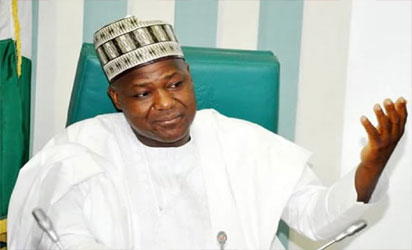
Speaker Dogara
To accelerate the holistic rebuilding of Boko Haram ravaged North East region of Nigeria, the Speaker of the House of Representatives, Rt. Hon. Yakubu Dogara sponsored a Bill which eventually saw to the creation of North East Development Commission, NEDC. On October 25, 2017, President Muhammadu Buhari assented to the Bill, making it now, a legal entity.
In this interview, the Speaker who hails from Bauchi State expressed his joy and also commended the President for signing the Bill into law. He told a story of how the Bill was conceived and processed legislatively, warning that stakeholders in the zone would be eternally ashamed if the commission is mismanaged. Excerpts:

Speaker Dogara
By Levinus Nwabughiogu
Would you say that the North East Development Commission, NEDC Bill recently signed into law by President Buhari is a dream come true for you?
First of all, I will start by extending our sympathies, that is, of members of the House of Representatives, as well as those of members of our own caucus, over this very deadly crisis that has bedeviled our own section of this dear country.
Let me also thank the press for their effort in highlighting the crisis and the security agencies for the very extraordinary sacrifices put in place in order to restore some sanity in our region. For us who are sons of the North-East, we know our History very well, so we appreciate this gesture and we will not take it lightly. I commend the President for signing the Bill into law. As I said before, this shows the level of the President’s sensitivity to the plight of the highly traumatised people of the North East.
What informed your decision to push for the creation of the NEDC?
From day one when we started meeting, our thinking was how do we ensure that whatever policies that are developed by government that are aimed at tackling the millions of challenges facing us as a zone are policies that will survive whoever is formulating them. So it became clear to us that if we leave everything at the level of policies, granted that today we have a president that supports, loves and likes our people, chances are that he will not continue to be there forever. Not even chances, that is the reality.
Will you say that this is the end of the insurgency and the beginning of a new era?
As a matter of fact, the heat was becoming very close to our section of the North-East, if not for the timely intervention that was brought, owing to the change of government in this country, and then they were able to put these insurgents on their backtrack. With this progress made, some have said Boko Haram has been degraded, decapitated, some have said that they have even been defeated. But whatever the situation is, the most important thing is for our people to go back to where they belong. And then, for them to get hope in the environment where God has given us, they can continue to contend with destiny of life. That is what is important. The debate shouldn’t be about the degrading and decapitating of the Boko Haram, but about the survivors, the IDPs and then rebuilding these communities, and hopes that were shattered on account of terrorism.
Some have argued that the Boko Haram insurgency was caused by prolonged years of neglect and marginalization of the North East.
As sons and daughters of the North-East in the House, we have been meeting and putting our heads together as true representatives of the zone to see what it is that we can do. As a matter of fact, these signs were there, it’s just that we didn’t notice them on time. It is true that for years in this country, the North-East has always come last in terms of budgetary allocation. This is in spite of the fact that we face more challenges than others. And when it comes to development indices, we are the last in the country, but we didn’t pay attention. When the population curve was going up sharply and opportunity costs were nose-diving, we didn’t pay attention.
Will you say that poverty and deprivation caused the insurgency?
I don’t know the correlation between violence and poverty, but I’ve seen that in societies where hope is lacking, there always seems to be tendencies of violence. Or where you find extreme poverty, the likelihood of violence is always there. I guess that was where we missed it.
So as true believers and representatives of the zone, our focus has always been what is it that we can do so that we build on the successes that this government is gaining in its fight against terrorism? And ultimately, to ensure that we do not have a relapse in that zone, back into this kind of situation in which we find ourselves. Even those zero statistics of human development indices have been destroyed. Businesses, factories, I think as we speak, perhaps the only productive enterprise in the North-East may be Ashaka Cement. I don’t know if we have any other factory employing people in the North-East. Infrastructure is zero.
The new law stipulates that the major source of funding will cease after 10 years. Are you Okay with that?
The truth is that the level of devastation as a result of this insurgency is one that is going to take us decades to recover from. If you were to quantify the infrastructure, wealth and everything that we have lost, you would be talking about trillions, then you can imagine in the national budget, where are we going to get allocation of trillions to the North-East? Is it within the next 10 or 20 years? So, even to recover the things that we have lost, as we are saying will take us decades, not even a few years. So that was why as skillful legislators, we decided that we will go for the North East Development Commission.
Some people believe that the commission was not necessary and that it may end up being like the Niger Delta Development Commission, NDDC which many believe has failed to do deliver on its mandate…
Yes, a lot of people thought it was not necessary, some even thought, well, we want to create a system that will be like a pool of prosperity in the desert so that a few privileged sons and daughters of the region will just mismanage the resources.
And I know that even the president was watching us before signing this bill into law. But I guess that he saw the plight of the people and that he has been told of the level of devastation in that region. And since this current efforts are not enough, and may never be enough to address the challenges, if these interventions are left at the level of policies, any subsequent government that comes and doesn’t love our people that much, will just with a stroke of the pen, strike the policy out, and that is the end.
So, the thinking was that if we could elevate this to the level of a law, then any future government that seeks to reverse it will have to face the members of the National Assembly to repeal that Law.
And because we have a voice, we will continue to have a voice in the National Assembly; it is going to be exceptionally difficult for that to be achieved. So we were making provisions for the long run, not for the short term. And as a matter of fact, in some places where I have had to advocate for this commission, I have said the freedom for us to plan for ourselves, to manage the resources accruing to the zone is something, and we should be given that freedom.
I should never be understood to be canvassing that we will mismanage resources given to us, but I said even if we do it, and we fail, a free man when he falls blames no one. We will accept the blame that we have been given the liberty and resources, but we mismanaged it, and then we will carry the shame for the rest of our lives. It is better, than to leave this on the level that one day it may just be thrown to the dogs.
There was this fear that the President would have vetoed the Bill. Was that real?
We lobbied members from other zones and fought to get through this process of lawmaking. And at the end of the day, the law was prepared and sent to the executive; obviously they had issues with it. And realising that time was going and if the President doesn’t sign within 30 days, it means that he has vetoed the legislation.
The only other option is to bring it back to the National Assembly and override the veto. But the question was whether we could muster the two-third votes that we need in order to override the veto should that be the case? And we thought it wasn’t wise. So at a point, I had to ask that a letter be written to the executive to withdraw the bill so that we can address those concerns that they had. So they brought it, some lawyers were brought from the executive side, I gathered a team of lawyers as well, and I chaired the meeting.
We were on this matter for three weeks with a notable son of Borno, who is no more in the House with us, but I knew him with accounting during our work as lawyers in this city of Abuja. I had to draft him in too to give a helping hand.
At the end of the day, we cleaned up all the misunderstandings, addressed all the issues the executive had, and we sent it back to them. And if that Bill had not been signed on October 25, 2017, I think officially the 30 days would have elapsed by now. So we should thank God for His intervention, even as we thank the president, and I want us also not to forget the role of the First Lady, her members were here with us. When we had a public hearing on the bill, she personally led wives of governors to witness that public hearing. And happily, so many high ranking stakeholders of the North-East were there. From across the states, former governors, former ministers, I have never seen this kind of solidarity before.
Is this a new beginning of togetherness for the region?
In fact, it was on account of that I now know that this issue of unity in the North-East – it is just that we have been playing with it but it is something that is achievable because I saw it.
I even noticed that a delegation was sent under the leadership of the Governor of Borno to the National Assembly to thank both the Senate President, the leadership of the National Assembly, not me because I’m the promoter, I should be the one thanking them. And through all that I saw a lot of emirs from the zone, two governors, from Yobe and Bauchi, he wasn’t there but he was ably represented, he sent a representative to stand in for him. And at that courtesy call as well, I saw leaders from the zone, former governors like I said, former ministers, across the board, they were all there.
So you know that if we can continue to pursue things in the zeal of this unity that I saw, there’s nothing that we cannot achieve. Sincerely, there’s nothing that we cannot achieve, if this unity is possible, then the only reason why we are not seen to be united is because nobody is working on that.
With the right leadership, we can unite, and with that unity we can push through so many regional objectives, and they will come to fruition.
So that is one thing that is left for us to do. Like I said before, we shouldn’t just celebrate the coming into being of this commission. Obviously we should, because it’s going to increase the level of opportunities available to our people, whether in terms of employment, mobilsation of resources and redeveloping the infrastructure that were destroyed, we’re going to be better off for it.
Disclaimer
Comments expressed here do not reflect the opinions of Vanguard newspapers or any employee thereof.