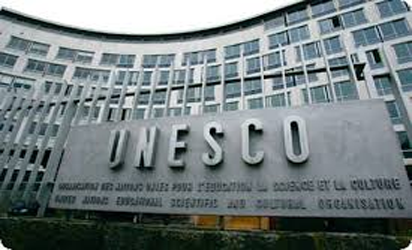
UNESCO building
…Tasks govts on independent institutions to handle complaints.
…Urges governments to approve more qualified private schools.
By Dayo Adesulu with Agency report
The United Nations Organization for Education, Science and Culture (UNESCO), Tuesday in Paris called on governments to design accountability and transparency for schools and teachers, adding that governments should set up independent institutions to handle complaints emanating from the sector.

UNESCO building
This was just as it also urged countries to approve more qualified private schools to boost the chances of more children in school.
According to UNESCO findings, 45 per cent countries have not justified the right to citizens’ education.
Director of UNESCO, Global Education Monitoring (GEM), Manos Antoninis in his report said: ”Governments should develop credible and efficient regulations with associated sanctions for all education providers, public and private, that ensure non-discrimination and the quality of education.
”Governments should allow for democratic participation, respect media freedom to scrutinize education and set up independent institutions to handle complaints.
”Governments should design accountability for schools and teachers that is supportive and avoid punitive mechanisms, especially those based on narrow performance measures.
While stressing the need for transparency and accountability in education sector, he said: ”Whereas transparency would help identify problems, only one in six governments publishes annual education monitoring reports.
”Strong independent bodies such as ombudsmen, parliaments and audit institutions are also needed to hold governments to account for education.
”Lack of accountability opens the door to corruption. ”In the European Union in 2009-2014, 38% of education and training tenders only had one bidder, compared to 16% of tenders in the construction sector, indicating that the risk of corruption is higher in education than in the building industry.
”Setting and enforcing regulations ranging from contract tendering to teacher qualifications are also crucial, argues the Report. Fewer than half of low and middle-income countries had standards for early childhood education and just a handful had mechanisms to monitor compliance. There are no regulations on class sizes in almost half of countries.
”No approach to accountability will be successful without a strong enabling environment that provides actors with adequate resources, capacity, motivation and information to fulfil their responsibilities.
Antoninis who cited Lagos State as an example, said: ”In Lagos, Nigeria, only 26% of private schools in 2010/2011 had been approved by the State Ministry of Education.”
Pointing out the danger of unapproved schools, he warned that in countries with weak accreditation processes, thousands of students would graduate with unrecognised degrees.
”In countries with weak accreditation processes, thousands of students graduate with unrecognised degrees.”
He noted also that in Kenya and Uganda, private schools were operating without qualified teachers and with inadequate infrastructure before regulations were put in place and courts shut them down.
He, however advised that where formal mechanisms fail, citizens could play a vital role in holding governments to account for meeting their right to education.
In Colombia, he said, a citizens’ campaign successfully challenged the government in court leading to the establishment of free education.
”In the United States, parents and media successfully lobbied for the removal of climate change denial from textbooks, and students in South Africa were able to halt university tuition hikes,” he said.
The Report emphasizes the importance of accountability in addressing gaps and inequalities. Globally, less than 20% of countries legally guarantee 12 years of free and compulsory education. There are 264 million children and youth out of school and 100 million young people currently unable to read.
Disclaimer
Comments expressed here do not reflect the opinions of Vanguard newspapers or any employee thereof.