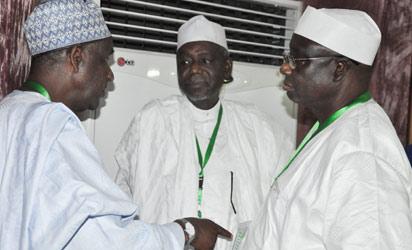
Confab: From left, Alh. Umaru Hadejima discussing with Senator Shaidu Dansadau and Dr Garba Abari during Consideration of Devolution of Power Committee’s Report at National Confab in Abuja. Photo by Gbemiga Olamikan
By Gabriel Enogholase
A PROFESSOR of Economics and Deputy Vice-Chancellor of Benson Idahosa University, Benin, Prof. Sam Guobadia, has said that devolution of power to the federating units in the country will ensure effective and efficient resource mobilisation.

Confab: From left, Alh. Umaru Hadejima discussing with Senator Shaidu Dansadau and Dr Garba Abari during Consideration of Devolution of Power Committee’s Report at National Confab in Abuja. Photo by Gbemiga Olamikan
Prof. Guobadia, while delivering the 7th Inaugural Lecture of the university titled, It is The Environment, said that Nigeria’s federating units should have full autonomy over their resources and grow at their comparative advantage pace.
He said: “A true federating entity should not depend on the centre; a federating unit that is dependent on another unit cannot be a viable federating unit. A complete overhaul of the political system for the full realization of our economic aspirations is strongly recommended.
“The 36 states of Nigeria have become mere appendages to the distant federal government in Abjua whose major responsibility is to preside over revenues generated at the state levels only to dole out crumbs back to the states,
“What a misnomer. For effective and concentrated form of widespread economic development, a region or state should remit what is due to the central government from sales of commodities within its borders and not the other way round.
“A strong fiscal federalism is a more appropriate approach to the current practices. Good governance discourages an atmosphere of corrupt practices, encourages the conservation of resources which are channelled to capital formation, capacity building, security as well as national integration.”
He stated that the major challenge facing any economic plan in the country, be it NEEDS or ERGP, is the lack of capacity to build an enabling infrastructure base, especially power, requisite skills base, transportation and a vibrant iron and steel sub-sector.
“Currently, the energy policy structure in Nigeria is top-down, involving huge investments in large electricity mega plants, generating electricity into mega grids, for mega distribution. This policy has for so long been mismanaged that after years of trial and errors, generation is still at a very low level.
“The top-down policy approach in Nigeria should give way to the trending and sensible bottom-up policy for energy production and distribution. There are lessons we can learn from a country like Germany that can produce over 22,000 MW of electricity through solar panels, having embraced, encouraged and pushed for bottom-up policy approach.”
Disclaimer
Comments expressed here do not reflect the opinions of Vanguard newspapers or any employee thereof.