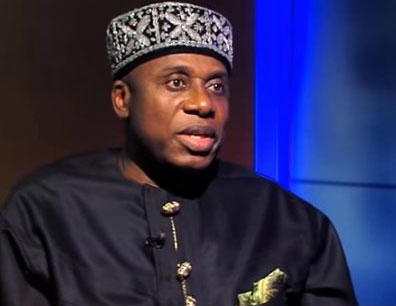
Amaechi
By Favour Nnabugwu
By As Sultan of Sokoto, Tambuwal, Sirika, Zakari concur
PRESIDENT Muhammad Buhari has ordered the Minister of Transportation, Mr. Chubuike Amaechi to connect the 36 states of the federation and the Federal Capital Territory, FCT by rail.
Amaechi who made the revelation during the 15th National Council on Transportation, NCT, in Sokoto, stated that the mandate given to him by Buhari is to ensure that the entire country is connected by rail.

Amaechi
He said, “The President called two of us, myself and my colleague in the Ministry of Power, Works and Housing, Babatunde Fashola; and told me specifically that I must ensure that the 36 states including Abuja are connected by rail,” adding that the ongoing rail projects in the country will create employment opportunity for the teeming youths.
Rehabilitation of the rail lines
He said that to grow the economy effectively and efficiently, the railway must be developed.
Amaechi said the federal government was on the verge of signing a contract agreement with General Electric for the rehabilitation of the rail lines across the country to ensure they are put to use in the very shortest time, saying that government has ordered more Locomotives for the Standard Gauge rail lines.
He stated further that the President has given approval for the construction of Abuja-Itakpe rail line and at the same time preparing to commence commercial activity on the Ajaokuta-Warri line which will be completed in June 2018.
Emphasizing the importance of the National Council on Transportation, Amaechi said aside being the highest policy advisory body on all transport matters in the nation, the council sets the policy agenda and provides the regulatory framework for the development of the Nigerian Transport sector.
Amaechi who noted that the theme for this year’s National Council “Efficiency of Intermodalism in Transportation: Panacea for Economic Recovery” was apt as it is consistent with the determination of the present administration to diversify and stabilize the economy, added that the Ministry of Transportation has revived the erstwhile Transport Sector Reform Bills in the National Assembly and has opened it for private sector and other tiers of government participation. In this way he said, government will now be left to focus on technical and economic regulations of the sector.
While reliving some of the achievements in the aviation sub-sector, the Minister of State, Aviation, Sen. Hadi Sirika in his address emphasized the need for every sector of the economy to operate efficiently for the recovery of the nation’s economy given that the falling price of oil has led to decline in government revenue and was impacting negatively on the economy.
Represented by the Permanent Secretary, Mallam Sabiu Zakarii, Sirika noted that in preparation for an efficient inter-modal transport system, President Muhammadu Buhari had approved a robust roadmap for the aviation sub-sector.
According to him, the road map which includes airport concession, establishment of national carrier, establishment of maintenance, repair and overhaul (MRO) facility, development of agro-allied cargo infrastructure, establishment of aerospace university and establishment of aerotropolis cities through PPP was intended to address some of the infrastructural gaps and challenges with a view to providing long-term solutions.
He disclosed that the airports in 2016 handled 15.2 million passengers, conveyed over 195,230 metric tonnes of cargo and 7,373.0 metric tonnes of mails.
Sirika said,“Transportation is the wheel that rolls the economic development of countries. The sector contributes to the economic sectors which include oil and gas, tourism, travel, agriculture, trade and commerce, manufacturing and other non-oil sectors. Nigeria is the largest economy in Africa with a population of over 180 million people.
Presently, the country has 27 functional airports and several privately owned airstrips and helipads. The airports in 2016 handled 15.2 million passengers, transported over 195, 230 metric tonnes of cargo and 7,373.0 metric tonnes of mails.
In their contributions, Governor of Sokoto State, Aminu Waziri Tambuwal and His Eminence, the Sultan of Sokoto Alhaji (Dr.) Muhammad Sa’ad Abubakar reiterated the need for the Federal Government to connect the State with rail line in the shortest possible time. Tambuwal described effective transportation system as critical to the growth of the economy of any nation, adding that the state needs such infrastructure for movement of people and agro-allied products.
The Governor urged transportation stakeholders to ensure the formulation of the right policies that would ensure easy movement of people and goods to enhance the life of the citizenry.
“Considering the importance of the transportation sector to human lives, the state government resolved to host the council meeting as part of its contribution to facilitate more economic development.
However, His Eminence, the Sultan of Sokoto stated that the responsibility of road construction and maintenance in all designated federal and state roads ought to be under the Ministry of Transportation. In this way, according to him, all bottleneck and official diplomacy associated with road construction and maintenance between the Federal and State Governments in the country will be completely eliminated, and the benefits will be to the advantages of the citizenry.
Tolling the same line with Tambuwal, the Sultan of Sokoto, Alhaji Sa’ad Abubakar, ascribed the importance of transportation to people’s lives and commercial activities.
Disclaimer
Comments expressed here do not reflect the opinions of Vanguard newspapers or any employee thereof.