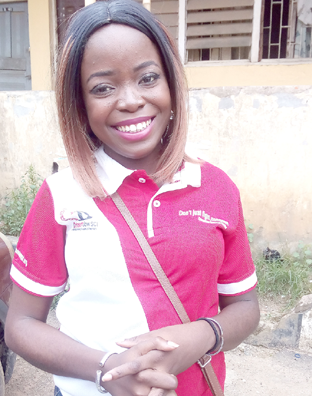
*Timi…I faced serial humiliations
By Chioma Obinna
In the past, people living with Sickle Cell Disorder, SCD, often died from organ failure, infection and other complications at an early age. Today, with modern medicine, people living with SCD can live into their 60s. Studies have shown that with healthy lifestyle, victims can even live into their 80s. Meanwhile, sadly, one of the major challenges victims have faced over decades is the stigma of the disease. SCD is an inherited disease in which red blood cells are unable to properly carry oxygen throughout the body because of their distinctive crescent-like, or sickle, shape.

*Timi…I faced serial humiliations
The condition causes severe episodes of pain and fatigue, and it can lead to damage to the eyes and other organs.“However, the challenges of living with SCD are great, right from home to the time a sickle cell patient arrives at emergency rooms to the difficulty getting proper treatment. These have limited so many people living with SCD. But scientists say, with diligent care, the disease can be managed.“Even in Nigeria, SCDs are living a fulfilled life. One of them is 30- year –old Miss Timi Edwin, a graduate of mass communication. Looking at TIMI today, you need a soothsayer to tell you she lives with SCD. The manager of a farm in Lagos narrated her story to Sunday Vanguard.“
Big belly but no breasts
Although growing up with sickle cell physical features written all over was not easy among other pupils in a Lagos school, she struggled to break all barriers.
She was made to deal with so much stigma and discrimination. With a big stomach and no breasts at age 10 when she entered secondary school, she felt different from other girls in her class and this almost discouraged her from continuing her education.
“Living with sickle cell has not been easy. Right from age 10 when I entered secondary school, I was looking different. I had big tummy, no breasts and other puberty things. I suffered so much humiliation in the hands of my class mates,” Timi said.
But her mother, who is also living with SCD, continued to encourage her. Sadly, the humiliation didn’t get any better as she grew older. According to her, because her school management knew her condition and accorded her the best of attention, friends and classmates were jealous and decided to bully her at any slight provocation.
“They called me all sorts of names. So I grew with the belief that sickle cell is a kind of curse,” she stated.
As if the stigma and discrimination she received in secondary school was not enough, securing admission into the university became another phase in her life. She was seen as a health risk to other students.
The unprintable humiliation she received from friends and classmates almost impacted negatively on Timi’s self-esteem.
“When I got into the university, at some point, they told me to pull out of school because I was always falling ill; they thought I was a health risk to fellow students. It came as a blow to me. I was told to leave school because of my health and it was like the worst thing I ever heard in my life. I was astonished about how you can tell someone to leave the university because of her health; it got me really angry and upset.
“I did a lot of things I should not have done. I just went wild, what is the point of life?, I asked myself.”
Death wish
During this period, the victim was still falling ill. At a point, she wished for death.
“I said to myself, ‘why take these pains? Why not die?’ But something inside me told me that there were many lives to be touched that were hanging and connected to me. I did not know then that I would be doing what I am doing right now. But I just had this feeling that my life was worth more, so I prayed with all my heart and that was when I got connected to God and He gave me this personal assurance. “After that, I still prayed for death but I knew that sickle cell was not what will kill me; it could be something else, it could be old age but not sickle cell. So all these gave me low self-esteem but, thankfully, God has helped me this far.”
Although Timi was able to defeat the challenges of making it through the university, she was also faced with the challenge of marriage. Most of the men that courted her saw their relationship as a help to her. Even one suitor that would have married her, two years ago, all of a sudden called off the marriage.
“I was engaged but, at some point, the guy just woke up and said he couldn’t ‘do this sickle cell thing anymore’, that is just the summary of his words. He said lots of nasty things to me. So at that point, I was thinking this must be the reason I am not married, coupled with the fact that I have met other guys, some will say to me, ‘I am doing you a favour by dating you’. Some will say all sorts of things. Maybe that is the reason I am supposed to work harder and achieve so much because I am trying to prove to people that I have this thing at the back of my mind that we really are normal people. Yes, we fall ill but we can do a lot, especially with the right care and medication,” the victim said.
“At some point, I broke these limitations and I am proud to say I have an excellent career. I have a farm which I manage; so I do so much for people living with sickle cell but that is limited in the extreme sense of it. Yes, I have my down time, I still fall ill but it’s not so frequent because I now know how to manage myself.”
Timi, the Co-Founder, Crimsonbow Sickle Cell Initiative that provides support for children living with SCD, also narrated the impact sickle cell anaemia has had on her life and family.
She said she owes all to her mother who, despite managing her own SCD, has been her backbone. “God is the number one secret of my good looking today. My mother has been there for me. At a point, I stopped being desperate and started taking good care of myself. I told myself I needed to start looking for answers like I needed to live more healthily; I needed to stop falling ill and asking for sick leave and all of that. So I started doing research and found out that there are specialists in Nigeria, haematologists, especially the ones that specialise in sickle cell; if you see them, your life will not remain the same again because they will carry out tests on you, give you vaccines and medications that will generally give your life a boost. It is important to work with a haematologist that will take you on simple tips.”“She urged Nigerians to see people living with SCD as normal persons. “I will like to tell people out there that we are human beings that have feelings, dreams and aspirations.
So don’t look down on anybody because looking down on someone may keep that person down and some may even commit suicide because of your actions”, she stated. ““Many sickle cell victims die because they don’t have a reason to live. So please be your brother’s keeper, love us, show us care, show concerns and don’t look down on us. If you see that we have limitations, please understand”. “Timi, who also advocated for improved health centres, urged the Federal Government to provide free simple basic health checks for people living with SCD.“She applauded the latest government policy which discourages marriage between two people with sickle cell traits, adding that the policy would help eradicate sickle cell in the country.
“People should be informed about their genotype before marriage. This will make them take decision whether they should copulate or not copulate to bear children. It also makes people to be more aware about sickle cell because a lot of people hear about sickle cell but they don’t really know how serious it can be. So the policy has put this in the minds of people.”“Speaking to Sunday Vanguard, a general practitioner, Dr Ameze Odia, who said sickle cell disease was not an African disease but a global one, explained that an individual acquires the disease by virtue of the two parents having trait of sickle cell disease. “All of us have genotypes. Sickle cell has to do with genotypes. Individuals fall under different genotypes. The common ones are AA, AS and SS. There are some other traits; the minor ones are SC and AC.
“For an individual to have any of the three genotypes that are common depends on the parents. If my genotype is AS and I get married to a man who is AA, the chances of us having a child who is AA are 25 per cent. It is by cross multiplication. If my A and my husband’s A come together, they produce AA but my S and my husband’s A come together, they produce AS; so it depends on what we bring to make a child.
Each of us has to bring one, so the chances of us having a child that is AS are 25 per cent in 4 chances.
“If the wife has an S trait, it is advisable that the other person does not have any S trait, so that their chances of having a child with SS are reduced. When one has SS and the other person has AS, it is sure that the chances are higher because the man has one A. This is the reason why we discourage intermarriage between individuals who have not checked their genotypes, to be sure that they do not have any possibility of crossing S with S and producing a child that has SS, it is the SS genotype that produces sickle cell.”
WHAT DO WE CALL THAT SICKLE?
Odia said: “It is from the way the cells form. The blood cell of an individual who does not have sickle cell is usually round, soft and flexible; it is spherical in shape and easily flows through the bloodstream, with no disturbance and blood passes through every part of our body. If you cut your eyes, blood will come out; if you cut your leg, blood will come out; there is blood everywhere and the movement is made easy because of the shape of blood which is spherical, soft and flexible, and can manoeuvre its way. Meanwhile, a sickle cell is half moon, so you have a half moon that is sickle and that can get stuck in the pathway of the blood vessel, so that when it is flowing, it doesn’t flow properly. It can now come together and block. When they are not flowing well and they are hard, they can block a vessel and cause pain. The common place where they come together and cause pain is usually joints. And when the blood is not flowing well, it can cause death.”“She regretted that there are challenges facing sickle cell patients in this part of the world following inadequacies in the health system.
“The burden of the cost of managing sickle cell patients is very high; now imagine the impact of the cost of drugs on a low income worker or a middle class person. At one point when they are admitted into hospital, they need like five pints of blood; blood may not even be available and blood that is not screened is always the one that is found and it is dangerous, dealing with another problem like HIV.”
Disclaimer
Comments expressed here do not reflect the opinions of Vanguard newspapers or any employee thereof.