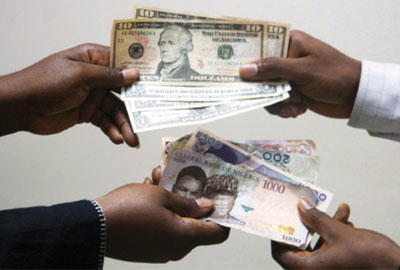
Indeed, Naira devaluation is probably the most potent weapon against the prosperity of Nigerians. Nigeria’s migration from a potential industrial power house with bustling social affluence, to a subdued and stumbling economy clearly began with the adoption of IMF’s Structural Adjustment Programme during Babangida’s regime: the chorus from International Agencies, at that time, was also that falling oil prices with an unserviced debt burden and the consequent restriction of trade credit to Nigeria, were the products of an allegedly overvalued Naira exchange rate.
By Babajide Komolafe
LAGOS—Dollar inflow into the newly created Investors and Exporters, I&E, foreign exchange window has reached $1 billion per week.
Fitch Rating agency disclosed this, yesterday, saying its discussions with Nigerian banks revealed that volume of dollar inflow into the I&E window has reached $1 billion per week.
The company stated this in a statement entitled: “Foreign-Currency Liquidity Improving for Nigerian Banks.”
The rating agency noted that “Nigerian banks’ ability to access foreign currency, FC, has improved considerably since the Central Bank of Nigeria, CBN, introduced a foreign exchange ‘window’ at the end of April aimed at investors and exporters.
“The Nigerian Autonomous Foreign Exchange Rate Fixing, NAFEX, mechanism, commonly referred to as the “Investors’ and Exporters’ FX Window,” appears to be boosting FC supply and the flow of FC liquidity into the banking system.
“Improved access to FC means that liquidity pressures have, for now, eased for Fitch-rated banks. FC was in acute short supply through much of 2016 and early 2017, restricting imports and forcing several Nigerian banks to extend maturities on their trade finance obligations.
“NAFEX provides investors and exporters with a more transparent mechanism through which they can sell FC to willing buyers. Authorised banks act as intermediaries, clearing funds supplied by portfolio investors and exporters and ensuring timely execution of settlement for buyers.
“Despite its short record, volumes transacted through NAFEX are growing. In our opinion, NAFEX offers a more transparent alternative to accessing FC than is available through the other foreign-exchange markets in the country. Several exchange rates operate in Nigeria.”
“The CBN was the main supplier of FC during the height of the FC liquidity crisis and it still sells FC to the market through regular auctions, with banks acting as intermediaries. Its official exchange rate is NGN305 to the US dollar but it sets alternative official rates at its FC auctions and different rates apply for retail, wholesale, personal and small business purchasers of FC.
“NAFEX introduces yet another exchange rate, which adds to the confusion, but its rates are set by market participants and this is already attracting greater volumes than other exchange mechanisms.
“Access to FC is essential to boost growth in the country’s highly import-dependent economy. The ability of market participants to set their own rates under NAFEX is also forcing down exchange rates on the parallel markets. This is positive for the banks as it helps to draw funds back into the banking sector.”
Over time, exchange rates may converge, but this will depend on a range of market and political considerations.
“The CBN can intervene on NAFEX, but we understand from our recent discussions with banks that CBN interventions have been limited. NAFEX rates have averaged about NGN380 to the US dollar recently and volumes are reaching about $1 billion a week, according to these discussions. While the improved FC access is credit positive for banks, the ratings of all the Nigerian banks remain constrained by our sovereign rating of ‘B+’/Negative.”
Disclaimer
Comments expressed here do not reflect the opinions of Vanguard newspapers or any employee thereof.