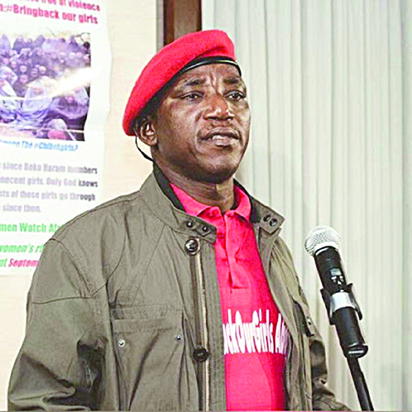
Dalung
By Jacob Ajom
Never before has elections into national sports federations generated the amount of controversy, as witnessed during and after the elections held on Tuesday, June 13, 2017 at the Abuja National Stadium.
Assurances by the Sports minister, Solomon Dalung that a level playing field would be given to all candidates, and that the federation elections would follow the best democratic practices, were only meant to massage his own ego as it turned out later.
Before the elections, the supervising ministry, Ministry of Sports and Youth Development reeled out guidelines, which kept on changing with every passing day and it was easy for stakeholders and some interested parties to conclude that the minister and the authors of the guidelines have “a hidden agenda.”
A lot of people who indicated interest and readiness to participate in the board elections were either disqualified or unable to meet the stiff conditions spelt out in the guidelines. Before the elections, however, a meeting of ‘stakeholders’ was conveyed by the sports minister, Solomon Dalung in Abuja on April 13 to help fashion out a framework for the 2017 elections.
The meeting ignored statutes of international sporting bodies and voted overwhelmingly that anyone who had done two consecutive terms in office as president or vice president of any sports federation should not contest in the forthcoming elections.

Dalung
The meeting also barred members of international sports bodies from contesting for president or vice presidents of federations.
Naturally, a lot of influential figures in the Nigerian sports circle were affected. Engineer Habu Gumel (Nigeria Volleyball Federation), Engineer Sani Ndanusa (Nigeria tennis Federation), Chief Solomon Ogba (Athletics Federation of Nigeria), and Tijani Umar (Nigeria Basketball Federation) were knocked out as they were no longer eligible to contest.
Despite the negative reactions that trailed the decisions of the meeting, the guidelines that followed were proof that the decisions of the meeting were upheld by the minister of sports.
But the Nigeria Basketball Federation distanced itself from the controversial guidelines and the election that followed.
Instead, the NBBF, led by Alhaji Tijani Umar went ahead to conduct its own board election in Kano, one day before the Abuja elections which also produced another board and another president for the Nigeria basketball. As expected, Tijani Umar, the North-East representative, was returned as President; Olumide Oyedeji, FIBA World Representative, as Vice-President.
Other newly-elected members of the board are Muktar Khaled, the FIBA Africa representative, Dr Joseph Adeyemo from Kwara, the North-Central representative, Mustapha Suleiman from Kano, North-West representative, and Segun Famuyiwa, the South-West representative.
The rest are Ejike Paul, the South-East representative, Stanley Gumut, the Athletes representative, and Mrs Margaret Porbeni, the representative of the National Association of Women in Sports (NAWIS).
The next day, June 13, attention was shifted to the Abuja National Stadium which became the centre of drama, intrigues and political shenanigans.
Taekwondo federation and the Athletics Federation of Nigeria (AFN) were the centre of attraction to the journalists who monitored the election. The athletics federation got the large chunk of the crisis as candidates and delegates engaged themselves in a free for all fight before the intervention of security agents.
Trouble started when on the morning of the election, it was discovered that Rosa Collins who made the board on the platform of Nigeria Association of Women in Sports was replaced by Gloria Obajimi. Brown Ebewele who won the coaches and technical officials representative, was replaced by Gad Monument. Others who were adjudged to be close to Collins were also disqualified.
Olympian, Charity Opara, was not only denied voting right but also marched out of the voting arena by stern faced security operatives.
Ebewele lamented that he could not understand how his name got missing from the delegates list, “My grouse is that I participated in an election and won with 31 votes and one other person who did not participate is now cleared as delegate for the election.
“It is even more worrisome that the person is a civil servant on level 9.
“We just came to the venue of the election and noticed that our names are not on the delegate list. Many of those disqualified knew of their disqualification on election day.
Teakwondo federation was equally enmeshed in crisis when a South East delegate, Ferguson Oluigbo, who was earlier screened, cleared and given delegates tag to vote, was later told that some of his credentials were missing in the documents he submitted. The controversy in the taekwondo federation became more intriguing when the name of one of the immediate past federation’s boss, George Ashiru, who was to stand for re-election got missing in the original candidates’ list. As a result, Ashiru’s opponent, Elizabeth Binga, was declared the winner.
Few minutes after the election, it was discovered that Ashiru’s name was in the original list of candidates. It ignited serious protest from Ashiru’s camp but it was too late.
It was the same story in hockey, where the Sports Ministry almost disqualified the incumbent president, Senator Abdul Ningi over what they termed “non-submission of age declaration certificate”. It was after he threatened to sue Dalung and his lieutenants, that his name was restored.
One of those disqualified in the Nigeria Tennis Federation election was Godwin Kienka who was chairman of the Sports Reform Committee set up by Dalung. Kienka, it was gathered led the campaign for the changes that gave birth to the election guidelines. It was therefore an irony that the guidelines consumed its author. He was made to issue a press statement after the elections. In the statement Kienka heaped praise on his benefactor, Dalung while blaming his fate on those he called “the cabal” in and out of the ministry, indirectly indicting Dalung.
In 1983, following the annulment of the June 12 elections and the subsequent incarceration of the Chief MKO Abiola who was believed to be the winner, a former NPN chieftain, Umaru Dikko told Abiola that if you ride on the back of a tiger, one day you will find yourself in the belly of the tiger. He accused Abiola of having been too close to the military(the tiger). Kienka deserves no pity because being in the belly of the tiger.
Dalung is not new to controversy. Since his appointment, he has generated more heat than any other minister. He was the first sports minister to deny knowledge of Under-20 Olympic team’s training tour of Atlanta, he unearthed ‘a dead case’ which pitched the NFF President Amaju Pinnick against Chris Giwa. It took the intervention of world football governing body, FIFA to put that matter to rest. The minister’s controversial handling of the N640 million purportedly left behind by the former Director General of the defunct NSC, Alhassan Yakmut, whose bid to to become the next President of the Nigeria Volleyball Federation failed at the just concluded federation elections.
Former vice President of the Nigeria Olympic Committee, Alhaji Ibrahim Galadima was least impressed by the conduct of the elections which has polarised the Nigeria sporting family.
“The whole drama of intrigues and manipulation of the election process will create confusion in sports. Dalung has run sports down and there is no likelihood that it will improve under his tenure,” the Chairman of the Kano State Sports Council said.
Disclaimer
Comments expressed here do not reflect the opinions of Vanguard newspapers or any employee thereof.