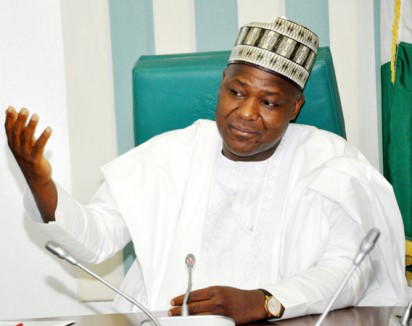
Yakubu-Dogara
By Emman Ovuakporie
The inauguration of the 9th House of Representatives on June 9, 2015, was laced with many intrigues with political stakeholders across the polity engaging one another in many political conspiracies. The leadership election pitched Yakubu Dogara from Bauchi State against the party’s favourite, Femi Gbajabiamila. Dogara, who won the election despite the lack of support from his state became the first Northern Christian to lead the Fourth Republic House.
However, his election went beyond religious sentiments as it was pushed by some unlikely alliances including a linkage with a similar uprising in the Senate. Even more, the charming testimony of Dogara’s uprightness in the Seventh and Eight Houses endeared him to many who put aside party, religious and ethnic sentiments to throw
Despite the hiccups that engulfed the emergence of the Speaker of the House of Representatives, Yakubu Dogara, on June 9, 2015, the Bauchi born lawmaker still holds the ace as he has stabilised the once very turbulent House.
Dogara weathered the stormy weather for almost 14 months particularly after he frontally confronted the allegations of budget padding raised against his leadership by Rep. Abdulmunin Jibrin.
The 180-day suspension that was slammed on Jibrin by the House checkmated other ambitious lawmakers who would have assisted him to further rubbish the image of the 8th House.
After the September 28th, 2016 suspension of Jibrin, Dogara’s leadership prowess soared as peace finally rested on Dogara’s House.
More ad-hoc committees were inaugurated to help combat the menace of corruption beaming the House searchlight on the oil and gas sector of the Nigerian economy and combating corruption with the zeal of a wounded lion.
To this end, the House carried out landmark investigative hearings in different sectors of the economy such including oil and gas, procurement, corruption issues, security, finance among many others.
Investigative hearings
One of the investigative hearings that drew much attention to the House was the probe on the Alleged Violation of Procurement Act where a lot of issues were unearthed by the committee. The Committee on Public Petitions which has become an avenue for aggrieved Nigerians to channel their misgivings has equally performed well.
After the 97 substantive committees were inaugurated, they went to work with much zeal but by midterm only about a quarter of them could be said to be running with the same energy and enthusiasm that they started with.

Yakubu Dogara
Among them are Public Accounts, Public Petitions, Basic Education and Services, Foreign Affairs, Public Procurement, Aviation and Agricultural and Production Services.
For the better part of the past two years, the majority of the committees in the view of many stakeholders have remained in slumber, and where not, covered their tracks from the public scrutiny.
It was perhaps with a view to ensuring that the ad-hoc committees do not slip into the same kind of slumber as the substantive committees that the House leadership earlier this year dissolved 42 of the ad-hoc committees.
The view of some stakeholders in the legislature is that some of the committees do not have defined purposes especially in their engagements with the MDAs with the process of oversight not yielding any positive benefit to the polity.
BILL
Briefing House correspondents last Tuesday on the activities of the House in the last two years, Chairman anniversary planning committee, Rep. Pally Iriase said the House had made process in its legislative duties especially in the passage of bills. He said that the House had passed as many as 166 bills, a remarkable achievement for a House that started with bickering.”
Rep. Iriase said 25 of the bills passed by the House were assented to by Mr. President, the highest in Nigeria’s history.
Even more remarkable was the fact that 22 of the bills assented to by the president originated from the House.
Following the inauguration, Speaker Dogara set up a panel to review more than 1,000 bills that were yet to be considered by the 7th House. That move led the introduction of an unprecedented 130 bills on the same day.
Another innovation of the Dogara House was the introduction of sectoral debates. Under the scheme, ministers are invited to the House chamber during which they give a brief on their activities and answer questions relating to their ministries and sectors. Another innovation of the Dogara House is the decision to break bills relating to constitution amendment into fragments so that any one that is vetoed would not affect the general amendment or alteration process.
Rep. Iriase also pointed at budget reforms as another achievement of the Dogara House.
“The House had to introduce a new Budget Process Bill to regulate the timeline for Budget activities. And put an end to the lingering problem of non-implementation of budgets that has stifled execution of developmental projects since 1960.
“Budget now is passed at plenary with full details done as was done in the passage of 2017 budget.
Under the review, two-thirds of Committee members are now required to sign committee budget reports before it can be presented for consideration. That in effect would stifle the considerable powers of House Committee chairmen who were in the past severally alleged to have acted as sole administrators in the conduct of their committees.
The effect of the reform, Iriase said is that “Generally, the Budget process has been made more transparent and accountable.”
Another landmark achievement of the House was the introduction of electronic and Diaspora voting in electoral Act.
Speaker Dogara personally sponsored seven bills, an unprecedented feat by a presiding officer.
Though the Dogara administration has recorded landmarks in the last two years, there are yet complaints from clerks who felt that their monthly stipends to run committees had been drastically slashed.
Despite muttering from some corners, the leader of the opposition, Rep. Leo Ogor felt otherwise describing the 8th House as “one of the most outstanding assemblies since the inception of democracy in Nigeria.
“All I can say is that we’ve performed excellently well in the last two years and I can assure you that we’ll do better in the remaining half time.
But lawmakers from the South East are not ready to bury the hatchet yet with Dogara after the South East Development Bill seeking to establish a development commission focused on their zone was sent to an untimely grave by the House last Thursday.
This is one-time bomb that is ticking so fast that Dogara needs to quickly get deactivated.
up the minority Northern Christian as Speaker of the 9th House of Representatives. How has he fared at halftime?
Disclaimer
Comments expressed here do not reflect the opinions of Vanguard newspapers or any employee thereof.