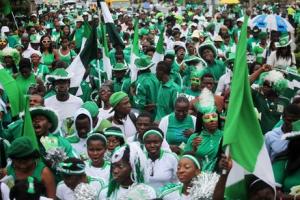
Nigerians on independence day
…Topsy-turvy search for an acceptable, workable structure
By Clifford Ndujihe, Deputy Political Editor
NIGERIA is currently wading through a sea of challenges. Apart from economic recession and inability of most state governments to pay salaries, there are also menace of herdsmen and recurring murderous clashes with farmers, agitation for the Republic of Biafra, restiveness in the oil-rich Niger-Delta, and alleged maltreatment of some sections of the country by the President Muhammadu Buhari Administration through appointments.
How can Nigeria wriggle out of these problems. Suggestions are diverse. Some opinion leaders want the Federal Government to implement the over 620 recommendations of the 2014 National Conference, which according them, proferred solutions to these drawbacks. Yet some leaders think otherwise and want the National Assembly to spearhead the move through the amendment of the constitution.
The divergent views are not out of place. The country’s history is replete with avalanche of moves to hammer out a workable structure by leaders and representatives of the people.

Nigerians
Past conferences, their aims and shortfalls
Before Independence, Nigerian leaders were locked in series of constitutional conferences. In 1958, for instance, 106 Nigerian delegates drawn from the ethnic nationalities attended a conference in London to look at what was then the Nigerian federation. That conference yielded the 1960 Constitution that ushered Nigeria into independence.
In 1963, with the departure of Southern Cameroon from Nigeria three years into self-rule, the country fashioned another codebook — the 1963 Republican Constitution. The military intervention of 1966 had the constitution abrogated and the country was ruled by decrees. However, the military set up a Constituent Assembly in 1977, which produced the 1979 Constitution that returned the country to civil rule. The 1979 Constitution was ratified by the Supreme Military Council, SMC, headed by the then Head of State, General Olusegun Obasanjo. About four years later, the military overthrew the civilians and captured power again. They also set aside the 1979 constitution and promulgated decrees.
In 1989, the then General Ibrahim Babamasi Babangida-led military government set up a Constituent Assembly with the intention of returning power to civilians in 1990. The move produced the short-lived 1993 Constitution, which went up in smoke when Babangida postponed the handover date several times even though members of the National Assembly and governors had been elected and were in office. His annulment of the June 12, 1993 presidential elections presumably won by late business tycoon, Chief M. K. O. Abiola, unleashed much tension and violence on the polity. He stepped aside in 1993 after appointing Chief Ernest Shonekan as interim president.
Agitation for SNC
The clamour for a Sovereign National Conference, SNC, gained currency in 1994 following the ‘June 12’ misadventure. Proponents picked holes in the unitary system of government and canvassed a restructured polity that would drive socio-economic and political development.
The General Sani Abacha regime, which snatched power from Shonekan organized a National Constitutional Conference, NCC, in 1994 made of elected and government appointed delegates. The confab was boycotted by the progressive wing of the South-West, led by late Senator Abraham Adesanya, which insisted on the SNC. The conference came up with far-reaching decisions like creation of the six geo-political zones and 13 per cent derivation. But it was perceived as an exercise meant for Abacha to transmute into a civilian ruler. The proposed constitution was in the works until Abacha died in 1998.
When General Abdulsalami Abubakar took over in 1998, he announced a speedy transition programme that lasted 11 months. He set up a committee led by Justice Niki Tobi to sieve through the volumes of constitutional documents and come up with a grundnorm. The process gave birth to the 1999 Constitution with which civilians reclaimed power in 1999. However, the 1999 constitution was laced with many ambiguities and inconsistencies that threatened smooth flow of governance. Pro-democracy activists among others questioned the preamble, which said: ‘we the people…. arguing that the people of Nigeria never took part in making the constitution. They went on to insist on SNC.
Constitution amendment exercise
However, then President Olusegun Obasanjo and the National Assembly opposed calls for sovereign national conference, arguing that there could not be two sovereignties in the country. Nevertheless, in his second term, Obasanjo organised a National Political Reforms Conference, NPRC, with all the delegates appointed. One of the resolutions of the confab was 17 per cent derivation. However, the decisions of the conference, which the National Assembly was discussing with the aim of including them in its constitution amendment exercise died with Obasanjo’s alleged Third Term agenda.
Under President Jonathan, the 1999 constitution was amended twice but the clamour for a restructured polity persisted.
In response, Dr Jonathan organised the 2014 national conference, to tackle these issues.
Indeed, the conference touched virtually all aspects of the socio-economic and political challenges besetting the country such as resource control, fiscal federalism, devolution of power, creation of states, forms of government, revenue allocation, ethnic nationalities and minority question, and resolution of the herdsmen and farmers’ crises.
For a start, the conference recommended part time legislature, removal of immunity clause on criminal matter, independent candidacy, part-time legislature, cutting cost of government by having only 18 ministers instead of 42, The Diaspora participation in voting, unbundling of the Independent National Electoral Commission, INEC, privatisation of existing refineries and stoppage of sponsorship of pilgrims.
The confab also recommended that anybody aspiring to become the country’s President must be a degree holder. It approved the rotation of Presidency between the North and South and governorship among the three senatorial districts of each state. Also, any elected official, executive or legislative, who carpet-cross, regardless of the reasons for such, shall automatically forfeit his seat.
It also recommended the creation of 18 new states (three per geo-political zone).Apart from the 18 proposed states, the Conference also recommended one new state for the South East to make the zone have equal number of states with the other zones except the North West which has seven. It said that states willing to merge can also do so based on certain conditions.
On the vexed issue of fiscal federalism and resource control, the Conference recommended the establishment of a special fund for the development of mineral resources. The Fund should be administered by a competent body according to guidelines that shall be specified by the National Assembly. It specifically said that excess revenue should be used for exploration of mineral resources in every part of the country.
It noted that assigning percentage for the increase in derivation principle and setting up Special Intervention Funds to address issues of reconstruction and rehabilitation of areas ravaged by insurgency and internal conflicts as well as solid minerals development, require some technical details and consideration. The Conference therefore recommends that Government should set up a Technical Committee to determine the appropriate percentage on the three issues and advise government accordingly.
To reduce economic power at the centre, it recommended that the sharing of the funds to the Federation Account among the three tiers of government should be done in the following manner: Federal Government – 42.5%, State Governments – 35% and Local Governments 22.5% as opposed to the prevailing 52.68 %, 26.72% and 20.60% respectively.
On form of government, the confab recommended the Modified Presidential System, a home-made model of government that effectively combines the presidential and parliamentary systems of government. The president shall pick the vice president from the Legislature. The President should select not more than 18 ministers from the six ego -political zones and not more than 30% of his ministers from outside the Legislature. Reduce Cost of governance by pruning the number of political appointees and using staff of ministries where necessary.
On Local Government, it said Local Government will no longer be the third tier of government. The federal and states are now to be the only tiers of government. States can now create as many local governments they want. The Joint State/Local Government Account be scrapped and in its place the establishment of a State RMAFC with representatives of LG and a Chairman nominated by the Governor. The Constitution should fix the tenure for Local Government Councils at three years. Conference recommends the scrapping of State Independent Electoral Commission, SIECs.
On Livestock, grazing reserves, ranching, an issue that is holding Nigeria at the jugular, the confab recommended that in the long term, cattle routes and grazing reserves be phased out to lay emphasis on ranching. But in the meantime, states which have large livestock populations should endeavour to maintain grazing reserves.
In spite of these recommendations, President Muhammadu Buhari, on assuming power elected to archive the report of the confab, a decision that partly led to the heated debates on restructuring. Going forward, do we really need restructuring or not? How can the country be restructured? What are to be restructured? Keep a date with Vanguard as we find answers to these burning questions and more.
Disclaimer
Comments expressed here do not reflect the opinions of Vanguard newspapers or any employee thereof.