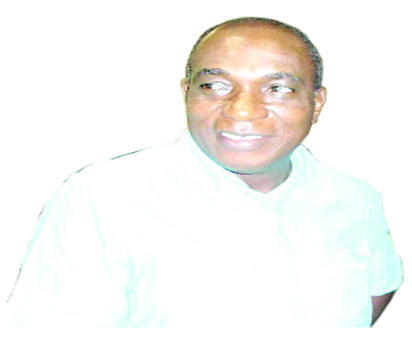
Olu Amoda
In this brief chat with Vanguard Arts Editor, OSA AMADI, Olu Amoda shares the inner workings of his creative mind, draws a parallel between his urban style and the spiritual connection with steel, especially the ogun mythology.
From where do you draw your inspiration as a visual artist? Life. I live and work in the urban settings. Everything you see in the urban sprawl speaks to me. I start my day with reading newspapers. Then what I see every day from my house to school, from school to where I see my friends and other things, these are the things that speak to me.

Olu Amoda
What are your challenges as an artist?
To start with, the challenges are not different from the challenges other people have. Life is a challenge. But I agree that there are certain specific challenges involved in certain specific productions. And every piece here has different challenges. In some work, the major challenge I have is space, and then power. You basically have to provide your own electricity here, because before you do one or two things, the power goes off. So you have to put on the generator. You have to run diesel. And you know that diesel is scarce and expensive.
What would be the most appropriate place to use these kinds of artworks?
The use of art is always subject to the desire of the collector. People buy what they need, and they have an idea where they want to put it. But sometimes, when people have a specific site, they ask an artist to produce works to respond to that site.
Can you draw a parallel between your urban style and the spiritual connection with steel, especially the ogun mythology?
Fine, I think this a very interesting question you have asked. If you imagine the first car people buy for use, they go to their spiritualists to bless it. They pray that they don’t have accident, that the car will not be stolen. But they never pray that the car will never break down. So while the ogun spirit stays in the bolts and nuts of the car, it protects the car from theft and accident. But when the bolt falls out of the car, part of that spirit stays in that bolt and when I use that bolt in my work, that spirit finds its way into my work. That is the only connection I can think of. For me I am not an ogun worshipper. I studied this (art) in school. The works here have nothing to do with religion. It has to do with what people can see. But you know that if you begin to speak to these works they take their own lives. So the artist just creates these things, but their use depends on the end user.
Are you fulfilled as an artist?
Yes.
What is the symbolism of art in the makeshift vehicle?
For the past two exhibitions I have been trying to deal with the issue of migration, that is, migrants, and privacy within public space. Most of the people you see who travel to UK, to America, travel by boat. Most people may not see that (makeshift vehicle) as the thing that can take people out. So, it falls within the same theme.
Disclaimer
Comments expressed here do not reflect the opinions of Vanguard newspapers or any employee thereof.