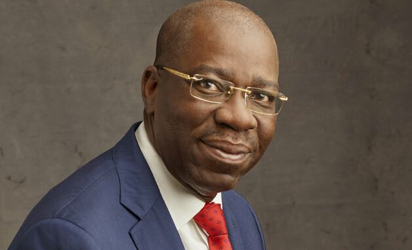
Governor of Edo State, Mr Godwin Obaseki
By Ernest Omoarelojie
WHILE criss-crossing the nooks and crannies of all the 192 wards in Edo state during the build-up to the September 2016 governorship election, incumbent governor, Godwin Nogheghase Obaseki, laid his cards on the table by making clear his vision for the state and its people. Essentially, the vision revolves round a bold determination to rejig the state’s economy and raise it to the level of relative sustainability with or without the monthly deferral revenue allocations. He harped on his intention to separate government from politics in order to avoid the distractive tendencies of political activities which are in practice often crises-ridden and time wasting.
Eruditely, he painted his knowledge of what must be done which, in the main, includes making investment on the state’s innumerable natural resources the plank for turning it into an economic model for its other federating peers. He enunciated the details of what must be done for the vision to take form and everywhere he spoke of his plan, he left no one in doubt about the fact that his plan’s practicability is well researched.
That much was obvious as pundits had no challenge gleaning or understanding his insightful argument that the state will have no reason relying on federation allocation for survival if its minders, as he placed developmental emphasis on three fundamental development points namely; opening the state up for viable investments, re-energizing the people’s productive capacity and taking advantage of location of the state as a connecting hub to the nation’s other geo-political zones.

Governor of Edo State, Mr Godwin Obaseki
But to situate and appreciate the difference in Obaseki’s vision, it is important to conduct a brief historical over view. For instance, prior to the emergence of the Oshiomhole administration at the tail end of 2008, godfatherism held sway and almost literally held every administration to ransom. The presence and place of godfathers was so sacrosanct that the interests of the people took the back seat while theirs and those of their political cronies received manifest attention at all times.
Indeed, with them around, no one saw the need to seriously raise any voice about the need for the administrations to pay due attention to taking care of the people’s welfare. However, apart from refusing to defer to godfathers at the expense of the people, the Oshiomhole administration prioritised general infrastructural renewal as a deliberate people oriented policy.
Instructively, Obaseki was emphatic that the Oshiomhole administration was the first part of a consciously engineered long term development programme designed to remove the state from the apron string of miserly federation allocation that is hardly enough to meet the state’s statutory monthly obligations. In other words, his administration is the second part meant to further his successor’s breakthrough but with its own fundamental different focus meant to enhance what is evidently on ground.
However, the new administration is emphatic in stressing the point that governance based on patronage system which benefits a few parasitic party patrons is unsustainable. In contrast, the new government is desirous of opening up investment and partnership opportunities for resourceful people to key in. By connecting people to such rare opportunities, he is optimistic that several party leaders and members will become millionaires through viable and sustainable economic activities.
In retrospect, one can relate the transition from Oshiomhole to Obaseki to that between Bola Ahmed Tinubu and his successor, Babatunde Raji Fashola. Remarkably, while both administrations had the intention of repositioning Lagos for better development and service delivery, the latter had a different idea for realising the same goal without undermining its predecessor. History proved that the latter came out successfully.
However, it can be deduced that both Lagos and Edo states have so much in common as can be gleaned from the mutually beneficial relationship between the leaderships. But like the Fashola example, Obaseki has made it clear that he has no intention of politicising governance. For emphasis, he was unambiguous in stating that his business is to, among others; make the state an economic hub. Part of the goal is to re-energize the people’s creative zest with specific agrarian and other investment policies calculated to re-directing their productive energies towards taking advantage of the abundant natural resources all over the state.
There is no gainsaying the fact that politics and government are as inseparable as Siamese twins but care must be taken not to allow one to demobilise or paralyse the other. Apart from the assurance of more effective superintendence of the party by its leadership and the support of the surrogates of the Governor, it is central to his plan to set certain days aside to attend to strictly political questions. This underscores the importance he attaches to political stability and development. During the campaign, he told his audiences that he will govern through the party structures. Thus, for the first time in history, Special Assistants to the Governor will soon be appointed from the ward level. That will not only mark a fulfilment of his promise but an unquestionable loyalty to the political class. Yet, the political class also stands to benefit from the more challenging and urgent issue of restructuring governance and the imperative of re- inventing the institutions of government in order to reinvigorate the system for better performance.
These are the issues all stakeholders must not only appreciate or understand but must also make conscious effort to tap into because it portends a win-win situation for all. There are people who are understandably accustomed to certain ways of doing things and whose relationship with the past has denied them the wisdom of realising that the new vision is the most viable path towards economic and development freedom for both the state and its people.
If we care the least for our wellbeing and the future of our children, the re-awakening of the people’s inherent ability for production and self reliance, particularly when given requisite impetus as the Obaseki administration seeks to implement is the only option! The minimum expectation from all stakeholders is to stand up and be counted on the side of development and growth!
Disclaimer
Comments expressed here do not reflect the opinions of Vanguard newspapers or any employee thereof.