Continues from last week
After all, there are psychopathic killers who derived special satisfaction in personally decapitating their victims.
The doctor drove into the newly-constructed housing estate on Kashim Ibrahim Road, on the way from Maiduguru to Potiskum. I had heard about the place but had never been there. As the gatemen at the entrance walked toward the Datsun car, I fixed a stare on the one dressed in jalabiya, his Koran in his right hand. They recognized the doctor, greeted and swung the gate open. My eyes darted about the place. Street lights illuminated the lawns and road curbs. All the houses were of uniform shape and colour. He drove further in and turned toward one of the white bungalows.
I noticed a window blind slide aside. In no time, the front door of the house was opened.Dr. Usman had stepped out of the car and was moving to the left side of the back door. I looked up and saw a young man in dark shorts and white singlet come out of the house; his stocky frame and light skin were conspicuous in the fairly illuminated premises. He appeared to be in his early 30s.
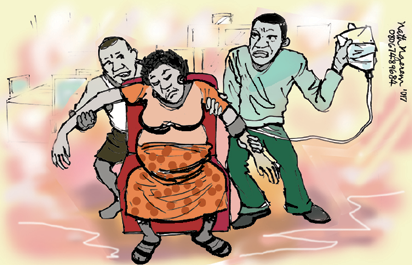
He walked to the car, greeted the doctor and joined in lifting my wife into the house. We put her on the brown-cushioned seat in the living room, and I stood beside her holding up the drip.

I raised my head and caught a glimpse of the Arabic inscriptions on an Islamic poster that was hanging on the wall. Quickly, I pulled my suspicious eyes away as the doctor approached again. He held Amina by the wrist to feel her pulse and instructed the young man to prepare the visitors room.
In no time, we settled into the room. A mattress was placed on the floor for me while she lay on the bed. The drip had been properly positioned on an iron stand by her side.
I heard a knock on the door. Dr. Usman stepped in. He walked to the bed and injected some drugs into the drip. As he turned toward me, the lights went out. The room was pitch-dark.
“Sorry, Mr. Ndukwe. I didn’t tell you the lights here usually go off by twelve,” he said.
“It’s OK, sir. Dark nights are something we’re all used to,” I managed to utter in the dark; my heart had begun to pound.
“I’ll be back,” he said.
He walked out of the room and shut the door.
******************************************
For three days, Dr. Usman sheltered us. He bought some new clothes for me and my wife. He treated her for free and was able to save the pregnancy. We all ate at the same table and virtually lived as a family.
There were two things Dr. Usman took passionate interest in: his fura de nunu drink, a formula of millet and cow milk. He never missed it a day; the other was the music of Alhaji Dr. Mamman Shata, especially the track, ‘Salabi Liman Kaura.’
But I noticed that Bala, the steward who helped bring Amina out of the vehicle on the first day, was not particularly friendly. He would react grudgingly to the slightest request from me or my wife, although he tried to conceal his feelings whenever the doctor was around. Dr. Usman still went to work in the morning and returned in the evening, so we were stuck the whole day with Bala. But his cold attitude and hostile stares began to worry us. We had heard stories of how several Christians who were hidden by generous neighbors were betrayed by unknown informants in such previous riots.
We considered reporting his inhospitable behaviour to the doctor but realized we would be over-stretching our luck, for we did not wish to put asunder a family we met just few days ago, particularly when they owed us no obligations.
Although we still had some money to sustain us in a hotel for about a week, the tension in town had not subsided. Pockets of skirmishes and sporadic attacks were still being reported. I conferred with my wife, and we concluded that the best thing to do in the circumstance was to thank Dr. Usman for his kindness and begin our journey to Ubo.
He returned home late that day. His vehicle taxied into the compound at nine fifteen. I was seated in the living room listening to the NTA Network News when Bala came into the sitting room and moved toward the front door to welcome his master. He shot a scornful look at me as he walked past.
I recoiled, bit my lips and mumbled, “I don’t blame you. Na condition make crayfish bend.”
I had resolved, with Amina, not to respond to the humiliating acts of Bala, no matter the provocation. It was not our intention to do anything that would make Dr. Usman regret his uncommon compassion.
“How’re you today, Udoka?” Dr. Usman asked as he stepped into the house.
I stood to welcome him. “I’m doing fine, Doctor.”
“You’re not looking good to me. How is Amina?”
“No, no. We’re OK, sir. Amina is fine, sir.”
“I hope you’ve all had dinner?”
I looked away, coughed to clear my throat. “Ehmm, we’re OK, sir. I think the gas in the house is finished. But we’re fine sir,” I said. I cannot say now if it was an instinctive response or a deliberate one.
The doctor stopped and stared at me with indignation in his eyes. Suddenly I wished I had remained silent or, at least, had not disclosed the true situation of things.
“Impossible. You mean you’ve not eaten since I left in the morning? What about Amina? She’s not had anything, too?” Dr. Usman fumed.
“We’re OK, Doctor. We’re fine, sir,” I said and feigned a smile.
“Bala!” Dr. Usman bellowed.
“Sir,” Bala answered and walked back lazily into the sitting room.
“What happened to the money I gave you in the morning for gas?”
Bala lowered his face and glared at the floor. “I look am for efery where. Gas e no dey for the ehztate,” he said.
“How can you say there’s no gas in the entire estate? And you did not bother to look for an alternative? What of the kerosene stove?” Dr. Usman said.
“E bad, sir. I call am for the tekniza. Long before e pinis am . . . e good now. Food ready now, sir,” Bala said.
“At this time? Look at the time.” Dr. Usman said, pointing to the wall clock. He turned toward me, his big eyeballs blazing in the fury of the moment. “I’m sorry, Udoka. I can assure you that this will not repeat itself.” He had barely finished the words before he turned and stormed out of the sitting room. Bala hurled a monstrous glance at me, hissed and brushed past.
Chapter Four
In the morning of the next day, I sat with Amina and Dr. Usman in the living room for about thirty minutes, trying to convince the doctor why we should set forth for Ubo. I must confess that I sincerely had wished to still spend some more time at Dr. Usman’s residence, not minding the frustrations we were subjected to by Bala. I had thought that with time we might be able to find common grounds for friendship with him. But his action the previous day was truly disturbing, particularly his not showing any sign of remorse for his misconduct. I realized that the possibility of ever ingratiating ourselves with him was far-fetched.
The doctor attempted to dissuade us from leaving. He said his house was free for us to live in for as long as we wished. But we had made up our minds to go. Dr. Usman, quite expectedly, was unhappy. He suspected, correctly too, that our decision to leave may have been informed by the events of the previous night.
When he finally realized that we were truly determined to return to the village, he reluctantly acquiesced to our request and prayed for journeying mercies. He went to his room and returned with an envelope. He handed it to me and asked Bala to put some food items in the car for us. The doctor patiently waited for us to put the few things we had together, before driving us to the bus terminal at Maiduguri-Damasak Road.
The bus terminal was a space of about half a football pitch, with an iron barricade rung round the dwarf fence. The congestion and potholes within the station inhibited free flow of movement. Anxious passengers scrambled for space in the available vehicles, as anything to take them out of town would suffice. Dr. Usman stayed with us to ensure we were able to secure a ticket for the last bus heading for Onitsha.
Onitsha was a bustling commercial city in the western fringes of the south-eastern part of the country where travelers disembarked to connect with other vehicles going further into the rain forest of the eastern hinterland.
The bus departed the station before Dr. Usman left to attend to his duties at the hospital. It was an old ‘OSONDU’ luxury bus and, tied atop the vehicle were the bags and boxes of the passengers. The luggage compartment underneath was filled, with parts of the stuffed belongings sticking out of the edges of the boot. In no time, the bus began to make its way through the open lands and hills of the North, to the thick vegetation of the South.
Five hours later, sandwiched inside the over-loaded Marcopolo bus, we saw the signpost welcoming us to the city of Lafia. We noticed that all the vehicles coming from the opposite direction had green leaves stuck in their hoods and license plates. They were hurrying out of the city of Lafia. The drivers and passengers in the fleeing vehicles were frantically waving and urging us to reverse and get out of the area. Our bus pulled up on the shoulder of the road.
The driver tried to make some enquiries and, hearing there were riots in Lafia metropolis, he quickly did a U-turn. The on-rushing traffic was making it difficult for the big vehicle to beat a retreat but the driver finally managed to turn the bus around and begin a backward journey. The passengers had started cursing and wailing.
As the vehicle headed deep into the long stretch of the highway in search of an alternative route to our destination, I turned and watched the faint skylines of Lafia recede out of sight. I glanced at Amina and noticed she was beginning to look pale and sick. Then I touched her neck to feel her temperature: it was rising.
“Please, is there any doctor in the bus?” I cried out. There was silence. All eyes riveted on me. A mix of grumbling and whimpers of empathy filled the air. Then a tall, light-skinned man stood and headed our way. I imagined he would be in his early thirties. “Doctor, please help me, sir. She is running a temperature,” I said.
“I’m not exactly a doctor, but let’s see what can be done. When did you begin to notice this?” the man asked, swaying as the bus bumped along the rutted earth road we had veered into.
I flashed a suspicious look at him. “About fifteen minutes ago,” I said with subdued pessimism. In as much as I desperately needed help, I would not wish to worsen the health of my wife in the hands of the several quacks who prowled such interstate commercial buses, parading unsubstantiated medical claims. The jerry-curled hair of the man and his overly fanciful jeans jacket and trousers, further diminished my faith in his credibility.
My eyes swept over him as he examined her. After a while, he stood and made for his seat. He returned shortly with a kit. Again, I scanned the man from head to toe. With my heart thumping and Amina slouched on my laps, I watched helplessly as the strange man administered treatment on my ailing wife.
***************************************
We arrived at Ubo by two in the morning. The community was in total darkness; the whole place appeared to stand still. We alighted from the motorcycles, and paid off the two riders who had brought us on the choppy dust road from Akeh, some twenty kilometers away.
Amina observed that not much had changed about the village since she visited five years earlier for the funeral of my father. Ubo was still a collection of old mud houses and few block buildings of mostly two or three bedrooms. I managed to find my way to my uncle’s house, for I needed to get the spare key to my house. My own copy of the key was lost in the inferno that consumed our house at Bulum-Kuttu.
Since the death of my father, Uncle Madu had become the patriarch of the Ndukwe family. The sixty-year-old farmer ensured that my three-room bungalow was secure. He would occasionally send in children to clean up the house. He was the glue that held the extended family together. Sometimes I did wonder who, between my father and Uncle Madu, had shown greater proficiency in managing the large family.
I was so engrossed in reflections about the extended family that I did not notice when I walked past the orange tree in front of the house. As children, the tree was a favorite spot under which we always assembled to savor the various tales by moonlight. I recalled with nostalgia that the quickest and most convenient way to direct visitors to the house used to be to ask them to look out for the orange tree in front of the house, as though there were no other houses with such a tree within the neighborhood. One can only now imagine how many of such visitors we may have misdirected by such a simplistic description.
We got to my uncle’s door and knocked. “Uncle, it’s me, Udoka.” There was no response.
I knocked again, “Uncle . . . Uncle Madu.”
I had started wondering if he had relocated to some other building within the premises when his hoarse voice echoed from inside. “Who is knocking at this time of the night?”
“It’s me, Udoka, from the North.”
“Chineke! Udoka! What. . .” he exclaimed as he quickly opened the door. He stepped out bare-chested, a gray wrapper draped around his waist. He turned up the flame of the hurricane lamp in his left hand, to properly behold the face of his, should I say, august visitors. He was still the slim, dark and smallish man I knew him to be. He looked behind me and saw a weak Amina who was struggling to remain on her feet. “Come in, come in and have your seats,” he said in our native Igbo dialect, for that was generally our medium of communication in the village.
“Thank you, Uncle,” I said.
My wife and I squeezed into the mud house, clutching onto the few items we had managed to bring from Dr. Usman’s.
Surprised and confused, Uncle Madu fretted about the room flashing curious glances at the wearied husband and wife, “What happened? Where . . . what are you . . . who. . .” he stammered.
I cut in, “It’s a long story, Uncle.”
I directed Amina to the wooden chair at the left side of the room and settled into the bamboo-crafted seat opposite Uncle Madu.
***********************************************
We were woken the next morning by knocks on the door of our three-bedroom apartment. After we had narrated our ordeal to Uncle Madu the previous night, the old man had walked us to our blue bungalow, which was three houses away from his. I guess the stress of the journey must have made us sleep beyond our usual rising hour.
I got up from the bed, hurried into my caftan and walked toward the front door. As I made past the window, I pushed the curtain aside and peeped. The visitor was not in view. I only beheld bleating goats and fowls crowing about the place. If we were still in Bulum-Kuttu, I would have held back further to get a glimpse of the person. But this was Ubo. Such fears of unknown intruders were virtually uncommon in the village at that time. People could still sleep freely overnight in open spaces outside their houses.
I unlocked and swung the door open. Nkiru, the thirty-year-old second wife of Uncle Madu, was standing there with a tray of food. The dark-complexioned lady wore plaited hair and a brown maxi gown. It had been the practice of Uncle Madu to get his wives to prepare my meals for the first few days of my arrival in the village. He knew I needed some time to properly settle in before I could fend for myself.
I welcomed her and asked that she place the tray on the table at the center of the sitting room.
Disclaimer
Comments expressed here do not reflect the opinions of Vanguard newspapers or any employee thereof.