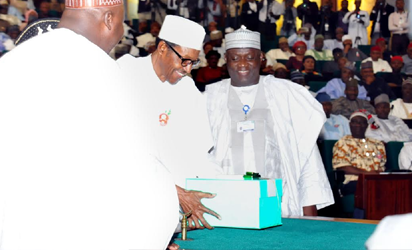
President Muhammadu Buhari (M) presents the 2017 National Budget to a joint session of the National Assembly at the National Assembly Complex in Abuja on Wednesday.
THE 2017 Budget, which was submitted late last November, approximately two months behind schedule, is going through the same tortoise pace which had characterised previous budgets since the first one under an elected government in 2000.

President Muhammadu Buhari (M) presents the 2017 National Budget to a joint session of the National Assembly at the National Assembly Complex in Abuja on Wednesday.
If there is anything which makes economists and financial experts entertain nostalgia for our years under military rule, it is the annual budget. In those days, the Military Head of State would simply announce the budget on New Year’s Eve and implementation started immediately after the Minister of Finance called major stakeholders to announce the regime of tariffs, taxes, duties and the general framework to back up the plan.
The Central Bank of Nigeria (CBN) would, a few days after, release the Monetary Policy guidelines and in less than two weeks all the elements of the budget were in place.
Return to civil rule brought back the Legislature into the picture, to debate and pass the Appropriation Bill, and this came with the unruliness of politicians and the usual Legislature/Executive prevarications leading to long-drawn budget delays. As a result, no single budget since 2000 had been passed before the end of March. Last year’s set an unenviable record by getting passed in May.
Our leaders at the Federal level apparently are unaware of the contempt the rest of the global financial community has for us as we delay global estimates with our budget process. It is obvious that budgets passed in April or May are definitely not going to be fully executed because time is a major economic variable which we waste by delaying passage of our budgets.
When the All Progressives Congress (APC) promised change, economists assumed that timely presentation and passage of budgets would be one of the changes to expect. Instead of the situation getting better, it is actually getting worse as the nation waits for the second budget presented by the Buhari administration.
Given the fact that this is the first budget aimed at reversing an economic recession, Nigerians have every reason to expect a sense of urgency and responsibility demonstrated by leaders of the executive and legislative branches. None is on display.
We cannot go on like this. As an interim measure, we urge the National Assembly to set a March 31, 2017 deadline for the submission of this year’s budget to the President for assent, even if they have to work on it day and night, including weekends.
We also suggest that preparations for next year’s budget should start early and get to the Legislature in November so that, by mid-January the following year, it will be ready for implementation.
We need a greater sense of commitment and urgency to make our annual budgets meet expectations.
Disclaimer
Comments expressed here do not reflect the opinions of Vanguard newspapers or any employee thereof.