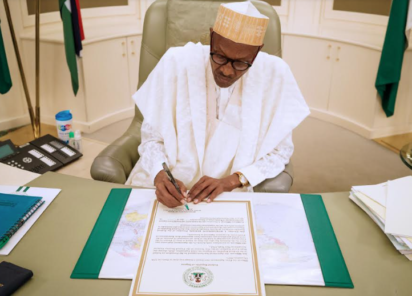
President Muhammadu Buhari signs Instrument of Ratification of the Paris Agreement on Climate Change in State House on 28th March 2017
Working relations between the legislative and executive branches of the Federal Government has, most of times in the past eighteen years of our renascent democracy, been tempestuous, with the President Olusegun Obasanjo years being the most notorious.

President Muhammadu Buhari signs Instrument of Ratification of the Paris Agreement on Climate Change in State House on 28th March 2017
After a lull during the tenures of late President Umaru Yar’Adua and Dr Goodluck Jonathan, the chaos returned to benchmark the past twenty-two months of the President Muhammadu Buhari dispensation.
Apart from the struggle for the control of the leadership of the National Assembly (NASS) by vested interests in the ruling All Progressives Congress (APC) which controls the two chambers of the NASS, series of upheavals have bedevilled efforts to pass the annual budgets, confirm some appointees of the President in the Senate and get some top officials of the Presidency to answer legitimate summons by the Senate.
The most prominent of these incidents were the recalcitrance displayed by the Secretary to the Government of the Federation, Babachir Lawal over alleged corrupt contract deals and conflict of interests involving companies he is linked to, as well as the Comptroller-General of Customs, retired Col Hameed Ali, who seems to have great difficulties responding appropriately to Senate summons on the controversial Vehicle Duty Policy.
We need to emphasise that under our democracy, the National Assembly has powers not just to make laws but also to exercise oversight functions on the Executive in tune with the principle of checks and balances. Section 89 of the 1999 Constitution (as amended) empowers the House of Representatives and the Senate to procure any evidence and summon any person, ministry or department in its quest to investigate any issue as provided for in Section 88.
The reason for this provision is to ensure that the federal legislature, as the elected representatives of the Nigerian grassroots, guards against excesses and impunity in the implementation of government programmes and policies.
It is however in overall public interest that the lawmakers conduct this sacred function with patriotism, eschewing witch-hunting and corrupt personal pursuits. While we insist on the sanctity of the National Assembly as a symbol of the virility of our democracy, we call on the legislature not to be a stumbling block in governance. Rather, the oversight power should be exercised to enhance accountability and improve the quality of governance.
The growing tendency on the part of top officials of the executive to treat Legislature summons with impunity is unacceptable and a slap on the Constitution of the Federal Republic of Nigeria.
We are delighted that the ruling APC has affirmed it will not support the belittling of the Legislature. Answering the summons of the Legislature should not, in any way, curb the right and determination of any Federal appointee to carry out his or her job in the overall national interest.
Disclaimer
Comments expressed here do not reflect the opinions of Vanguard newspapers or any employee thereof.