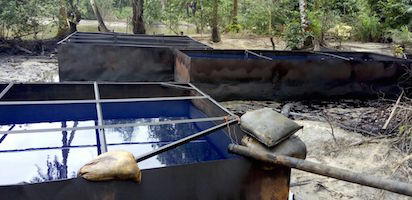
ILLEGAL REFINERIES
By Levinus Nwabughiogu
ABUJA-At last, President Muhammadu Buhari has caved in to pressure to recognize illegal and local refineries that dotted the Niger Delta.
This is not only seen as a new vision for oil-producing communities in the oil-rich region, but a strategy to permanently curb the issue of oil bunkering and the incessant destruction of major installations which had affected Nigeria’s production output and earnings in the international crude market.
The initiative which was first proposed by the Minister of State for Petroleum Resources, Dr. Ibe Kachikwu was essentially the outcome of the presidential interactive engagements in several oil-producing States led by the Vice President Yemi Osinbajo.
A meeting to that effect also held last week to which Mr. Laolu Akande, the spokesman of the Vice President confirmed to Vanguard last night.
The initiative would have all illegal refiners and the local communities in the Niger Delta integrated in the proposed Modular refineries concept of the Federal Government as they would not be left to operate on parallel basis.
Experts said it was good to integrate the illegal refiners which Presidency and the Nigeria Sovereign Investment Agency, NSIA is spear-heading and considering on how to achieve the purpose, rather than a scorched-earth policy that seeks to eliminate the operations of such refiners.
A modular refinery is a refinery made up of smaller and mobile parts- (skid-mounted)- that are more easily fabricated and can be more quickly transported to site.
They come in different sizes with varying capacities normally lower capacity than conventional refineries with more elaborate and complication set-up.
Under the plan being considered in the presidency, the Federal Government could supply crude to the local refineries at a reasonably considered price, as an incentive to stop the current practice whereby the illegal refiners vandalise and steal the crude.
This concept would also prevent the environment degradation that the spills and damaging the trunk lines have been causing.
Also, marginal field operators can also supply crude to the new modular refineries that would have the illegal refiners integrated.
Another important component of the plan under consideration is to involve the current illegal refiners and their communities as shareholders while the NDDC and the NSIA will also hold substantial holdings/equity sufficient to make the smaller refineries operational as a business and a going concern.
To facilitate effective community engagements, a Memorandum of Understanding, MOU, would be established under the plan with the affected communities determining the communities share, while the FG would supervise the implementation, which would be driven largely by industry operators and the communities.
But in actualizing this objective, Presidency sources explained that there were a number of significant hurdles to be crossed especially issues around the engineering and technical ramifications of such a conversion, besides figuring out the financial models that would be workable and profitable.
The technical and engineering implications of how to integrate the refiners were however discussed with industry experts and practitioners who made presentations on how to implement the Buhari presidency modular refinery at the meeting last week.
According to a Presidency top source, experts at the meeting later reported that they had worked closely with the Nigeria National Petroleum Cooperation, NNPC, Oil & Gas operators, owners of marginal fields, operators of refineries and various technical services providers “to develop a workable system to develop this initiative”.
Disclaimer
Comments expressed here do not reflect the opinions of Vanguard newspapers or any employee thereof.