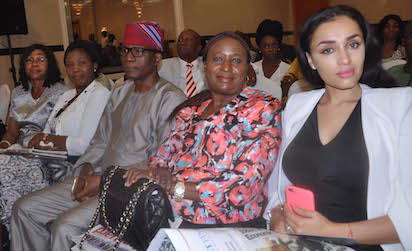
From Left; Mrs. Yetunde Arebi, Deputy Women Editor, Vanguard Newspaper, Mrs. Mrs. Funmi Ajumobi, Kids Editor, Mr. Kayode Komolafe, Deputy Managing Director, Thisdays Newspaper, Mrs. Funmi Komolafe, fomer Labour Editor, Vanguard and Mrs. Iara Oshimhole at the Vanguard Economic Discourse with the Theme;The Hard Facts to Rescue The Nigeria Economy held at Civic centre Victoria Island Lagos yesterday.PHOTO; Bunmi Azeez
By Denrele Animasaun
”To call a woman the weaker sex is a libel; it is man’s injustice to woman. If by strength is meant brute strength, then, indeed, is woman less brute than man. If by strength is meant moral power, then a woman is immeasurably man’s superior. Has she not greater intuition, is she not more self-sacrificing, has she not greater powers of endurance, has she not greater courage? Without her, a man could not be.
If nonviolence is the law of our being, the future is with a woman. Who can make a more effective appeal to the heart than woman?”—Mahatma Gandhi
It is that time of the year again: March 8th is International Women’s Day. So pardon me if I stand on my soap box to mark a day dedicated to women worldwide. I do this every year and this time last year, I wrote;” Women hold up half the sky” and the year before that I wrote; “Make it happen”.
Nothing much has changed though, women still hold up half the sky and no, it did not happen, I mean, bridging the gender equality pay. This year’s theme for International Women’s Day, focuses on; “Women in the Changing World of Work: Planet 50-50 by 2030”.
Of course, it is a catchy strapline and wishful thinking if we think this would happen in Nigeria anytime soon. As things go, do we honestly think that equity in pay will happen by 2030? I do not think so. Call me a cynic, but I do not see that happening without strategic forward planning and commitment of the government and lawmakers. Right now, Nigeria has failed to make the move to address the inequalities in gender opportunities and pay.
It is time to stop banging the drum and grandstanding, no more lip service and doing too little but no action. Enough of pet projects, go easy on the parades, pomp and pageantry and the promises that never materialise. Time to put up and shut up.
Last year, the lawmakers rejected a bill proposing a new gender equality law on religious grounds. It is disappointing and a missed opportunity. They had the golden opportunity to improve the lives of half the population and they failed spectacularly. We all know when economic situations are bad, those that feel the impact the most, are the most deprived and marginalised groups, the elderly, children, the sick, women and girls fall into that category.
Women and the girls in Nigeria have not advanced that much in terms of basic needs, education, employment, safety, opportunity and equality of opportunities. It is confounding that half of the population have to go begging for their rights for equal pay, opportunities and better treatment when it should be the given, that every citizen has the opportunity to reach their fullest potential regardless of their gender.
There has not been a level playing field and up until the 1990s, when education was free and accessible the recipients are the very same people now denying the very same opportunities to many girls and women in the country. This is rather unfortunate and Nigeria is poorer for their legislative process or inaction.
The quality of life for women and girls in Nigeria has progressively worsened in the last twenty years and it correlates with the paucity of opportunities and education. So what is the government doing to improve the lives of half of its population?
The country in the 21st century needs a literate workforce, one where men and women who are equipped to shape the future of the nation.
First, it needs to offer access to many more disadvantaged women and girls, in particular, the northern part of the country (but also other parts that have been without) where over two thirds of girls aged 15 to 19 years are illiterate and are definitely likely to be excluded in the digital workforce and less likely to contribute to economic wealth of the nation.
Research do show the more educated a girl is, the less likely for her to marry at a young ageless likely to be poor, less likely to suffer miscarriages, have less children, more likely to be educated, more socially mobile and be more healthy and have a better quality of life and so will her family.
We know that if the lives of women improve, so does the community. The world is moving towards a more digitalised age and in order for Nigeria to take its rightful place in the league of nations, it must invest, improve the standard of education and the quality of life of its female citizens, that is the only way, it can be competitive in the digital age or else the country will be left behind.
It really does not take a rocket scientist to work it out, that if the government invests and works to improve the parity of opportunities for women and girls, then the nation will flourish.
This is 2017, and no more excuses, other countries are making strides so why not Nigeria?
Women are Heads of States in about 52 countries across the globe; the UK has the Queen Elizabeth II, she has been queen for over six decades, and the UK also has a female Prime Minister, Germany has Angela Merkel, the US narrowly missed out on Hillary Clinton as President. So what is Nigeria’s excuse? Liberia has Ellen Johnson Sireaf, she is serving her second term as head of state so it is not far-fetched in Africa to have a female head of state and religion has nothing to do with it.
Similarly in Rwanda, women make up 64% of its lawmakers and they came 5th in the global gender equality index and Nigeria, it was 118 down in the same list.
So how will Nigeria empower its women and girls to reach parity of rights and opportunity by 2030? What seem to be the problem that stops the lawmakers from addressing their reservations when the fact remains that Nigerian women are very hard working and sometimes are the main breadwinners. We have to deal with inequality of females and the way they are perceived in our society.
The fear of the impact of women’s liberation is unfounded and if anything, studies have shown that when the lives of women and girls improve, the lives of the whole community improves. More has to be done to encourage girls and women to participate in the economic development of the nation. An improvement in gender equality could add billions to the nation’s GDP, the success would increase gender empowerment and improve birth ratio, life expectancy, social mobility, better health, improving mortality rate and tackling poverty. This is a win/win situation.
Our young people regardless of gender have a crucial a role to play in the digital age, and so it is imperative that young girls participate actively in its development.
The Director of People and Culture at Andela, Taiwo Judah-Ajayi stressed the need to put more programmes in place to educate Nigerian women about the countless benefits of being connected: “to improve female participation online, women need to be educated about the benefits of technology from an early age. Every interaction with a young girl should be seen as an opportunity to create more awareness about tech”. I could not agree more.
The time for Nigeria to make use of its valuable resources: Nigerian girls and women and prepare them for the digital age ahead is now, not tomorrow.
Recognition of top Nigerian women
The former Minister for Environment, Amina Mohammed, has been officially sworn in as Deputy Secretary-General of the United Nations at the headquarters in New York. She recently took the oath of Office from the newly appointed Secretary-General,
Antonio Guterres, who appointed her as his deputy in December last year. She was presented at the United Nations headquarters when her boss took his oath of office. She becomes the second African woman to be appointed to the role of Deputy Secretary-General of the UN, the first being Tanzania’s Asha-Rose Migiro who served in the role between 2007 – 2012 under Ban Ki-moon.
President of Harvard Law Review
ImeIme Umana was elected president of the prestigious Harvard Law Review in January. She is following in the footstep of Barack Obama, who held the very post 27 years ago. She becomes the second woman in 41 years. She made headlines as the first black woman to hold this office in the 130 year history of Harvard Review Journal.
Those who know her describe her as a brilliant woman, dedicated worker and an exceptionally caring leader. Umana was asked why it took so long to elect a black woman, she said: “We’ve been systematically excluded from the legal landscape, the legal conversation, and we’re just now making some important inroads”
The previous black president of the review Journal became the 44th president of America, so who knows, perhaps Ms Umana, could be a future president of Nigeria. I would not rule her out, she definitely has the qualities and academic pedigree.
The world is changing and Nigerian government should get with the programme. Time they changed the mindset and removed the perceived obstacles, bridged the gender pay gap, improved the lives of women, encouraged entrepreneurial spirit, improved access to health and social care for women, protected and safeguarded girls and women .
Provide education and opportunities for girls. Let us revisit the subject, this time next year, God willing. Here is hoping.
Above all, don’t lie to yourself. The man who lies to himself and listens to his own lie comes to a point that he cannot distinguish the truth within him, or around him, and so loses all respect for himself and for others. And having no respect, he ceases to love. -Fyodor Dostoyevsky
Disclaimer
Comments expressed here do not reflect the opinions of Vanguard newspapers or any employee thereof.