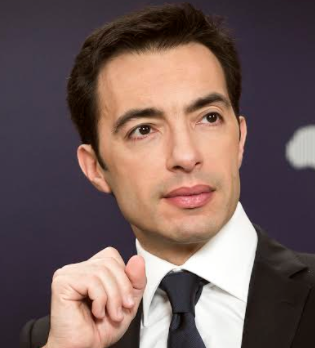
Amir Ben Yahmed, Managing Director, Jeune Afrique Founder/President, The Africa CEO Forum.
By Onome Amawhe
The annual Africa CEO Forum gets under way in Geneva, Switzerland from March 20 through 21 with the theme; ‘Re-thinking Africa’s business model. Since the maiden edition of the event in 2012, African political leaders with captains of business and industry have developed timelines and programs of action to bring about economic recovery on the continent: “I firmly believe that the private sector has an even more central role to play in the sustainable transformation of the African economic model”, says Amir Ben Yahmed. “By holding the 2017 edition under the theme, we have chosen to focus on the changes that must be made in order to succeed in Africa’s new economic cycle”
Amir Ben Yahmed has been an important figure in Africa since he founded the forum in 2012. A scion of French media aristocracy. Amir graduated from Institut des hautes etudes économiques et commerciales (INSEEC) Paris. In 1993, he joined the New York based investment banking and brokerage firm Gruntal & Co before heading back to Paris to get involved in family media business (Groupe Jeune Afrique, publishers of The Africa Report and Jeune Afrique).

Amir Ben Yahmed, Managing Director, Jeune Afrique Founder/President, The Africa CEO Forum.
In 1995, he was made Executive Publisher of Paris based Jeune Afrique, the French language weekly news magazine co-founded by his father Bechir Ben Yahmed and a group of Tunisian like-minds in 1960. Thereafter, Amir Ben Yahmed took the position of Group Development Director, initiating business oriented publications such as Jeune Afrique’s business section, and two special annuals Top 500 African Companies and Top 200 African Banks.
In 2007, Amir Ben Yahmed was made Managing Director, Group Jeune Afrique where his remit was to propel the company’s 3-pronged development policy on Internationalization, Diversification and Digitization. Taking a much bolder step in 2012, Amir Ben Yahmed convened the AFRICA CEO FORUM, where he pushed African CEOs to be accountable to all stakeholders. Since the launch of the forum, top government officials, corporate executives and top economists have consistently converged to help expand the forum for African CEOs. In this interview, Amir Ben Yahmed discusses the challenges—and opportunities—that he sees awaiting African CEOs on the horizon.
What has been achieved since last year’s meeting in Abidjan?
Year after year, we’ve been focusing on delivering the best programme to debate the continent’s economy and address the bottlenecks in Africa’s development. The discussions last year showed that, despite the headwinds, African CEOs are bullish, ambitious and resilient. For this new edition, we have reshaped the programme, offering twice as many panels that address African CEO’s strategic priorities. We are also bringing new topics to the table such as women’s leadership in Africa and youth entrepreneurship.
In addition, we have included several exclusive business-to-government sessions during which high-level Government officials from Cameroon, Ethiopia, Guinea, Senegal and Gabon will present their countries’ development strategies while interacting with participants on the most important public and private investment projects that are being implemented in their respective countries.
What is the greatest economic concern for you, right now?
It’s not really an economic concern but a political and social one. The lack of improvement in terms of governance and the growing economic divide between the haves and the have nots. Bad governance is fertile ground for corruption, which leads to ineffective rule of law and institutions. Combined with the economic inequalities we’ve been witnessing over the last 10 years, this eventually leads to social unrest. In the mid-term, this creates a vicious circle, less and less accepted amongst civil society and creating insecurity for investors.
What are the topics you foresee dominating the debate at the next ACF meeting?
I firmly believe that the private sector has a central role to play in the sustainable transformation of the African economic model. By holding the 2017 edition under the theme ‘Re-thinking Africa’s business model’, we have chosen to focus on the changes that must be made in order to succeed in Africa’s new economic cycle.
Unleashing innovation and all entrepreneurial energies, including those of start-ups as well as young people and women, increasing Africa’s attractiveness to international investors, improving the competitiveness of stock exchanges, and encouraging the creation of more export-orientated activities all feature as major themes of this 5th edition.
The AFRICA CEO FORUM 2017 programme will also feature more than 20 sessions that debate and examine a number of practical issues that African companies face, including: Digital Transformation, Fintech, Agribusiness, Private Equity, the development of African champions and off-grid electricity.
As founder/CEO of the ACF, a gathering of the continent’s powerful elite, how do you see your role and what impact can you have?
The AFRICA CEO FORUM has now become a game-changing event where real differences are made. This is the result of a threefold strategy we’ve been implementing since its inception.
– The forum is a place for cutting-edge discussions, where CEOs can engage with new concepts and ideas that will help them develop their business and thus contribute to Africa’s development.
– The AFRICA CEO FORUM also provides a unique networking platform for African CEOs from different regions to meet and close business deals, thus strengthening regional integration.
– Through our business-to-government sessions, the AFRICA CEO FORUM is dedicated to bridging the gap between public and private decision makers. This also facilitates the financing of projects through PPPs.
If you could make one thing happen in the next twelve months, what would it be?
If I could make one thing happen it would probably be to ensure Africa has the 20 best universities in the world. Why? Because education is key. Without education and brain power, Africa cannot succeed and face the challenges ahead.
Much has been said about the Fourth Industrial Revolution, how prepared is the African Continent?
Not well I would say. You have to understand that what makes a country competitive and successful is brains, hard work and money. If we think deeply about it, Africa has a human capital problem. We are not training enough scientists and mathematicians to compete with the likes of Silicon Valley. We are also short on money so that leaves us with… hard work!
But I think there are two sides to the story. For example, the FinTech industry has shown that Africa can be a player. At the 2015 AFRICA CEO FORUM, we had already broached this avant-garde topic. Jeremy Rifkin, thought leader of the “Fourth Industrial Revolution” gave a keynote speech to highlight how Africa can be at the forefront and embrace the Fourth Industrial Revolution.
What should African business be doing to get ready for this revolution? What business sectors are poised to capitalize on the Fourth Industrial Revolution?
Governments have to invest in digital infrastructure and education. Digitization can spur growth in many key sectors for Africa such as agriculture, retail, banking, education, and health. With more than 80% of mobile payments made in Africa, the continent has shown that the lack of basic infrastructures can eventually lead to great developments. In that light m-health or m-education are business sectors to capitalize on.
What can ACF do to help African businesses succeed in this Fourth Industrial Revolution?
We have two dedicated panels that will give African businesses the insights and tools to navigate through this 4th industrial revolution. The first one will put the spotlight on Fintech and how by multiplying the possibilities well beyond payments and money transfers, this new industry will profoundly transform African economies in the coming decade. The second panel will focus on the impact of digital transformation of all business lines and how to speed up this crucial transition in Africa’s race for competitiveness.
Discussions from the last ACF meeting showed that business leaders and top government officials aren’t showing signs of giving up on the continent– on the basis of the “Africa Rising” narrative. And yet, a growing instability is evident in most part of the continent. What, in your opinion, is the basis of this optimism and what must be done to instil trust in the continent, government and leadership?
Our goal is to be a dialogue platform between public and private decision makers to discuss the real state of our economy and the much-needed reforms to free the entrepreneurial spirit in Africa. We are not promoting optimism nor pessimism for Africa. We want to showcase a true story of Africa.
A discussion point, in recent years, has focused on striving for social as well as financial returns on investment. In the past, non-profits and philanthropists tackled social challenges. What role do you see individual investors playing today, and what sector has the greatest potential for both social and financial return?
This is one of the topics at the heart of the 2017 edition’s programme. The necessity of the private sector playing a more central role in civil society. Especially in Africa where governments contribute less to people’s well-being than in Europe for instance. As you may know, the private sector is already the main engine of Africa’s growth. As such, it generates around 70% of Africa’s output, 70% of its investment and 90% of its employment. For social return, we see emerging private investments in health and education, which are supposedly handled by the state. They are now becoming a private sector priority.
Klaus Schwab (the founder and executive chairman of the World Economic Forum) often asked the question: “How can governments build institutions capable of making decisions when the challenges they face are more complex, fast-moving and interconnected than ever before?” How would you respond to this very timely question ?
It’s a very interesting topic. One which is not very well addressed by our governments unfortunately. The world is becoming more complex and is experiencing rapid changes. The answers to the questions related to Africa’s development lie in dialogue with all segments of civil society. We’ve been witnessing a proliferation of topics that require sharp expertise and that cannot be handled by the public sector alone. This is obvious in developed economies with significant resources in the public sector and, a fortiori, even more critical for Africa.
The ACF hasn’t hosted many English-speaking CEOs. Why is this? Are there plans to host the event in an English-speaking country someday? Which country would be an ideal location?
This view might stem from the fact that the forum has not yet taken place in an English-speaking country. We have had quite a large attendance by CEOs from English-speaking countries at previous editions of the forum. We had 45% of English-speaking CEOs last year among our top CEOs list: Aliko Dangote, Oba Otudeko, Uche Orji to name a few from Nigeria. We are expecting 50% of the CEOs attending this new edition of the forum to be from English-speaking countries, which is our goal in terms of promoting regional integration. The 2018 edition will take place in Africa and we have shortlisted many English-speaking countries. So 2018 might see us in Nigeria, who knows….
Disclaimer
Comments expressed here do not reflect the opinions of Vanguard newspapers or any employee thereof.