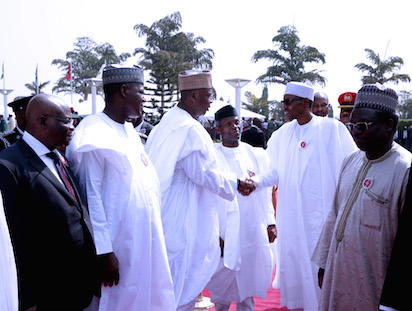
President Muhammadu Buhari, Vice President Yemi Osinbajo, President of the Senate, Dr Bukola Saraki, Speaker RT Hon Yakubu Dogara and Acting Chief Justice of Nigeria, Hon Justice Walter Onnoghen on arrival for the Wreath Laying ceremony of 2017 Armed Forces Remembrance Day at the Arcade in Abuja.
By Denere Animasaun
“He who controls the past controls the future. He who controls the present controls the past.” — George Orwell, 1984
I have come to accept to take any news from Nigeria with a pinch of salt. I no longer take it seriously or accept it as gospel, especially stories that are directly from Nigeria. So when I read a story earlier this week, I called my father to confirm the validity of the story, he told me that the story has been disproved. It seemed that it was the handiwork of some mischievous miscreants who, have nothing better to do but spread misinformation for their churlish and childish perverted delight. Of course, they do not care how their doom and gloom news affect the people. For them they have achieved their aim by causing distress and chaos. It is ironic, that I no longer believe the stories peddled as facts from Nigeria unless I check and recheck the source.
This is the year of false news, misinformation and gaslighting, and it is shocking how quickly some gullible people quickly jump at the earliest whiff of information, jump to conclusions based on these lies, failing to dismiss anything that insults their intelligence. Their brand of alternative facts is dividing the country, creating paranoid and suspicious citizens with their divisive propaganda. Having said that, it seems that most people believe lies than the truth, and they have been fed alternative facts and misinformation for far too long. Common-sense seems to have left our shores and it is a sad state of play.
Yahya has left the Gambia
It is commendable how the African nations came together with the people of Gambian for the peaceful exit of former Gambian president Yahya Jammeh. They averted bloodshed and a despot’s wish to hang on to power, even when he lost the people’s mandate. Of course, the international press under-reported how remarkable it was managed by the ECOWAS.Africa can and will manage its affairs if they are united and this was one case in point.
Nigeria’s enemy is the Nigerian
The conversations with my mother always head towards the costs of living, escalating costs of foodstuff and, lately the costs of foodstuff is what we talk about. This is very serious. People can not afford to buy staple items and it does not make sense in a country that is lush and green. On paper it should be able to feed its people and trade its surplus with surrounding countries. But for far too long successive governments have depended on oil and failed to invest in agriculture and affiliated infrastructure to enable the country to be self-reliant and thrive. Some years ago, parents reportedly fed their family twice a day, one can only guess how much more difficult they provide regular meals for the family in light of the price hike many families are having to go without.
My mother tells me that the cost of Gari has increased by 100% since last week so has Rice, onions, vegetable oil, beans and ogbono. Petrol is N145 per litre, kerosene, N320 a bottle. Then there is the meat, fish or chicken, which is now out of reach of many people’s diet. They say we are what we eat, you may want to question then how are people getting sustenance from an ever decreasing food choice. All this has a devasting impact on the health of the people, malnutrition, opportunistic health related diseases and mortality rate. The UN reviewed the poverty line for Nigeria which has dropped from $1.25 per day to $1.90 per day and it continues to worsen by the rising costs of living and declining purchasing power in the country.
The standard of living, according to the World Bank, most Nigerians’ real income has dropped over the past twelve months with the massive fall in the value of the naira and rising unemployment. Most households have tightened their belts that there are no more areas to cut costs. It is a dire situation and for a lot there seems no way out. First time, there are increase cases of people committing suicide because of their financial difficulties. This is disturbing, it is a sign of desperation and it should be taken seriously.
My father who is brutally honest admitted that his generation had a part to play in the demise of the current Nigerian situation. That is big coming from my father but I expect no less from a man, given the title’ Sotofaiye of Ayede- Ekiti. My father is very concerned about the present situation and is not as optimistic as he once was.
Nigerians are their own enemy, there is no need for the shortage and extortionate prices but most Nigerians hoard food, creates artificial scarcity and they rather maximise their profits, rather than make resources available. There should be enough food to feed every man, woman and child if not for the overwhelming greed. Despite price setting, traders continue to hoard products, transporters raise the price of travel then, in turn, passed on to the consumer, who has not been paid for months, the students are off university for months, the landlord has not been paid, he cannot send his children to school and schools cannot afford to pay their staff, and staff cannot afford to feed their children nor send them to school.
Of course, there is the big issue of corruption which greases all aspects of the Nigerian life and Nigeria has never had it so bad. It ranks 136th among 167 nations on the “perceptions of corruption” index compiled by the advocacy group Transparency International, with first being least corrupt (Denmark) and 167th the worst (a tie between Somalia and North Korea). The World Bank survey in 2014 found that 55% of firms in Nigeria expected to pay bribes or give gifts to bureaucrats or politicians and others to “get things done,” more than double the average in sub-Saharan Africa. Forty-five percent said corruption was “a major constant.” Until corruption is tackled it will continue to be the main obstacle in getting people out of poverty. So for all those, wanting change, can they first start by changing themselves too.
“Let him who would move the world first move himself.” Socrates
Some have blamed the present government for the recession because of its anti-corruption drive. The bigger picture is that Nigeria has depended on oil for so long and it failed to diversify when it was raking in the oil and with the decline of the price of oil, it continues to spend money at the same rate. The economy shrank more than 3% in the second quarter of 2016 alone and yet, it spends $4.4 billion a year on civil service salaries, 40% of all spending and it is unsustainable. Time for the government to take the initiative, and set up a programme to make food cheaper and available as soon as possible. The change definitely begins with each Nigerian and if we can all start with a new mindset, together we can make the changes .
Adieu Buchi
Adieu, Madam Buchi Emacheta, who died this week in London, aged 72. She was an incredible writer and role model to many across the world.
Buchi Emecheta, born to Igbo parents in Lagos on 21 July 1944. Dr. Buchi Emecheta was a prolific novelist who has published over 20 books, plays and shorts stories including Second-Class Citizen, The Bride price, The Slave Girl and The Joy of Motherhood. She said; “I grew up hearing these stories. Then, when I got married, my mother-in-law told me stories. Her own children would not listen, but I listened”. She moved to Britain in 1960, where she worked as a librarian and became a student at London University in 1970, reading Sociology. She worked as a community worker in Camden, North London, between 1976 and 1978. In 1983 she was selected as one of twenty ‘Best of Young British Writers’ by the Book Marketing Council. She lectured in the United States throughout 1979 as visiting Professor at a number of universities and returned to Nigeria in 1980 as Senior Research Fellow and visiting Professor of English at the University of Calabar. Buchi Emecheta also wrote several novels for children, including Nowhere to play (1980) and Moonlight Bride (1980). She published a volume of autobiography, Head above Water, in 1986. Her television play, A Kind of Marriage, was first screened by the BBC in 1976. Buchi was made an Order of the British Empire (OBE) in 2005. She played an active role in and was a member of the Home Secretary’s Advisory Council on Race in the UK, where she lived.
I remember picking up Second Class Citizen and enthralled and blown away by the first-hand depiction of survival against adversities. Every page was like experiencing the struggle and sharing the eventual joy and triumphs overcoming all the obstacles. She said, ‘Then I showed it to my husband and he burned it. He just burned the book. So I had to start all over again. I started really writing when I left him. She did not shy away from telling it as it is. Not many African women were brave enough to go it alone; she never gave up or gives in, her steely determination paved way for many to follow.
She said;”I believe it is important to speak to your readers in person… to enable people to have a whole picture of me; I have to both write and speak. I view my role as writer and also as the oral communicator.” –
I admired her honest depiction of child slavery, motherhood, female independence, breaking through and gaining her independence by dogged determination to be educated. This found resonance with the readers; it brought hope and courage. She won world critical acclaim and awards. “That’s why I say education is important. Get yourself educated and you can emancipate yourself from any kind of slavery. Education is freedom”. Emecheta died this week.
Disclaimer
Comments expressed here do not reflect the opinions of Vanguard newspapers or any employee thereof.