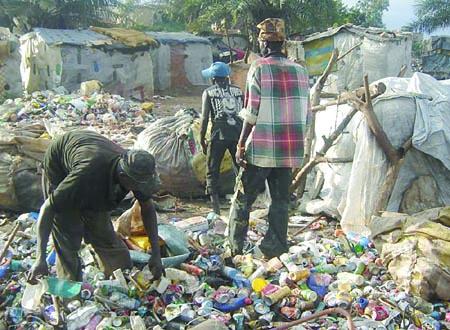
Vestiges of poverty, feeding from the waste dump
By Kingsley Adegboye
Nigeria’s quest to achieve the Sustainable Development Goals (SDGs) by 2030 could become an exercise in futility if the country remains reluctant to implement strategies, practices and processes that will enable it effectively manage its rising waste level. This is the submission of facilities management and waste management experts who gathered at the just concluded National Waste Management conference in Lagos.

Waste by the road side
Leading others in their submissions, Femi Akintunde, an engineer and Group Managing Director, Alpha Mead Facilities, said the country needs to rethink its strategy with keen attention to developing a holistic waste management plan, encouraging Public Private Partnership (PPP) in the sector and aligning current actions with the principle of waste hierarchy, which thrives on the principles of reduction, re-use, recycling and disposal in its quest to achieve the sustainable development goals by 2030.
In his paper entitled “Achieving Sustainable Development through Effective Waste Management Strategy and Practices in Nigeria”, Akintunde pointed out that with the exception of Lagos which has recorded appreciable success in managing it’s over 10,000 tons of urban waste daily, most states currently grapple with two major challenges: Inadequate capacity to cope with the upsurge in the volume of generated waste and the lack of thorough implementation and enforcement strategy of necessary regulations.
Expressing concern over the country’s pace in articulating an inclusive waste management plan, he noted that the current trend which Akinwale Aboyade described as “Waste rising in a geometrical progression while, collection and disposal at arithmetical progression” is a threat to achieving the SDGs which are just few years away.
Corroborating Akintunde’s submission, Mrs. Morris Atoki, Manager, Sustainability and Climate, PricewaterhouseCoopers (PwC), listed other challenges scuttling the country’s waste management value chain to include; lack of modern technology, policy formulation/strategy implementation, lack of skilled professionals, monitoring and control among others.
These limitations she believes can be tackled if the fundamentals of effective Waste management is examined and the approach to a greener environment becomes more strategic.
For Ola Oresanya, Managing Director, Globetech Ramedial Nigeria Limited, environmental degradation and infrastructural decay are part of the many challenges of Sustainable development with waste management being a visible index for performance of urban administration.
“Effective Waste management is the first sign of a sustainable city,” Oresanya said, adding that the task of urban waste management centers include street sweeping, refuse storage, refuse collection, transportation, emerging waste services, resource recovery, revenue generation, disposal, monitoring and evaluation.
Disclaimer
Comments expressed here do not reflect the opinions of Vanguard newspapers or any employee thereof.