Naira depreciation
By Babajide Komolafe
Prices of federal government bonds (FGN Bonds) fell for the second consecutive week in the secondary market due to sell pressure triggered by over supply. Money market sources told Vanguard that the sell pressure in the secondary market was due to banks and investors trying to diversify away from FGN Bonds to treasury bills to take advantage of the higher interest rate (yields) on secondary market for treasury bills.
Financial Vanguard investigations also reveal that some of the sell pressures were as a result of banks trying to raise liquidity to fund their subscription for the FGN Bonds offered by the Debt Management Office (DMO) last week.
On Wednesday the DMO offered N130 billion FGN Bonds but sold N214 billion due to 80 percent oversubscription, as investors demanded for N235.05 billion.

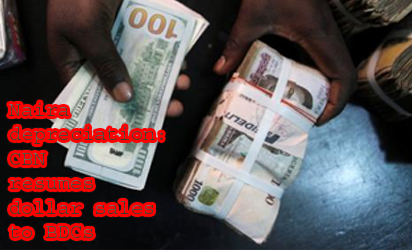
ATM-Naira-and-Dollar
According to a senior bank treasurer, the outcome of the bond auction was surprising to the market especially the coupon rates of 16.99 percent on the bonds. He said some of the people that submitted bids did not expect their bids to be successful due to the high rate quoted and hence did not prepare the liquidity to fund the bids. Thus when the result of the auction were released, some of them resorted to sell down their secondary market bonds holdings to raise the necessary liquidity.
According to Cowry Assets Management Limited, a Lagos based investment firm, FGN bond and Nigeria’s Eurobond recorded decline in prices during the week. In its weekly review of financial markets, the company stated: “In the just concluded week FGNbonds traded at the OTC segment depreciated in value amid sustained bear pressure.
The20-year,10.00 percent FGN July 2030 debt, the 10-year, 16.39 percentFGN JAN 2022 debt and the 7-year 16.00 percent FGN JUN 2019 debt depreciated by N0.69,N0.57 and N0.35 respectively; theircorresponding yields rose to 16.49 percent (from16.30 percent),16.67 percent (from16.41 percent)and16.54 percent (from 16.37 percent) respectively.
However, the 5-year,15.10 percent FGNAPR 2017 debt appreciated byN0.04; its corresponding yield fell to 14.61 percent (from 14.82 percent). Meanwhile, the Debt Management Office issued Federal Government bonds worth N214.95 billion, viz: 5-year, 14.50 percent FGN JUL 2021 paper worth N34.95 billion (SR increased to 16.89 percent from 15.99 percent), 10-year, 12.50 FGN JAN 2026 bond worth N74.90 billion (SR increased to 16.99 percent from 16.24 percent) and 20-year, 12.40 percent FGNMAR 2036 debt worth N105.1billion (SR increased to 16.99 percent from16.4348 percent).
Elsewhere, FGN Eurobond straded on the London Stock Exchang edecre as edinvalueacrossall maturities amid sell pressure. The10-year, 6.75 percent JAN 28,202 1bond, the5-year, 5.13 percent JUL 12,2018 bond and the 10-year year. 38 percent JUL12,2023 bond lost $0.49(yieldrose to 5.88 percent),$0.24(yieldroseto3.62 percent)and$0.52(yieldrose to 6.53 percent)respectively. This week, weexpect amixof bargain hunting and profit taking at the OTC bond market.”
External reserves rise to $27.44bn
Meanwhile the nation’s external reserve rose further last week to $27.44 billion on Thursday, indicating $470 million increase when compared to the previous week level of $26.97 billion. Consequently, the external reserve has gained $1.6 billion since the beginning of the year.
According to analysts at Financial Derivatives Company, the increase in external reserve will persist throughout the month. They stated, “External reserves are currently at an 8-month high of $27.22bn on January 16th, a 4.3 percent ($1.13 billion) gain from the opening level of $26.09 billion on January 3rd. The level of net reserves is significantly lower than published reports. The external reserves level is 5.91 percent lower than 2016’s peak of $28.93bn and 30.74 percent below 2015’s peak of $34.51 billion.
External reserves have been on the increase since October 21st. This trend is expected towards the end of January as forex inflows gradually gain momentum. Risks to this include stalled or disappointing borrowing plans and further disruptions to Nigeria’s oil production.”
MPC to maintain status quo
Analysts have predicted that the Monetary Policy Committee (MPC) meeting today and tomorrow will retain the Monetary Policy Rate (MPC) at 14 per cent.
“Despite the instability in macroeconomic variables, we do not expect a tweak in policy rates next week given the limited scope for easing or tightening and reluctance of the central bank to shift FX rate peg. However, subsequent meetings from March will be decisive as base-effect set in from February to moderate Inflation rate, testing the resolve of the CBN to abide by the inflation-targeting thrust it committed to in 2016,” said Afrinvest analysts in the company’s weekly review of financial markets.
FDC analysts also said: “We do not expect the Monetary Policy Committee to make any significant adjustments to rates in its meeting this month.”
Analysts at Cowry Assets similarly projected that: “Inthemonetary sector, ahead of the Central Bank of Nigeria’s monetary policy committee meeting scheduled for Monday 23 and Tuesday 24, January 2017, weanticipateretention of the monetary policyrate (MPC) at 14 percent, Cash Reserve Ratio Requirement at 22.5 percent and Liquidity Ratio at 30.00 percent based on well known positio nof the Central Bank Governor to focus on reining in inflation as well as attract foreign port folio in flows with high interestrates.”
Disclaimer
Comments expressed here do not reflect the opinions of Vanguard newspapers or any employee thereof.