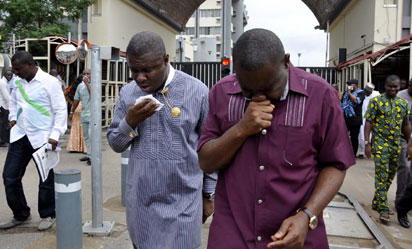
PROTEST: Rivers State All Progressives Congress, APC, governorship candidate, Dakuku Peterside (left) and APC South East Senatorial candidate, Sen. Magnus Abe, gasping for breath after they and other Rivers State APC candidates were tear gassed at the gate of INEC head office, during a protest to the INEC National Chairman in Abuja, yesterday.
By Erezi Efeunu
A single breath into a newfangled breathalyser is all doctors need to diagnose 17 different diseases, including lung cancer, irritable bowel syndrome and multiple sclerosis, a new study found.
Researchers invited about 1,400 people from five different countries to breathe into the device, which is still in its testing phases.
The breathalyser could identify each person’s disease with 86 percent accuracy, the researchers said in a publication on LiveScience.
The technology works because “each disease has its own unique breathprint,” the researchers wrote in the study.
The breathalyser analyzes microscopic compounds — called volatile organic compounds (VOCs) — to detect each condition.
To investigate using breath for diagnosis, the researchers developed a breathalyser that had two nanolayers, one with carbon and the other without. The carbon-free layer contained modified gold nanoparticles and a network of nanotubes, both of which provide electrical conductivity, the researchers said.
Once the breathalyser was built, researchers administered it to 813 people who were diagnosed with one of the 17 diseases, as well as 591 controls. These were people from the same locations who did not have those diseases.
Next, the scientists used artificial intelligence to tally up the VOCs in each breath, search a database for diseases showing the same VOC concentration patterns and deliver a diagnosis.
Researchers took breath samples from about 1,400 people from five different countries, and tested them for 17 different diseases with a breathalyzer-like device. Then, they verified the results using another method, called GC-MS. The new breathalyzer isn’t ready for the market yet — further testing and better accuracy are needed first — but the study is an encouraging development, the researchers said.
Disclaimer
Comments expressed here do not reflect the opinions of Vanguard newspapers or any employee thereof.