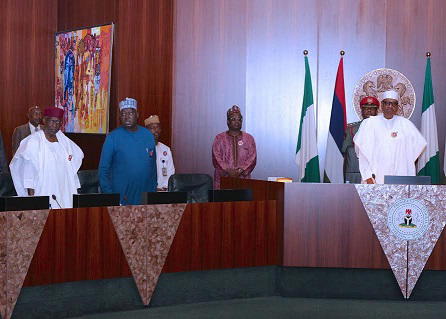
PRESIDENT BUHARI PRESIDES OVER FEC MEETING 1. R; President Muhammadu Buhari, SCOP Ambassador Lawal Kazaure, SGF, Engr Babachir David Lawal and Chief of Staff, Mallam Abba Kyari as President presides first 2017 FEC Meeting at the Council Chambers, Presidential Villa Abuja.
By Ochereome Nnanna
THERE is an old adage that says: “when the cat’s away, the rats play”. Whenever you hear stories of cabals developing around a leader or powerful offices such as our Presidency, there is a power vacuum. Nature – and politics – abhor vacuum.
The last time we experienced a power vacuum was when the late President Umaru Yar’ Adua fell sick late in 2009. A cabal, mainly from his home Katsina axis coalesced under the quiet leadership of the President’s wife, Turai. They took over the Presidency, hiding information about the true state of health of our President, even when he was returned to Aso Villa from his elite Saudi hospital ward.
It was not only the nation that was kept in the dark: the then Vice President, Dr. Goodluck Ebele Jonathan, was not allowed to see his boss or know what was happening. The objective of the cabal was to continue to hold on to power for as long as Yar’ Adua remained alive. However, the media uproar created over the strange turn of events led the National Assembly with Senator David Mark as its Chairman to invoke an extra-constitutional “doctrine of necessity” to transfer power to Jonathan when it was clear that Yar’ Adua had become irretrievably incapacitated.
In today’s case, however, there are several evidences of a power vacuum, even though President Muhammadu Buhari seems hale and hearty. At the official age of 74, he belongs to the average age bracket of many African presidents. After all, the late Dr. Nnamdi Azikiwe contested for the presidency in 1983 at the age of 79.
Moreover, Buhari has drastically scaled down his frequent foreign travels, and he is not known to hop around the country that much. Added to that, he has not been too frequently reported indisposed health-wise. The last I heard he travelled abroad for medical attention was in June, 2016. Therefore, Buhari is available and should be fully in charge of his government, especially the Presidency. So, why should there be a power vacuum? Or, what makes us think there is a power vacuum?
First of all, his wife, Hajiya Aisha Buhari, said so. She chose to break the news to the BBC, perhaps for maximum impact (you know how these our rulers value foreign media more than the local ones, even their own NTA and Radio Nigeria). She said up to 60 per cent of Buhari’s appointees were not known to him, or her, his wife of 27 years standing.
Up till today, Buhari has not fully constituted the Federal Government. Contrast this with Mrs. Theresa May, the UK Premier, who had her government in place within a few days, even though her appointment as Prime Minister came unexpectedly. Also, the US President-elect, Donald Trump, has most of his cabinet in place, more than two weeks to his inauguration.
Another evidence of power vacuum (and therefore power struggle within his kitchen cabinet for the upper hand) showed up when, early in December 2016, the name of the Acting Chairman of the Economic and Financial Crimes Commission, EFCC, Ibrahim Mustapha Magu, was sent to the Senate for confirmation. Usually, you would expect a President to conduct a meticulous security check on his appointee to mann a post so central to the declared mission of his government: war against corruption. Before sending Magu’s name for confirmation, another check should have been conducted to ensure he had not soiled his fingers during the days he had been in office. The objectives of these checks would two-fold: to ensure that the person carrying out this job is clean, and to avoid embarrassment for the President when the Legislature conducts the confirmation screening.
But what did we find? Magu’s nomination was rejected by the Senate because, according to their spokesman, the State Security Services, SSS, sent in a report that Magu allegedly had an unwholesome record, both as a police officer and Acting Chairman of EFCC!
Now, when you look at the structure of the Presidency, Magu reports directly to the President, though administratively, the Office of the Attorney General of the Federation, OAGF, exerts supervisory authority over aspects of the EFCC’s work. The OAGF also reports to the President, so does the Director General of the SSS. A President who is fully in charge would not suffer the embarrassment that the SSS subjected Magu to, which suggests a serious power tussle within the Presidency. When a leader’s core henchmen take their bickering public to the point of embarrassing the leader, something must give. Yet, nothing has given. All that Buhari did in reaction to this embarrassment was to ask the Attorney General to “investigate” the SSS’s report.
We are waiting to see if the AGF will discredit or confirm the SSS report. Either way, Buhari will lose face, as an effective leader.
My opinion, taking into account what I have gleaned from the leadership style of Muhammadu Buhari from 1984 till date, is that he is cut out for ceremonial presidency. If the Nigerian political system had a Prime Minister to run the government (especially the economy) while Buhari controls the Armed Forces, attends conferences to deliver speeches, sign treaties and wave to crowds, he would have fitted in very well.
But we have a system where the buck stops at the President’s desk. In Buhari’s case, when the buck comes he passes it to his appointees, then sits back and expects them to deliver without exercising keen supervision to ensure they are doing so. Even when reports come that they are not doing so, you don’t see that spark of decisive reaction. You get this impression that there are aspects of fighting corruption and securing Nigeria he is interested in and others he is not bothered with.
2017 is the last opportunity President Buhari has to wake up lead “from the front”. How he goes about it is his business, but he will account for it.
Disclaimer
Comments expressed here do not reflect the opinions of Vanguard newspapers or any employee thereof.