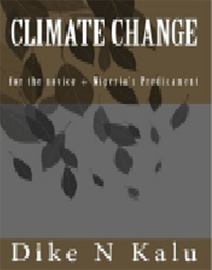
By JAPHET ALAKAM- REVIEW
One of the most discussed issues in the entire earth is the issue of climate change/global warming and its devastating impact on the existence of human beings.
The term ‘climate change’ today is generally used when referring to the change in our climate which has been observed since the early part of the 20th century.
The term is not new, there have been many publications/seminar papers to that effect and many scholars/writers have written about it and its devastating effects. But, the ugly side of it is that despite all the awareness created so far about it, many do not still know more about it especially in developing countries. What is Climate change/global warming, how does it occur, what are the effects and how can it be checked? These and other issues are what Prof. Dike N. Kalu, whose main interest is to make his audience especially in the developing countries as well-informed as possible about the events that affect their lives and well being diagnosed in his new book entitled Climate change, for the novice + Nigeria’s predicament.
The University of Texas Health Science Center professor Emeritus in the 121 page book discusses the role of fossil fuels in climate change, the latter’s global nature, its deleterious consequences and the heightened vulnerability of developing countries to its undesirable outcomes.

Climate change, for the novice + Nigeria’s Predicament; Dike N. Kalu, USA, Charleston, SC, 2016; PP.121.
The author begins with introduction where he gave a lecture to students about the meaning of climate change or global warming and due to the great interest the lecture generated, he decided to write the book for his adopted students in Nigeria and other areas.
The author in chapter one of the eight chapters book discusses the meaning of global warming/climate change and why people should be concerned that planet earth is getting warmer. He highlights the need to check the continued rise in temperature, the weather, climate and climate change, also what education can do to arrest the situation.
Chapter two takes care of the causes of global warming and climate change which he attributes to natural and human causes. Also he states the view of the skeptics and deniers, who he claims oppose the concept of greenhouses as the primary cause of climate change.
In chapter three, the author educates the readers about greenhouse effect. Here, he explains what greenhouse gases areand looks at the two component effects of greenhouse and the other components like carbon dioxide, methane, nitrous oxide, water vapour, ozone and the F-gases.
Chapter takes a comprehensive analysis of the impacts of climate change, with a table of the European Union Commission findings on the effects in various localities. While, the next chapter takes a look at climate change in developing countries. In it he brings to the fore the reasons why developing countries are prone to deleterious consequences of climate change. They depend heavily on their natural environment for sustenance, live in unplanned dwelling areas, economically disadvantaged and do not have infrastructures and technology to respond to such natural disasters etc.
In chapter six, the learned author takes the readers to what can be done to about climate change. He posits that it is a global problem that requires a global unified effort to counter, as such every developing country must invest in its disaster program. He mentioned two main approaches, the adaptation method, which involves protecting the people and the environment from the adverse consequences and mitigation approach, which involves attempt to slow its progress by eliminating greenhouse gases from the environment. The individual challenges and what they will do to help fight against it. Chapter seven takes a holistic look at the search for alternative energy sources that will replace the offending fossil fuels with alternative clean energy sources and the potential impact of such change when the world moves completely to clean energy.
Finally, in chapter eight, which is a bonus chapter specially for Nigeria’s predicament, the author , who incidentally is a Nigerian and understands her problem assembled here in a concise and easy way the relevant information required by a novice to appreciate climate change issues.
Written in simple and understandable language for easy reading. Prof Dike has through this book provided a unique and invaluable resource material for all especially students who want to know more about climate change.
Disclaimer
Comments expressed here do not reflect the opinions of Vanguard newspapers or any employee thereof.