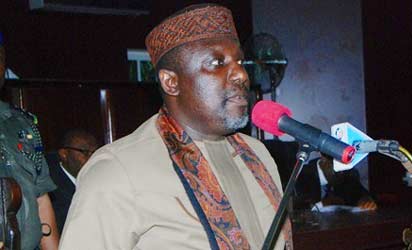
Gov Rochas Okorocha
By Chidi Nkwopara
There is no doubt that Governor Rochas Okorocha was a direct beneficiary of the face off between the Catholic Church and Chief Ikedi Ohakim, ahead of the 2011 general elections.
The news that rented the air at that time was the alleged manhandling of a Catholic priest, Rev. Fr. Eustace Okorie, by Ohakim. Truth is that all efforts made by Ohakim to prove that he neither touched, saw nor ordered the arrest and torture of the priest, fell on deaf ears.
As expected, Christians from all denominations joined the fray. The mantra of the All Progressives Grand Alliance, APGA, and the refrain that “the man who assaulted a priest can never rule Imo again”, gained currency.

Gov Okorocha of Imo State
The ultimate result was that Okorocha effortlessly smiled to Douglas House, while the “offending Ohakim” was denied a second term in office.
It would be recalled that the Justice, Development and Peace Commission, JDPC, of the Catholic Ecclesiastical Province of Owerri created a forum at Odenigbo Pavilion of Maria Assumpta Cathedral, Owerri, where all the gubernatorial aspirants were given the opportunity to market themselves.
Ohakim was booed, jeered and even insulted openly, all because of Rev. Fr. Okorie, while Okorocha was endlessly applauded throughout the outing.
Four years after, the JDPC floated a similar forum for all governorship aspirants. The likes of Chief Emeka Ihedioha, Captain Emmanuel Iheanacho and others were quietly sitted for the event to take off, when suddenly, identifiable government functionaries and their thugs stormed the place and turned everything upside down. The outing failed.
For the very critical watchers of political governance in the state, one thing led to the other and the crater started growing into a gulf.
Then came the day when the Nigerian Society of Engineers floated the maiden issue of the annual lecture series for one of their own and chieftain of the Peoples Democratic Party, PDP, Chief Emmanuel Iwuanyanwu, in Owerri.
A lot of people from within and outside Imo State, including Archbishop Anthony J. V. Obinna, and the host governor, Chief Rochas Okorocha, were invited to the event.
It was not clear, even as it still is now, why the organizers preferred inviting Archbishop Obinna, to say the opening prayer, out of the many clerics from different Christian persuasions.
In the course of the prayer, Obinna passionately appealed to God, to touch and soften the Governor’s heart, and make him see reason to pay workers and pensioners their earned salaries and pensions.
While the prayer attracted a deafening applause from the crowd, Governor Okorocha was not amused by it. He fired back at the Archbishop when it was time for him to make a speech.
Okorocha accused the Archbishop of dabbling into politics instead of keeping strictly to his religious calling.
Although the Governor failed to explain how and why he summarily concluded that the cleric had gone deep into politics, the Governor however accused the Archbishop of inciting the citizenry through his political prayers.
Journalists only realized that Okorocha was not joking about the darts he fired at the Archbishop a few days earlier, when he repeated the canon shots when he addressed the press in his sprawling Spibat Road mansion.
Okorocha said: “The Archbishop once confirmed to me that he is an APGA loyalist. I advice him to distance himself from partisan politics. The Archbishop is getting too deep into partisan politics”.
Obviously making a surreptitious reference to the event of the Iwuanyanwu lecture, Okorocha said that the cleric had no business asking government to pay pensions and workers salaries, when he was called to say the opening prayer.
He went further to say that priests would be jobless if people refrain from sin and pay their tithes.
“I advice Archbishop Obinna to imbibe the habit of praying for the government and people in authority, instead of saying inciting prayers,” Okorocha said.
ARCHBISHOP REACTS
When South East Voice approached the cleric for his comment on the Governor’s allegations, he appealed to Okorocha to govern with human face, especially as he cannot keep quiet in the face of palpable maladministration and suffering of the citizenry.
“Will it amount to partisan politics if I ask government to pay workers their earned salaries and allowances? How can I shut up when pensioners are senselessly dying as a result of non-payment of their pension and gratuity? If the Governor wants me to stop criticizing and exposing his observable flaws, he should please learn to do the right things”, Archbishop Obinna said.
Making particular reference to the plight of Imo pensioners, the cleric said: “It is most baffling that the Governor wants to pay a paltry 40 percent of their legitimate pension and expect all of us to remain quiet in the face of this glaring injustice to humanity”.
Answering another question, the cleric said that the humanity in him would lose meaning if he fails to speak for the voiceless, hapless, helpless, sick and hungry citizens.
“Has the Governor spotted me in any political meeting? I am entitled to cast a single vote in an election. Voting for a candidate of my choice cannot make me a party faithful,” he said.
While challenging Okorocha to publish any political party document that bears his (Obinna) name, the Archbishop said that the Governor is angry that he refused to embrace the All Progressives Congress, APC.
He described the projects going on in Owerri as “impressionistic”, adding that although the quality of the jobs are something else, there was no reason why they should only be sited where the eyes can see.
“A trip to the rural communities leaves a candid impression of decay, abandonment, neglect and suffering. If that makes me a partisan politician, so be it”, the Archbishop said.
PEOPLE REACT
Meanwhile, angry reactions have started trailing the bashing of Archbishop Obinna by Governor Okorocha.
A devout Anglican, Mr. Amanze Oparaugo said that “the Governor has no justifiable reason to insult the Catholic Archbishop the way he did”.
According to Oparaugo, “Archbishop Obinna has over the years, been the voice of the voiceless majority in the state.”
It was the considered opinion of Mr. Oparaugo that Governor Okorocha does not have the capacity to gag or insult an anointed man of God, stressing that by opening his mouth to pour invectives and venom on the respected cleric, Okorocha has not only misfired, but has also failed woefully in the fight against Christianity.
“What the Archbishop said about unpaid salaries and pensions was spirit-led. Would the Archbishop have complained if the state government was paying these statutory bills on time? That is what the Governor should have addressed instead of going to the gutter level of insulting the cleric,” Oparaugo reasoned.
Continuing, the Anglican faithful said that the Governor cannot direct that level of insult to an Imam or Muslim leader.
“Okorocha should thank his stars that the cleric and Catholics are not prone to violence. This state would have been on fire since the Governor made those unguarded statements”, Oparaugo said.
In his own reaction, a retiree, Chief Donald Ekenta said that he will never sign the document Okorocha is forcing down the throat of pensioners.
“How can I sign a document that compels me to dash 60 percent of my pension to the government? I am prepared to wait till 2019, when hopefully, a more humane government will come into office,” Chief Ekenta said.
He was particularly irked that the cleric’s “sin” was his quest for fair treatment for retirees and Imo workers.
“The Archbishop cannot join the silent majority within the clerical family, who have failed to condemn the wrongs of government. The Governor should please retrace his locus and beg the cleric”, Ekenta said.
He reminded the Governor that “in Igbo custom and tradition, age is highly respected and one wonders if Chief Okorocha has discarded this ageless custom and tradition”.
Disclaimer
Comments expressed here do not reflect the opinions of Vanguard newspapers or any employee thereof.