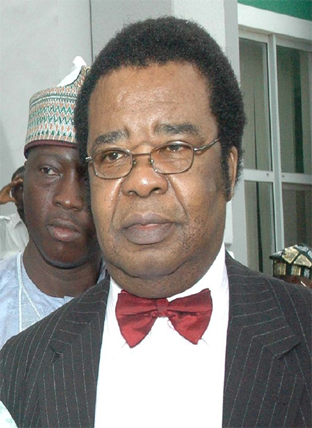
•Professor Bolaji Akinyemi
By Bolaji Akinyemi
A former External Affairs Minister, Professor Bolaji Akinyemi, says Nigeria must address the issue of structural instability. Akinyemi spoke, last month, while delivering the 2016 Convocation Lecture of the University of Ibadan. Extracts from the lecture:
That FESTAC was not just a cultural event simplicter was propagated by the Arts people themselves. Writing in 1981 in the SURVEY OF NIGERIAN AFFAIRS, 1976-77, Femi Osofisan, a major participant at the Festival, wrote an article, titled “FESTAC AND THE HERITAGE OF AMBIGUITY” in which he commented as follows “secondly, there was also in the choice of Nigeria as host a tacit recognition of the country’s symbolic role as the ancestral home of the blacks in diaspora… thus, for the blacks outside, coming to Nigeria was like a pilgrimage back through history and suffering to the replenishing fountains of their and our ancestry”. Ola Balogun, another participant at the FESTIVAL, delivered a lecture at the Nigerian Institute of International Affairs in 1986 titled “CULTURAL POLICIES AS AN INSTRUMENT OF EXTERNAL IMAGE-BUILDING: A BLUEPRINT FOR NIGERIA.”
In it, Balogun commented “in other words, given our country’s large population, our internal dynamism, and our considerable economic and military potential, Nigeria will inevitably have to assume the role of Black Africa’s leading nation. It is also quite obvious that Nigeria’s potential leadership role in Africa is not only a duty that we owe to the rest of Africa and to the black race in general, but also a natural prolongation of our own quest for a coherent national outlook.”
Edem Kodjo, a former Secretary-General of the Organisation of African Unity, who later became the Prime Minister of Togo, put it eloquently thus, “This strong Africa…must be powerful Africa. I mean militarily powerful. We should not fall into the angelism in a world where power mongers are equally military. Africa cannot make the economy of a modern army at the service of a brighter diplomacy. This does not mean warmongering.
On the contrary, it is in Africa’s interest that peace reigns in the world. But she must learn to walk on her two legs, and the more she progresses economically, the more she develops militarily…though I am not a Nigerian, I believe in the fundamental role of Nigeria in building a united Africa. I have been saying it over the years and I am getting furious that Nigeria is not totally assuming the role which should be hers ever since…There should be ‘federatingfactors’: countries with a dense geopolitical mass and an acceptable economic power who will take upon themselves to achieve, by federating gestures, the unity of our continent… Nigeria is indisputably one of these countries, if not the only one.”
The latest exposition is to be found in “NIGERIA AND THE FUTURE OF THE BLACK WORLD” by Ambassador Walter Carrington The words of the title say it all. Embedded in his lecture was an unstated disappointment with the state of Nigerian exceptionalism, given that his conclusions were based on the hope driven by GDP projections which showed Nigeria growing from no. 20 in 2014 to no. 9 in the world in 2050. Such projections prepared by PriceWaterCooper House showed an incredible faith in Nigerian future.
I delivered a lecture in February 2005, under the auspices of the Centre for Black and African Arts and Civilisation, titled “NIGERIA: THE BLACK MAN’S BURDEN”, where I dealt with this phenomenon in an inverted manner. I will return to this issue later.

•Professor Bolaji Akinyemi
Maybe it is not really very important but to lay the issue of whether the Nigerian exceptionalist syndrome is authoctonous or not, I would like to draw attention to the fact that there were Nigerians who felt the syndrome should be used to enhance the status of the black race as shown by the views which a former President of Nigeria, Chief Olusegun Obasanjo ascribed to Major Chukwuma Kaduna Nzeogwu, that enigmatic figure of January 15, 1966. in his seminal book simply titled “NZEOGWU”, Obasanjo wrote:
“ Chukwuma had a dream of a great Nigeria that is a force to reckon with in the world, not through ineffective political rhetoric but through purposeful and effective action…He dreamt of a nation where social justice and the economic interest of its citizens will not be subjugated to foreign control and manipulation. He believed in the ability of the Blackman…. Chukwuma, as had been pointed out, was a well read individual. He was familiar with Marx, Giap and Mustafa Kemal – the Attaturk.
He probably saw himself in the mould of the latter, a kind of Nigerian military hero on horseback, a moderniser, a nationalist, and a Nigerian bent on carving a niche for the Blackman in world history, an idealist who wanted to put the Blackman on the same pedestal as all other races. He saw Nigeria as pivotal to his dreams. In order for Nigeria to realise what seemed to him a divine if not self-evident mission, he had to clear the augean stable…”
Naturally, this is a loaded passage that one can fill a whole book deconstructing. The only two issues I wish to draw attention to are firstly, no one can accuse Nzeogwu of being a character that is subject to manipulation. Secondly, there is manifested here a recurrence of that theme of “manifest destiny” characterised here as “divine destiny”. Obviously, there is sufficient evidence here of a domestic fertile ground for a home grown philosophy of an exceptional Nigeria and its relationship to the emancipation of the Black race. This is not to imply that aspects of this philosophy did not only surface abroad but that attempts were made to transplant its overseas variant back into Nigeria.
The real question and the core of this lecture is to interrogate this concept of Nigerian exceptionalism as to whether it is an illusion or not. If it is an illusion, then Nigeria has been led up the garden path or has allowed itself to be led up the garden path into believing it could bat above its weight. But if it is not an illusion, has it achieved it, and if she has not, then where did it as a nation derail?
I have already presented the comparative statistics showing the relative positions of Nigeria, Ghana and Ethiopia at Nigerian independence. I have already drawn attention to the red carpet welcome Nigeria received from the international community at independence. The ink has hardly dried on the independence document before Nigeria was invited to send troops under United Nations command to the Congo. Not only did she do so, but General Thomas Aguiyi-Ironsi, the Nigerian contingent Commander, was later appointed the United Nations Commander for the Congo operations, the first African to be so honoured.
Following that precedent, Nigeria has taken part in peace-keeping and peace-enforcement operations in former Yugoslavia, Lebanon, India/Pakistan border, Darfour, etc
As far as national embrace of the exceptionalism syndrome is concerned, Nigeria sent troops to Tangayika to suppress an attempted coup detat. When President Sylvanus Olympio was overthrown in Togo, the Nigerian Foreign Minister, Jaja Wachukwu, declared that Nigerian border extended through the Republics of Benin and Togo right to the Ghanaian border.
In terms of enforcement action, Nigerian experience with the ECOMOG operations in Liberia and Sierra Leone, the former under the camouflage of ECOWAS, marked the unilateral projection of Nigerian military power into West Africa.
Nigerian programme of the Technical Aid Corps is the only scheme of its type in Africa, providing technical assistance to African, Caribbean and Pacific countries since 1987. Right from its inception in 1987, the scheme covered twelve countries which included Fiji and Jamaica, two distinct non-African countries. The following batch in 1990 expanded to fifteen countries with Dominica joining the list of non-African countries.
The following batch in 1992, saw Belize joining the list of non-African countries. The following batch in 1994 saw St. Kitts and Nevis joining the list of the non-African countries. As an average, non-African countries have been responsible for about a quarter of the yearly beneficiaries. Of course, General Yakubu Gowon was in fact the first Nigerian Head of State to go for a global reach when he offered to pay the salaries of civil servants in the West Indies. As the original designer of the Technical Aid Corps, let me state categorically here that Europe was also part of the target areas conceived in the original plan.
There are large black communities in European inner cities where the African history that is taught is a travesty of the real thing. In a slightly modified form, the Technical Aid Corps would have included a corps of African historians who would have been offered to educational authorities in the inner cities to teach African history – a reversal of the missionary flow of early years sent to evangelise Africa. Such countries as Brazil, Venezuala and Vietnam have expressed interest in participating in the scheme. At present, there are 1500 Nigerian volunteers serving in 32 countries.
Reviewing these actions in a speech delivered on October 19th 2004, to mark the celebration of the 70th birthday of General Yakubu Gowon, Professor Ali Mazrui reused the words “Pax Nigeriana” to describe leadership aspects of Nigerian Foreign Policy.
He, in fact, titled that section of his speech “Towards a Pax Nigeriana.” In fact, as far back as 1969, in the conclusion to my Doctor of Philosophy thesis at Oxford, I had used the very same words “Pax Nigeriana” to describe the adoption of Nigerian vision on Pan-Africanism in the charter of the Organisation of African Unity. Ali Mazrui argued his justification of the adoption of the concept thus “almost from independence, Nigeria’s exceptionalism included a potential leadership role to keep the peace in West Africa – a kind of Pax Nigeriana”.
POWER STATUS AND NIGERIAN EXCEPTIONALISM
The first issue to interrogate is whether Nigeria has the power status to underwrite an exceptional vision and mission. The power/realist school will still hold that Nigeria is still a regional power. I used the word “still” because as far back as 1982, I had titled my lecture at the Royal Institute of International Affairs in Brussels, “The Emergence of Nigeria as a Regional Power”. Her military prowess is still second to none in West Africa and presumably the fourth in Africa.
To be continued…
Disclaimer
Comments expressed here do not reflect the opinions of Vanguard newspapers or any employee thereof.