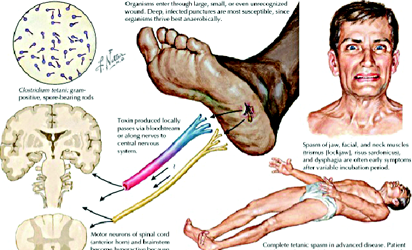
Tetanus is a disease you don’t want to experience at any cost. It is serious and often-fatal despite being vaccine preventable and non-infectious. By all means, tetanus is a natural predator that attacks directly and precisely. It lurks in hot, dirty, damp places, lying in wait, for the chance to infect someone, anyone. It gets to start an infection only when it finds a break in someone’s skin. The disease relentlessly attacks the nervous system of its victims, injecting deadly neurotoxins produced by Clostridium tetani, the tetanus bacteria).
Are you at risk?
Tetanus is common in Nigeria, with an average of 20-60 percent fatality among newborns and adults. Have you never been vaccinated against tetanus or are you one of those whose vaccine protection has worn off with time? Then you are definitely at its mercy. Nearly all cases of tetanus are among newborns, or people who have never received a tetanus vaccine, or adults who don’t stay up to date on their 10-year booster shots. Only immunised people are protected but only for 10 years at a stretch.
Target sites
Contaminated wounds are sites where tetanus bacteria multiply. Deep wounds or those with dead tissue are particularly prone to tetanus infection.
The tetanus bacteria can get into the body through broken skin, usually through injuries from contaminated objects. Certain breaks in the skin that are more likely to get infected with tetanus bacteria include wounds contaminated with dirt, faeces, or spit (saliva) and wounds caused by an object puncturing the skin, like a nail or needle (puncture wounds). Others are burns, crush injuries and injuries with dead tissue
Tetanus has also been linked to clean superficial wounds (when only the topmost layer of skin is scraped off), surgical procedures, insect and animal bites, dental infections, compound fractures (a break in the bone where it is exposed), chronic sores and infections, and intravenous drug use.
The incubation period – time from exposure to illness – is usually 3–21 days (average 10 days), although it may range from one day to several months, depending on the kind of wound. Most cases occur within 14 days. In general, shorter incubation periods are seen with more heavily contaminated wounds, more severe disease, and a worse outcome of the disease.
Tetanus toxin
When the tetanus bacteria invade the body, they produce a toxin (poison) that causes painful muscle contractions, or tightening of the muscles (spasms) usually all over the body. This tetanus toxin is extremely potent. It affects the interaction between the nerve and the muscle that it stimulates, specifically at the neuromuscular junction. It amplifies the chemical signal from the nerve to the muscle, which causes the muscles to tighten up in a continuous (“tetanic” or “tonic”) contraction or spasm, resulting in either localised or generalised muscular spasms powerful enough to break the victim’s bones.

Potential hazard
The infection can lead to “locking” of the muscles of the neck and jaw muscles making it hard to open the mouth or swallow. Another name for tetanus is “trismus” or “lockjaw” because it makes opening of the mouth or swallowing difficult or impossible. Tetanus can be very hazardous to both a mother and newborn child typically within the first two weeks after birth if there is a poor sanitation method in caring for the umbilical cord stump of the neonate. The toxin can affect neonates to cause muscle spasms, inability to nurse, and seizures. Tetanus suffocates and kills almost one-third of the people it infects. It is a universally recognised medical emergency that requires urgent and comprehensive treatment in a competent hospital.
Symptoms
Common symptoms of tetanus infection include headache, jaw cramping, and sudden, involuntary muscle tightening (often in the stomach). There is painful muscle stiffness all over the body, trouble swallowing, jerking or staring (seizures), fever and sweating, high blood pressure and fast heart rate. Complications include uncontrolled/involuntary muscular contraction of the vocal cords (laryngospasm) and break in the bone (fracture). Breathing difficulties from tetanus infection could possibly lead to death in 10-20 per cent of cases.
Diagnosis
Doctors can diagnose tetanus through examination of the patient and looking for specific signs and symptoms. There are no hospital lab tests that can confirm tetanus. It is a medical emergency requiring hospitalization, immediate treatment with human tetanus immune globulin (TIG) (or equine antitoxin) and tetanus vaccine. Aggressive wound care is adopted with administration of antibiotics and drugs to control muscle spasms. Depending on how severe the infection is, a respiratory machine may be required.
Tetanus toxoid (anti-tetanus)
Vaccines are recommended for infants, children, teens and adults to prevent tetanus. Thankfully, there is a vaccine known as the Tetanus toxoid that can prevent tetanus. The earliest tetanus vaccine for children is in a triple-protector vaccine called “DTaP” because it protects against three diseases—diphtheria, tetanus, and pertusis. It is given as a part of routine childhood immunisation -the Diphtheria, Pertusis & Tetanus (DPT) vaccine. The “toxoid” is an inactivated or dead tetanus “toxin” that “teaches” the immune system how to fight tetanus, but won’t make the patient sick. It is virtually 100 per cent effective as long as the vaccinated person has had the proper vaccine dosage within the past 10 years.
Adults should get a tetanus shot, or booster, every 10 years. A bad cut or burn requires urgent attention so go to the hospital immediately because you may need a booster. Immediate and proper wound care can prevent tetanus infection. Tetanus vaccines are recommended throughout life.
Prevention
Being fully immunised is the best tool to prevent tetanus. Because the vaccine’s protection doesn’t last forever, be sure to get tetanus “booster” shots. Boosters are needed about every 10 years.
Tetanus vaccines are recommended for people of all ages, with booster shots throughout life. Immediate and proper wound care can also help prevent infection. If you get a tetanus infection, you can still get it again someday if you’re not protected by timely vaccination.
But, don’t stop there. Be a clean freak. Clean all skin injuries completely with soapy water. Take extra special care cleaning cuts from anything that’s been outside such as dirty glass or rusty metal. Keep skin injuries covered to heal. Even if a scrape or burn doesn’t look dirty to you, remember that to tetanus it looks like a big door- way into your body.
Precautions
Get tetanus vaccine to teach your body to ward off this predator, but note that the vaccine’s protection doesn’t last forever. Adults need tetanus “booster” shots about every 10 years. But even this is not enough. Learn to be clean and hygienic. Clean all skin injuries completely with soap and clean running water. Take extra special care cleaning cuts from anything that’s been outside such as dirty glass or rusty metal. Keep skin injuries covered to heal. Even if a scrape or burn doesn’t look dirty to you, remember that to tetanus it looks like a big doorway into your body.
Disclaimer
Comments expressed here do not reflect the opinions of Vanguard newspapers or any employee thereof.