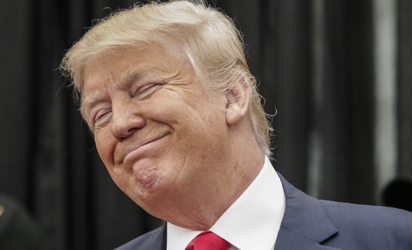
Trump
By Douglas Anele
Hilary Clinton was an establishment candidate with impressive curriculum vitae and experience for the job, whereas Trump, a political neophyte who made a fortune for himself in real estate and entertainment, campaigned on the platform of change.
Trump cleverly tapped into, in the words of Hegel, “what was ripe for development” in the consciousness of millions of Americans – jobs and change. Aside from projecting himself as a change-agent who would “make America great again” by providing jobs, he intentionally magnified the reactionary mood of white Americans by denigrating minority groups such as Afro-Americans, Latinos and Muslims. While some commentators believed that Trump’s divisive campaign rhetoric could cost him the election, the Republican party’s presidential nominee guessed correctly that his extremist pronouncements would resonate with disgruntled Americans who felt that the Obama administration did not meet their aspirations and that a Clinton presidency would just be a continuation of Obamacare and other policies disliked by Republicans.

Trump
Surely, Clinton’s character flaws are not as frightening or worrisome as her opponent’s, which implies that Trump’s victory is an oddity in a so-called civilized society unless it is interpreted as the outcome of the Cunning of Reason demonstrating once again that in human affairs hardly anything should be ruled out completely, that the unexpected is relative, not absolute. In my opinion, the emergence of Donald Trump as President-elect is an experiment for Americans to experience firsthand the quality of leadership a cunning businessman and reality TV impresario can provide at a time when America and the world are facing unprecedented security, economic, and socio-cultural challenges.
The erratic character of Trump is already manifesting. During the campaigns, he promised to abolish quickly the Affordable Care Program which made healthcare available to millions of Americans not covered in previous healthcare programs. He pledged to deport about 11 million undocumented immigrants mostly from Mexico, and build a huge concrete wall between the two countries which would be paid for by the Mexican government. In addition, Trump said his government would place a temporary ban on Muslims entering America until the security agencies could “figure out what was going on;” that America may renege on her obligations to the North Atlantic Treaty Organization (NATO), and that he would abandon or renegotiate trade agreements with other countries (particularly China) to make them more beneficial to the United States. In a burst of negative triumphalism, Trump promised to jail Hilary Clinton for using a private email server when she was Secretary of State. These and other tough-sounding pledges are good and exciting for campaign purposes, but their implementation in real life situations is a different matter altogether.
Thus, having won the election, Trump is gradually realizing that campaign and actual governance are light years apart. On Obamacare, for instance, he would retain the most popular aspects of the program and discard the rest, although experts insist that it would not be easy for him to do so since what he might want to throw away are what make the popular features possible. On deportation of illegal immigrants, Trump claims he would concentrate on those with criminal record. However, implementing this more reasonable option is problematic as well: different states and cities in America may not go along with it for logistic and humanitarian reasons. Trump still insists on building a wall along the southern border with Mexico, but he indicated recently that the wall would be complemented with fences. And instead of prosecuting and jailing Hilary Clinton because of her email misadventure, Trump now says that the Clinton’s are good people and do not deserve to be hurt any further. From the foregoing, it is clear that Trump’s impending presidency would be like opening a Pandora box, with serious consequences for America and the world in general.
Can Trump metamorphose into a world historical figure or will he end up as a mere footnote in the annals of American presidents? Given America’s status as the only genuine superpower in the world right now, there is the possibility that Trump could eventually become what Hegel called a world-historical individual. But unlike Hegel who had a romantic admiration for warmongering rulers and who philosophized when wars were fought with very crude weapons by contemporary standards, I believe that Trump can claim an exalted place in history if he spearheads the resolution of some lingering significant problems in America and in the international arena as well.
For example, if his government stops the hemorrhaging of jobs from America to other countries and gives every willing diligent American irrespective of race, religion, gender, sexual orientation and socio-economic status the opportunity to pursue his or her “American dream,” Trump would be celebrated as a great President by Americans. In the international plane, assuming Trump succeeds in actualizing a two-state solution for the Palestinians and the Israelis or successfully compels North Korea to end its quest for nuclear weapons or leads America to create an efficient global coalition that quickly destroys terrorist organizations such as the Islamic state, then his place as one of the greatest American Presidents would be assured.
Unfortunately, Trump does not seem to have what Hegel called “cool passion” or philosophical temperamental sagacity to provide the kind of leadership the world needs at this time. Take the Israeli-Palestinian conflict as an example: his active support for blocking the proposed resolution by the UN Security Council asking Israel to stop building Jewish settlements in Palestinian territory, and pledge to move the United States’ embassy in Israel from Tel Aviv to Jerusalem indicate that Trump will be irrationally pro-Israel in his approach to the Palestinian question.
Given the constraints of actual governance, Trump will do his best to convince Americans, particularly his diehard supporters, that he keeps his word. He will deport some undocumented immigrants and convince a few companies, through tax incentives and subtle coercion like increased duties on their products, not to relocate their factories to other countries. He might reach some deal with the Mexican government on tougher border controls and built a tiny fraction of the wall he promised to build during the campaigns.
Now, because of Trump’s pendulous temperament, America has a rendezvous with the “cunning of reason.” Clearly, Americans missed a great opportunity to elect their first female President, which would have transformed Hilary Clinton into one of the most inspirational women in contemporary history. In my opinion, the women that voted for Trump made a big mistake: since, all things considered, Hilary Clinton was a better presidential material than her opponent, they should have voted massively for Mrs. Clinton in order to break the remaining glass ceiling preventing women from aspiring to become President or to any exalted position which were traditionally the exclusive preserve of men. I suspect that many women that voted for Trump did so because of envy or jealousy: for no good reason they just hated the idea of Hilary Clinton becoming the first female President of the United States.
Overall, the fact that despite Trump’s incendiary rhetoric and several personality deficiencies, he still won against a more “presidential” opponent can be seen as proof that Americans are not as civilized as they want the world to believe.
Meanwhile, because Mrs. Clinton won the popular vote by an unprecedented 2.9 million votes, America’s electoral system needs to be modified. If it was Nigeria, Clinton would have been President – and rightly so. In that regard, Nigeria has a better system than America. Hence, there is nothing wrong if Americans copy our system by changing the Electoral College system that produces the oddity of someone having millions of votes more than an opponent and still loses to one in which a candidate is declared winner if he or she gets the highest number of votes and garners at least a quarter of the votes in two-thirds of the states of the federation.
These two criteria, taken together, accommodate all the advantages of the Electoral College system without the unfairness and irrationality of a presidential candidate getting more votes than the opponent and yet would not become President. Nigerian politicians should emulate Clinton who, despite flaws in the electoral process, graciously conceded defeat and asked fellow Americans to give Trump a chance. America’s electoral system, like our own, is imperfect; but American politicians tend to put America first, which is good for democracy. Concluded.
Disclaimer
Comments expressed here do not reflect the opinions of Vanguard newspapers or any employee thereof.