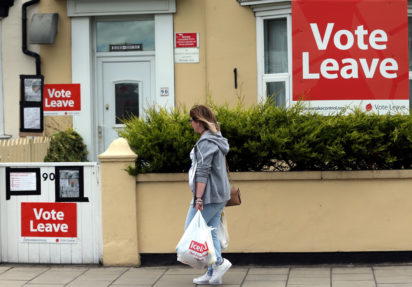
A woman walks past a house where “Vote Leave” boards are displayed in Redcar, north east England on June 27, 2016 Britain’s historic decision to leave the 28-nation bloc has sent shockwaves through the political and economic fabric of the nation. It has also fuelled fears of a break-up of the United Kingdom with Scotland eyeing a new independence poll, and created turmoil in the opposition Labour party where leader Jeremy Corbyn is battling an all-out revolt. / AFP PHOTO
As British lawmakers prepare for the Christmas break, many issues surrounding the country’s divorce from the European Union remain shrouded in confusion.
Here are key things known about the Brexit process, and the issues that need to be addressed in the new year.
– KNOWNS –
– Britain will leave the EU –
Prime Minister Theresa May is currently appealing a High Court ruling that she must seek parliamentary approval before triggering Brexit, with a decision due in January.
The original ruling allows lawmakers, technically, to delay indefinitely the triggering of Article 50, which starts the break-up process, throwing into doubt May’s promise to begin proceedings by the end of March.
However, May was able to get MPs to agree to stick to the timetable — regardless of the appeal ruling — in exchange for agreeing to reveal the government’s broad negotiating strategy to parliament.
– UK plans immigration curbs –
May has insisted that Britain would no longer accept the free movement of people to and from the EU on Brussels’ terms, and also pledged to repatriate legal powers.
“We are not leaving the European Union only to give up control of immigration again and we are not leaving only to return to the jurisdiction of the European Court of Justice,” she told her Conservative Party’s conference in October.
– Economy defies expectations –
Confounding economists, Britain’s economy has grown solidly since the June referendum, household spending has grown faster than expected, while the housing market has remained resilient and unemployment has dropped to its lowest level since 2005.
“For households, the signs of an economic slowdown are notable by their absence,” Bank of England chief Mark Carney said in October.
– UNKNOWNS –
– Parliament not sure to vote –
If the government is successful in overturning the High Court ruling, the government will be able to trigger Article 50 as planned, without a parliamentary vote.
– ‘Soft’ or ‘hard’ Brexit –
May has revealed little about what Britain will ask for during Brexit negotiations, but her vow to curb immigration and repatriate legal powers suggested she favoured a “hard Brexit”, which would mean Britain leaving the EU’s single market.
Former minister Oliver Letwin last week went further, stressing that “we’ve been very clear what the outlines are, we’re leaving the single market, we’re leaving the customs union.”
– A transition deal? –
Once article 50 is triggered, Britain and the EU have two years to agree the terms of the divorce, while at the same time thrashing out a deal for future trading arrangements between the two parties.
Finance minister Philip Hammond on Tuesday insisted that the government would likely seek a transitional trade deal to smooth the Brexit process after that deadline.
Brexit minister and arch eurosceptic David Davis said such an agreement should be struck “only if it’s necessary” and to implement gradually a final deal, rather than to extend negotiations.
A parliamentary report to be released on Thursday is also expected to warn that uncertainty over EU single market access threatened 200,000 jobs in Britain’s financial services industry, unless a transition deal is agreed.
Brexit champion Nigel Farage called such a deal a delaying tactic and evidence of “backsliding”.
– An early election? –
If May loses her court appeal, and is worried lawmakers will frustrate her attempts to trigger Article 50, she could decide to call an early general election and expose pro-EU MPs — many of whom represent constituencies that voted for Brexit — to public opinion.
Bookmakers have slashed the odds of a general election in 2017 to 2/1.
– Long-term economic prospects –
While short-term economic data is encouraging, the Office for Budget Responsibility last month cut its 2017 growth figures from 2.2 percent to 1.4 percent and warned of a knock-on effect on public finances.
Critics also point out that Britain is at least two and a half years away from actually leaving the EU, when any new trade, immigration and other arrangements would come into force.
Disclaimer
Comments expressed here do not reflect the opinions of Vanguard newspapers or any employee thereof.