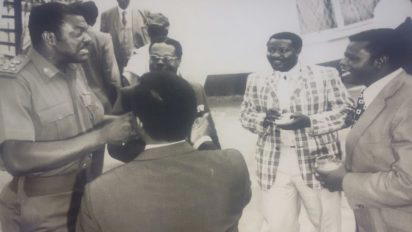
•Chief GBADAMOSI, extreme right, as Lagos Commissioner for Economic Development, and extreme left, Brigadier-General Mobolaji Johnson, then military administrator of Lagos State.
By Owei Lakemfa
Rasheed Abiodun Gbadamosi (R.A.G) the industrialist, administrator, former Minister, writer, dramatist and humanist who left on Wednesday November 16, 2016, was a patriot and universalist. He departed twenty one days short of his 73rd birthday.
Gbadamosi had traversed the world since he was a teenager. He was a citizen of the universe but had long ago, prepared his final rest place in his beloved Ikorodu. The town, which began as an outpost of the Remo and Ijebu people was founded by Epe Odu primarily as a vegetable farm. People going to the farm settlement often said they were going to Oko Odu (Odu’s farm) The British colonialists Anglicized Oko Odu to Ikorodu.
Gbadamosi’s great grandfather was Ajenise from the Agemo lineage. His grandfather, Gbadamosi Odesanya, alias Adaramadoti, traded in hand-woven clothes and was a tailor. His grandmother, Raliat Morounkubi was from Ode Remo. They had ten children but only three survived. His father, Sule Oyesola, adopted the father’s first name, Gbadamosi, he became known as Sule Oyesola Gbadamosi (SOG) while his uncle, Michael, retained Odesanya, the family name. He was to be later known as Justice Michael Adeyinka Odesanya.
The senior Gbadamosi had sixteen children. To try to treat them all equally, SOG, who was a man of considerable means, created a children section in his home, withdrew the children from the direct care of their mothers and placed them under a governess, Mrs. Odomosu, alias Mama Nurse. Given his very busy schedules as an industrialist and leading politician, he placed the governess under the supervision of his younger brother, Michael Odesanya, who also exercised discipline amongst the children.
His mother, Alhaja Rafatu Asabi Gbadamosi was from the royal family in Lagos. The greatest influences in young Gbadamosi’s life were his father who also mentored him in business and his mother with whom he had a sort of telepathic relationship. He told me a story about this. He said when he was quite young, his mother took a commercial boat from Lagos Island where they lived, to Ikorodu. In those days, that was the only means of transportation to Ikorodu. The alternative was a four-day journey by foot through Lagasa and Victoria Island.

•Chief GBADAMOSI, extreme right, as Lagos Commissioner for Economic Development, and extreme left, Brigadier-General Mobolaji Johnson, then military administrator of Lagos State.
He said shortly after she left, in a trance-like state, he saw his mother in distress in the boat as it was about to capsize. He began to weep. Gbadamosi said when his mother returned, she narrated how her and other passengers in the boat almost lost their lives as it nearly capsized.
Gbadamosi was born at about 2.am at the Mercy Hospital, Mercy Street, Lagos. By four, he started school at the Patience Kindergarten Modern School and was admitted to the prestigious Methodist Boys’ High School (MBHS)Lagos in 1956.
Although his father was one of the leading Muslims in the country, he not only sent his son to a Christian mission school, but also took him to live with the then Principal, Reverend Samuel Adeoye Osinulu.
Reverend Osinulu who marked his centenary this year had told me in an interview in 2003 that Gbadamosi lived with him for “quite a while and he was a good member of the family, apart from being a good student. His father gave him a good Muslim training at home and when he came to live with us, he also imbibed Christian values…He absorbed the best of the two religions and that can be seen reflected in his character” Gbadamosi was seventeen when he left secondary school in 1960 the year Nigeria gained independence.
His graduating class in MBHS became known as the Liberation Set. The following year, the young Gbadamosi was off to England for further studies. His father had seen off Gbadamosi and his elder brother at the old Ikeja Airport, Lagos.
The Italian flight, a propeller plane was scheduled to make the journey in twelve hours with stops in Kano, Tripoli and Barcelona. It was Gbadamosi’s first travel outside the country and his first experience in air travel.
Forty five minutes into the Barcelona-London flight, the Gbadamosi brothers and other passengers were moved from the economy class to the rear of the aircraft. They were given pillows to rest their heads. He held on to his elder brother who was sleeping. Then he saw the air hostess wincing and acting nervous.
What young Gbadamosi did not realize was that the movement of the passengers and their given pillows to lay their heads was to prepare them for a possible crash-land. One of the aircraft tyres had stuck and would not release, but as it made to crash-land, the tyre released and the plane taxied to a stop. Gbadamosi did not realize that he and other passengers had cheated death by the whiskers until after the airport formality, he got a congratulatory telegram from his father.
What happened was that after seeing his two sons off, the senior Gbadamosi was travelling to Ibadan when the British Broadcasting Corporation announced that a Lagos-London Italian flight had some problems and wasn’t able to land initially but that it eventually landed safely. The senior Gbadamosi immediately sent a congratulatory telegram to his sons.
From the jaws of death, Gbadamosi and his brother stepped into British soil in pursuit knowledge. He spent six years in Britain attending the City of Westminster College and University of Manchester where he majored in Economics and a Masters in the University of New Hampshire, United States.
The fall of Umuahia to Federal Troops in 1969 during the Civil War, was to him, a signal that he had to return to the country. Here he was with a degree and advanced diploma from Britain and a Masters in Economics from America. He had a good pedigree; his father was a big industrialist and one of the country’s best known political figures.
He declined an appointment in the Cabinet Office, to work in his father’s company. Life’s canvas stretched invitingly before him. Then suddenly he had to make a run for it. The military authorities were hot on his tail hunting him for charges of subversion or treasonable felony. For Gbadamosi’s supposed actions, the Federal Military Government of General Yakubu Gowon had put the First Division of the Army on alert to match on Lagos.
His accomplices had been rounded up and were already in prison. These included Christopher Kolade, the Director General of the Nigeria Broadcasting Corporation (Now, the Federal Radio Corporation of Nigeria) – he was years later, Nigeria High Commissioner to the United Kingdom. There was Edward Fiberesima, a star and a Producer of the NBC, Francesca Emmanuel who was to retire as a Federal Permanent Secretary and Kofo Bucknor-Akerele who later became Deputy Governor of Lagos State.
After some time in hiding, Gbadamosi emerged hoping that the heat was off. He was promptly arrested and thrown into the high security Kirikiri Prison.
The cause of the whole problem was a play! Titled, Trees Grow In The Desert, it was Gbadamosi’s first play which he had written three years before the Civil War. The play had been staged successfully and there had been glowing tributes about it. Then Edward Fiberesima thought it should be adapted to a radio play.
There as a scene in the play about an army mutiny in which the Head of the Armed Forces and the Chief of Staff were kidnapped. On stage, it was an innocuous scene. But that hot afternoon in Lagos when the play was on the NBC, it sounded real; that a coup was on. The authorities did not wait to hear the rest of the production which would have made them realize that it was just a play.
When the military authorities were informed it was just a play even if badly timed and badly edited, it did not matter to them. The sulking authorities rounded up all those connected with the play, but the playwright, Gbadamosi was at large hence the hunt for him. After two weeks in prison, the anger of the authorities was assuaged and he was set free.
The authorities reaction and the arrest made the headlines and Gbadamosi was thrust into prominence; his literary image soared and he was propelled into more literary activity.
In 1971, he reached out to Offa, Kwara State, to marry his heart-throb, the then Miss Tinu Adedoyin. At 29 he was appointed the Lagos state Commissioner for Economic Planning by the then Military Governor, Brigadier General Mobolaji Johnson. However, the government of General Yakubu Gowon was overthrown on July 29, 1975 and all state governors and their political appointees, sacked.
The new government at the Federal level led by General Murtala Ramat Muhammed accused the Gowon regime of incompetence, indecision and corruption. At the Lagos State level, the new Military Governor, Adekunle Lawal declared war on the sacked Johnson government. As a former Commissioner under Johnson, Gbadamosi, had to fight off such accusations. He reiterated his innocence and went on the pages of the newspapers to take on the new government, however, the harassment against the former leadership did not cease.
One evening, Gbadamosi went to see a friend in the Surulere area of Lagos. There he met a man who was introduced to him as Lt. Colonel Ibrahim Babangida a member of the newly constituted Supreme Military Council. The Colonel asked Gbadamosi to repeat his name after which he said off-guard “Oh, We have an appointment for you, you’ll hear about it.” Then he melted away.
The next day, Gbadamosi was named as one of the “Fifty Wise-men” to draft the country’s new constitution preparatory to the handover of power to civilians. Here was somebody who was rejected and vilified being appointed by the same military government.
The Government went on in addition to appoint him into the Board of Directors of the National Electric Power Authority (NEPA) the then sole electricity company in the country. With that, his rehabilitation and the redemption of his name was complete. He was at this time, a 32-year old youth. The best was yet to come.
Disclaimer
Comments expressed here do not reflect the opinions of Vanguard newspapers or any employee thereof.