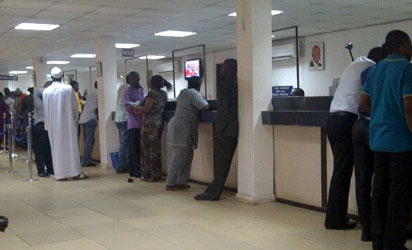
Banking hall
By Udeme Clement
THE West African Institute for Financial and Economic Management (WAIFEM), has concluded plans to start e-learning programme on Banking Supervision by 2017, in order to increase efficiency in the financial systems within the sub-region.
The Director General of WAIFEM, Prof. Akpan Ekpo, disclosed this while giving a keynote address, at the regional course on, ‘Advanced Modeling and Forecasting ;Dynamic Stochastic General Equilibrium’ ( DSGE), organised by the Institute for senior economists with operational responsibility for preparing policy papers, statistical data, forecasts and other inputs into the policy making process.
He explained that all the e-learning programmes of the Institute have accreditation from United Nations Institute for Training and Research (UNITAR) and the Chartered Institute of Banking of Nigeria (CIBN). “Forecasting for policy analysis helps in understanding the operation of an economy and enhances the policy and decision making process, both at the macro and micro levels. In implementation of monetary and fiscal policies, econometric help to quantify how the economy and monetary or fiscal policy works.
It is useful in monitoring how the economy stands and also how to make short and long term projections, in order to determine the path to be followed by policy makers. Indeed, monetary policy is conducted in a forward-looking manner. For its efficiency, there is the need for assessing trends and developments in the domestic economy and external environment as well as the simulation and evaluation of the impact of monetary policy over the medium term”, he said.
He went on, “There is need for Central Banks within the region to have a clear understanding of monetary policy transmission mechanisms. This is realised through macro-econometric methods based on the reality of the economy. This means, there is urgent need to have sound systems for acquiring, sharing and analysing economic and financial data, so that policy can respond quickly to unforeseen developments and steer actions to achieve policy objectives. Indeed, when sufficient data are available, policy makers should make use of econometric techniques and models for a better understanding of their economies.”
“However, these techniques should be used to support good economic analysis and not as a substitute for it. As such, it is important to understand the linkages between theory, data, economic methods, forecasting and policy decisions.
Disclaimer
Comments expressed here do not reflect the opinions of Vanguard newspapers or any employee thereof.