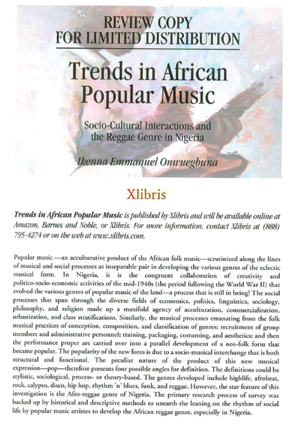
Trends in African Popular Music; Ikenna Emmanuel Onwuegbuna; Xlibris, Bloomington, USA: 2015; PP. 132
By JAPHET ALAKAM
Music is the greatest creation of man, which touches the soul and also helps man to sympathetically manifest unspoken desire and humanity in him. In fact, music can best be described as wonderful force that is capable of bonding people together and instituting international brotherhood, love as well as peace. But, one issue that has been bordering the minds of many, especially music teachers/lovers is the scarcity of literature on popular music studies.
And it was the need to provide a fresh perspective on its importance that Ikenna Emmanuel Onwuegbuna, a musician and music lecturer at Department of Music, University of Nigeria, Nsukka came up with a new book entitled , “Trends in African Popular Music: Socio-Cultural Interactions and the Reggae Genre in Nigeria”.
The 132 page book published by Xlibris was inspired by the author’s decades of involvement with the performance and teaching of music and his desire to produce a dependable piece of literature in popular music pedagogy.

Trends in African Popular Music; Ikenna Emmanuel Onwuegbuna; Xlibris, Bloomington, USA: 2015; PP. 132
The six chapter well researched book traces and chronicles the trends in African popular music – an acculturative product of African folk music. It inspects along the lines of musical and social processes as an inseparable pair to see the development of various genres stemmed from such an eclectic musical form.
According to him, “It is popular music that most people turn to as a representation of self-identity; the book therefore helps us understand the role African popular musical culture—including its origins, developments and future trends—plays in the human society.”
The author focuses on popular music, since he believes that this represents the voice of the people, combining a musician’s understanding of music with a musicologist’s perspective on how music impacts society and vice versa.
In chapter 1, tagged Prelude, the author as a professional pop musician who has operated from both sides of non-literate and literate musical performance over three decades explains the rationale and justified it by the fact the musical and social processes have received only a cursory attention in the hands of scholars.
Chapter two looks at the socio-cultural interactions. Here, he takes comprehensive and insightful look at the origin and development of different music genres. He traces the dramatic transformations, especially through urbanization and industrialization that brought about changes that disrupted traditional attitudes, lifestyles and forms of artistic expression and patronage, while creating new urban social class with musical taste.
In chapter three, the author defines popular music as the totality of those musics with diverse styles that have developed from artistic manipulations and fusions of musical activities of distant cultures, times and practices. He also provides the stylistic, sociological, process-based and theory based definitions and what African Popular music is.
The Reggae genre, its history and etymology, the growth and spread of the genre, the development of the various genre like Roots Reggae, Dub, Rockers Reggae etc. The modern trends in Reggae music, nature and features of Reggae and others are well documented in chapter four.
Chapter five takes a critical look at the Nigerian Reggae scene from the various periods, between 1960 and 1980, between 1980 and 2000 and the Nigerian Reggae in the present millennium and various artistes that dominated the scenes like EC Arinze, Orlando Owoh, Joe Nez down to Sonny Okosuns, Keni-St- George Ozoloke, Harry Mosco, Bongos Ikwue, Cloud 7, The Doves, Sir Victor Uwaifo, Semi Colon, Tony Grey and others. Finally, the author presents a reflections of the gains of the investigations into the trends in the creation, development and modifications in African popular music, covering the ethnic, interethnic, and styles as well as making a closer survey of the Nigerian reggae musical practices.
In all, Trends in African Popular Music reveals the connection between currently popular African music and the strings that wrap culture, economy and society. Through opening the eyes of readers to the socio-cultural issues inherent in new tunes, it makes them aware of the present situation they are facing.
Disclaimer
Comments expressed here do not reflect the opinions of Vanguard newspapers or any employee thereof.