Oil
By Michael Eboh
After several years of rot, lost investments, corruption and controversies, the Federal Ministry of Petroleum Resources has finally packaged a Draft National Oil Policy that seeks to introduce far-reaching reforms in the Nigerian petroleum industry.
The draft policy document, expected to be presented to the Federal Executive Council, FEC, on Monday (tomorrow), after consultations with stakeholders, explains that Nigeria needs a new petroleum policy for four major reasons.

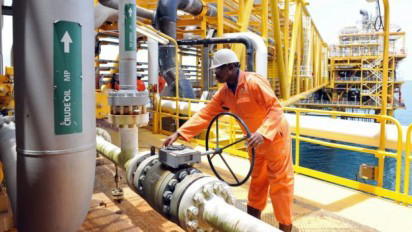
A picture taken on September 16, 2015 shows workers trying to tie a pipe of the first refinery in Nigeria, which was built in 1965 in oil rich Port Harcourt, Rivers State. The Port Harcourt refinery is Nigeria’s oldest, built in 1965, nine years after crude was first found under the marshy soil and creeks of the delta, where the Niger river meanders to the Gulf of Guinea. Refineries in nearby Warri and Kaduna in the north central region were built in the years that followed, while a new plant was added to the same site in Port Harcourt in 1989. In recent years, however, it became a byword for corruption, a murky, state-run body where billions of dollars in revenue apparently disappeared. AFP PHOTO
The reasons for the new policy, according to the document, are: That the previous policy has not worked; the world has changed: prices have collapsed and the world will be awash with oil for the next few years, and a new vision of value adding activities, due to the fact that the future for oil producers lies in moving and developing a value added refining and petrochemicals industry.
Lamenting the dwindling fortunes of the petroleum industry, Minister of State, Petroleum Resources, Mr. Ibe Kachikwu, told stakeholders that there are no parts of the world where policies are made like we do in Nigeria; where industries grow without any sense of direction and then we hope that, somehow, a higher power would show up and probably just solve it.
In addition, Kachikwu, who was addressing the stakeholders at a consultative forum on the Draft National Oil Policy, pointed out that lot of things had happened in the petroleum industry for so long, that it has almost become accepted as a norm.
On his own part, Clay Neff, Chairman of the Oil Producers Trade Section, OPTS, of the Lagos Chamber of Commerce and Industry, LCCI, stated that the new policy should address issues of security, oil, lengthy contract approval cycle and overlapping regulatory authorities, among others.
Neff disclosed that with the confusion currently witnessed in the upstream sector, it would be very difficult for any upstream oil company to heed government’s call to venture into the downstream sector or anywhere else.
He said, “We cannot be running a business that is not viable and be talking about expansion. If all the issues we have been talking about are addressed, then we will venture to downstream business.”
One document, many perspectives
In spite of the fine points of the policy, some stakeholders and groups are already crying foul, saying they were not included in consultations and their views were not taken in the drafting of the document.
Divergent views are also trailing the proposals in the document, with the organized labour threatening a showdown with the Federal Government in this regard.
While many stakeholders agree that the petroleum industry is long overdue for a reforms, there appears a unanimity that the reforms should be undertaken with a human face, whereas wide consultations should be made with all that would be affected by the policy.
Specifically, Chairman, Petroleum and Natural Gas Senior Staff Association of Nigeria, PENGASSAN, PPPRA Chapter, Mr. Victor Ononokpono, told Sunday Vanguard that any attempt to reform the petroleum industry without carrying labour along would be met with stiff resistance.
One of the regulators scheduled to be scrapped, the Petroleum Products Pricing Regulatory Agency, PPPRA, he stated, plays an important role in the regulation of the downstream petroleum sector, adding that the role cannot be overlooked, as it involves protecting commercial interest of the sector as well as the interest of the consuming public, to ensure they are not shortchanged.
PPPRA’s functions, according to Ononokpono, go beyond fixing prices and into broader areas of the downstream sector, which would be difficult to neglect, while it also comprises high level and critical manpower which had helped in driving the industry over the years.
The PENGASSAN leader wondered how a new single independent regulatory agency would be created and what would happen to the existing regulatory agencies and how the staff structure would look like.
He added that nobody should think labour would just fold its hands and watch the scrapping of the agencies, without intervening to protect the interest of its members.
Also speaking, President, Nigerian Association for Energy Economists, NAEE, Professor Wumi Iledare, stated that actions and strategies put forward in the policy document are better described as reformation and/or industry restructuring.
According to him, it is a splitting of the government-owned corporation into asset management and an integrated commercial-oriented business.
He said the PPPRA is a price control authority and with a reformed industry where deregulation is inevitable, its function has to be redefined within the framework of a single regulator, just like what the Central Bank is to the finance industry.
“Of course one may worry about diseconomy of scale with a large single regulator, but what you have now with respect to regulating the oil industry is too amorphous and, I think, with proper recruitment exercise in terms of the governing board and management team, efficiency and effectiveness can be guaranteed with a one-stop shop for the industry,” he argued.
The NAEE chief further stated that the success of the reforms depends more on appointing appropriate manpower, adding that, for the most time, Nigeria is very good at policy formulation but more often than not fails to implement well informed policies.
He said, “The success or failure of the ongoing reforms will depend on the implementors. Here is where the president and his advisors need to learn to follow due process. The idea of geo-political balancing to manage a complex business structure that the oil and gas industry represents is ludicrous.
“Let the filling of key positions be head-hunted and competitive. The ‘man-know-man’ approach to appointments to sensitive and highly demanding positions with implications for economic growth and development must be disabused.
“Just look at the collapse of our education system because of ethnification of university management. If we do that to the industry, it will fail and the reforms will be inconsequential.”
Meanwhile, the Nigeria Union of Petroleum and Natural Gas Workers, NUPENG, rejected the planned scrapping of the regulatory agencies, saying the move is unacceptable.
NUPENG President, Igwe Achese, claimed it was another attempt by government to reduce the workforce in the sector and vowed that the move would be resisted by labour.
Achese said what is necessary now is to strengthen the regulatory authorities by granting them autonomy and not to be controlled by red-tapism in government.
He said, “Scrapping these bodies and putting them under one umbrella to be known as Petroleum Regulatory Commission, PRC, will be too cumbersome and make the Petroleum Minister too powerful.
“We call on the Federal Government to put pressure on the National Assembly to pass the Petroleum Industry Bill, PIB, which will make the oil and gas industry much more efficient, transparent and accountable and, in the long run, bring the needed investments in the sector.”
Inside a reformed sector
Several controversial proposals are made by the Draft National Oil Policy. They include the consolidation of Nigeria’s oil industry regulatory authorities into a single agency to be known as Petroleum Regulatory Commission, PRC, while scrapping all other regulators, including the Nigerian National Petroleum Corporation, NNPC, Department of Petroleum Resources, DPR, Petroleum Products Pricing Regulatory Agency, PPPRA, Petroleum Technology Development Fund, PTDF.
According to the document released by the Ministry of Petroleum Resources, the proposed regulator will incorporate the activities of the existing petroleum regulatory authorities and also cover some new regulatory activities not currently in place.
The document shows that the existing institutional regulatory framework is weak, largely ineffective and inefficient, arising from a number of single-issue agencies; overlaps in regulation, gaps in regulation, mixture of policy, regulation and operations; and ineffective regulation.
The draft is also proposing a policy that would rule out the automatic renewal and extension of oil and gas licenses, while it lists stringent conditions which would be met before these can be granted.
According to the draft policy, licence renewals or extensions will now be based on progress made by licence holders in meeting their exploration or production targets, while licence holders, who do not meet licence conditions, including oil production, gas flare down, gas supply obligations risk losing the licence.
In addition, the document is proposing a policy that would ensure that certain percentage of petroleum revenue is set aside for capital expenditure and for savings for future generations.
Under the new policy, government will agree to a cap on the proportion of petroleum revenues that can be spent on recurrent expenditure, while setting aside a percentage of the petroleum revenue for capital expenditure items and savings for future generations.
The document provides that each of the country’s refineries will be given a transition period within which to become viable and profitable, adding, however, that government might consider divesting, selling off, concessioning or, if necessary, close down any non-performing refinery that fails to make the transition.
The aim is to make the NNPC refineries successful, high volume, commercially viable enterprises, and they would be encouraged to become so and will be supported as much as it is within government’s ability to do so.
Another major proposal is the corporatization and restructuring of the NNPC into five independent autonomous units (profit centre
subsidiaries) which will be operationally independent, self-accounting and will
hold funds in their own right.
Equally in the pipeline is a new parent holding company, to be called the National Oil Company of Nigeria (NOCN).
The emerging company would be incorporated as a limited liability company; governed according to the governance rules of the Nigerian Stock Exchange prior to the listing of its shares, and by the rules of any bourse where its shares are eventually listed; and will hold the subsidiaries.
Poorly performing units
Poorly performing units of the NOCN would be divested, sold or closed down, while international investors would be sought for autonomous units of the NOCN where it is considered appropriate.
The document states that the previous petroleum policy encourages rent seeking through a crude oil export for cash business, especially as Nigeria is the only OPEC country without effective oil refining capacity.
It adds that the petroleum sector had been dominated by state ownership and dominant market power in the upstream and mid-stream, consequently, the private sector has been constrained.
Under the draft policy, there are fiscal disincentives to new participants; a lack of regulatory rigour and absence of governance in cost efficiency, stating that as a result, state control and rent seeking by government has limited the growth of self-sustaining industries.
The Ministry of Petroleum Resources explained that the vision of the National Oil Policy is to move Nigeria away beyond crude oil exports into value added activities in oil, namely, refining and petrochemical industries; and expanding from oil into gas based industrialisation, based on the as yet largely untapped large gas reserves in Nigeria.
The unfolding dispensation, according to the Ministry, is to be anchored on the following strategic policy objectives: “Create market driven oil and gas industry; maximise production and processing of hydrocarbons; move away from oil as a source of income to oil as a fuel for economic growth; cost efficient storage, transportation and distribution for petroleum products; minimise the environmental footprint of oil exploration and production; and managing the balance between depleting oil resources versus renewable energy.”
Disclaimer
Comments expressed here do not reflect the opinions of Vanguard newspapers or any employee thereof.