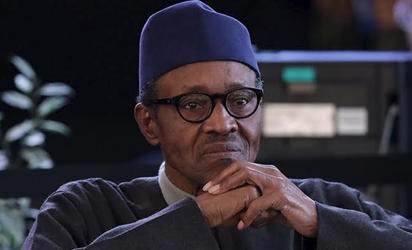
President Buhari
By Douglas Anele
Meanwhile, it is disingenuous and insulting to Nigerians for Lai Mohammed, Garba Shehu and other government officials to continuously ask us to tighten our belts when they themselves and Mr. President, governors, federal legislators and other “pigs” in the animal farm called Nigeria seem to be loosening theirs in order to accommodate their expanding appetites for sybaritic lifestyles.
Without any doubt whatsoever, the vuvuzela change slogan of the APC, now updated to the hypocritical hollow sermon of “change begins with me,” proves that the party was never sincere about improving the living conditions of our people. In otherwords, the 2015 elections merely led to the replacement of a set of largely incompetent public officials with another set dominated by hypocritical misfits.
What is President Buhari’s scorecard with respect to the so-called war against corruption, the single most important reason for his electoral success in 2015? Before I answer that question, it must be pointed out that corruption is broader than the popular notion of stealing public funds and assets. It connotes depravity, debasement and rottenness.
Thus, rigging of elections, making promises without genuine intention to fulfil them, lopsided appointments to the disadvantage of a particular section of the country, refusal to obey court orders and unlawful use of the state’s instruments of coercion to harass and intimidate citizens among other illegal or immoral acts of government, can be legitimately regarded as acts of corruption.

President Buhari
When Muhammadu Buhari announced both during electioneering campaigns and after his inauguration as President that fighting corruption will be given priority in his administration, some people thought that as a “converted democrat,” he would do so within the confines of extant laws. But some of us who vividly remembered the draconian handling of corruption cases during his short-lived tenure as military dictator were sceptical because, as the saying goes, a leopard does not change its sports overnight.
Unfortunately, our doubts have been confirmed by President Buhari’s serious errors of judgement which have weakened the moral basis of his self-imposed war on corruption and germinated cynicism concerning his motivation for launching it in the first place. Now, every right thinking Nigerian is convinced that the wicked stealing of public funds and assets constitutes one of the greatest evils that have befallen Nigeria since independence, and that if left unchecked it would eventually destroy the country.
It has been estimated that over four hundred billion dollars have been stolen by top government officials and their acolytes and cronies since October 1, 1960. Therefore, Nigerians have a moral right, indeed an obligation, to feel very angry about the extremely sloppy and avaricious manner our leaders have mismanaged the country’s resources over the decades.
Still many Nigerians lamenting about the evils of corruption perpetrate it in innumerable ways in their daily transactions with others at various levels. The major problem is that the quantum of money stolen by members of the ruling elite and top civil servants and their collaborators in the private sector is so huge that it borders on neurosis.
Now, if media reports about the incredible amounts stolen between May 2010 and May 29, 2015 are indeed true, current efforts by the Economic and Financial Crimes Commission (EFCC) to recover stolen funds and deal with those involved should be commended, with the caveat that the commission must always operate within the provisions of existing laws.
In some instances, the EFCC has operated as if it is above the law by its overzealous handling of corruption allegations especially against members of the Jonathan administration who have been severely critical of the Buhari government. Again, several unforced and unnecessary mistakes in the war against corruption have put a big question mark on the entire programme.
One, the President made a big mistake by concentrating his attention almost exclusively on the immediate past administration of Dr. Goodluck E. Jonathan. Granted that because of time factor it would be more expedient to start with proximate corruption cases, it is morally objectionable to single out only one dispensation among others for close scrutiny, when it is clear that corruption by public officials began right from the First Republic, as Prof. Chinua Achebe had argued in his thought-provoking little book, The Trouble with Nigeria.
Moreover, exclusive attention on Jonathan’s government creates the unmistakable impression of a witch-hunt and a desire to cripple the opposition: it is like trying to remove a dangerous weed by cutting the visible parts and leaving the roots intact. Two, by being so selective, Buhari is actually protecting military colleagues who ruled before and who worked behind the scenes to ensure that he replaced Jonathan as President.
Remember, If Buhari so desires, he can authorise the EFCC to gather evidence of whale-sized corruption perpetrated between 1970 and 2010 with help from relevant international agencies renowned for expertise in tracking financial crimes. As examples from other countries have demonstrated, a government genuinely serious about fighting corruption can go back decades in order to bring past corrupt leaders to justice.
But in Nigeria, there are untouchables, sacred cows that will never be investigated no matter the gravity of allegations and circumstantial evidence of corruption against them. The untouchables include surviving members of the infamous “1966 class,” the group of soldiers mainly from the north who were involved one way or another in the bloody revenge coup of July 29, 1966.
I am convinced that the EFCC will not be permitted by the President to thoroughly investigate Yakubu Gowon, Olusegun Obasanjo, Ibrahim Babangida, and Abdulsalami Abubakar. This group constitutes the “sacred cows of Nigeria,” the core of what Prof. Ben Nwabueze described as the “invisible government” that determines the overall direction of leadership at the federal level irrespective of who was President.
Therefore, now that Buhari is President, it is naive and unrealistic to expect him to move against former military heads of state all of whom, except Obasanjo, are northerners. But then, any war against corruption that does not investigate these retired military leaders is grossly incomplete and unsatisfactory. There are excellent reasons for investigating the administrations of Gowon and the rest, despite Buhari’s unwillingness to do so.
Take for example the “cement armada” fiasco that happened when Gowon was military head of state. In Oil, Politics and Violence: Nigeria’s Military Coup Culture, Max Siollun reports that at one point during the military regime of Gowon, the federal government imported over twenty million tons of cement, about half of the commodity imported globally at the time and ten times the total amount of cargo ports in Lagos can handle in a year assuming they had no other cargo to unload.
This led to massive backlog at Logos ports as over four hundred ships competed for dock space and waited to offload what was aptly termed a “cement armada.”Some ships were docked for a year, waiting to offload, and collected demurrage running into millions of dollars.
Other ships loaded with inferior goods took advantage of the situation and worsened the congestion by also docking at the port so that they could collect demurrage as well from a federal government seemingly intent to find elaborate means of squandering its newfound wealth. Even the fifty large cranes imported from the United Kingdom to help in unloading the cement were left to rust at the ports because no one knew how to operate them.
It was later discovered that the cement fiasco was a scam to steal money from the extravagant federal government: both the cost and quantity of the cement orders were massively inflated. Is it impossible now to investigate the unseating legendary extravagance of the Gowon regime? I certainly do not think so.
Meanwhile, the administrations of Obasanjo (both as a military head of state and civilian President), Babangida and Abubakar are also besmirched with allegations of mountainous graft and mediocrity, but the EFCC cannot do anything. From my own point of view, the war against corruption loses much of its moral justification and possible sanitising effect if President Buhari does not prosecute it holistically to include the years between 1970 and 2007.
Nigerians have been discussing from different angles the recent unprecedented nocturnal siege on the residences and arrest of Supreme Court justices and judges by the Department of State Services (DSS) based on allegations of corruption.
It is really a sad reflection of the serious lack of intellectual leadership in our universities that two well-known Professors of Law, Yemi Osinbajo and Itse Sagay, actually endorsed the Gestapo-like tactics used by DSS operatives around midnight in October to arrest the top-ranking judicial officers.
I do not really understand why senior academics in Nigeria, once they occupy prominent positions in government, tend to allow the temporary elixir of high public office to overshadow the attributes of rationality, healthy disdain for power, and respect for decorum and orderly conduct they ought to have internalised while in the university and which are the hallmarks of genuine intellectualism. To be continued.
Disclaimer
Comments expressed here do not reflect the opinions of Vanguard newspapers or any employee thereof.