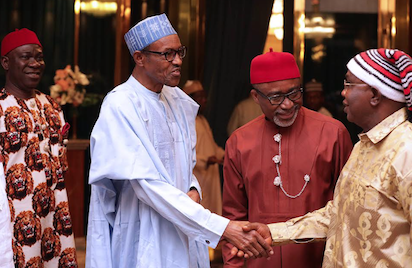
President Buhari with R-L: Senator Sunday Oji Ogbuoji, Senator Enyinnaya Abaribe and Senator Ike Ekweremadu as President Buhari receives in audience Deputy Senate President Senator Ike Ekweremadu and 7 other Senators in State House on 9th Nov 2016
By Douglas Anele
Perhaps President Buhari and his team underestimated the enormity of problems awaiting them, meaning that they were not well prepared in advance for the challenges ahead. One would have expected the President to hit the ground running, as someone who contested thrice for the presidency and lost.
But the sluggish manner with which he started and the questionable quality of some his appointments, if anything, indicated a man without a blueprint of how to handle the daunting responsibilities of his office.
The deterioration in our living conditions nationwide explains why many die-hard supporters of the President are now regretting voting for him, with some boldlyspeaking out against his penchant for blaming Jonathan and demonising PDP for the sorry state of our country. Of course,

President Buhari
Nigerians already know that the former President made a lot of mistakes, but those that voted for Buhari did not do so for him to make excuses and blame his predecessor: he was elected to solve problems. It follows that the President must be told the truth that the suffering masses nationwide are tired of the blame game, that he should face squarely the duties of his office and stop behaving like an incompetent craftsman who blames others for the poor quality products fabricated in his workshop. Blaming Jonathan, in my opinion, is a cowardly response to the difficult challenges of our time: it implies that Nigerians who voted for Buhari have unwittingly handed the most powerful political office in the country to someone who is mentally unprepared for the job.
Indeed, President Buhari is really wasting time if he thinks that he can continue the tiresome practice of shifting the blame for his mediocre performance to others without consequences – it cannot work. To really appreciate the point I am making, consider the difference between the strategy outgoing President Barack Obama applied in tackling the economic meltdown of the United States when he assumed office in 2008 and the one President Buhari is using presently to deal with economic recession in our country. Obama did not waste time and energy agonising over the failures of George Bush and blaming him for the problems he met on ground. Rather, he did a lot of thinking, assembled a team of competent and experienced technocrats and invested public funds wisely in selected key sectors of the American economy, such that after about a year and half,
America’s economy started improving again. In our own case, Mr. President seems preoccupied with rewarding those from his ethnic and religious enclave and political loyalists with key appointments in the commanding heights of the economy – for him, that is meritorious. He even pachydermously reiterated sometime ago that he would continue to blame the immediate past administration for our economic challenges. I am one of the millions of Nigerians badly affected by the current recession aggravated by shambolic and ineffective economic policies of the federal government.
Therefore, my questions to Mr. President are: if his party is sincere and serious about change, should nepotism and party loyalty, instead of merit and excellence, be the decisive factors in your appointments to critical positions that have consequential impact on the economy? In what ways would blaming Jonathan’s administration help us to end economic recession? If your policies are good, why are things going from bad to worse and on what basis are you making the promise that recession will be over very soon?
It is intriguing that many Buharimaniacs who are facing hardships like countless number of other discontented Nigerians are still making excuses for the President eighteen months after he assumed office, urging suffering Nigerians to be patient with the federal government because “tomorrow will be better.” It is good to be patriotic, but genuine patriotism cannot exist in a vacuum or in an empty stomach; it must be based on something tangible the average citizen can look forward to with real hope, and it must flow from the top since to whom much is given much is expected. The anticipation of a better tomorrow as justification for present hardships is a red herring; one may die in suffering and, as a result, would not experience the better tomorrow he or she was expecting. Again, there is no guarantee that when tomorrow comes things would not degenerate even further.
Now, my major concern with the present situation is not just that living conditions have gone from bad to worse so quickly in the last eighteen months. I am really worried that President Buhari and top public office holders at both the federal and state levels do not seem to appreciate the extent of hardships people are going through largely due to their incompetent handling of our affairs, and the urgency of making necessary changes. Of course, they can afford to be nonchalant about our plight because they are not experiencing firsthand hunger, destitution, unemployment, inability to access good medical care and other existential challenges majority of Nigerians are grappling with right now since they are protected and overpampered with public funds.
Consequently, I am bothered anytime top government officials, including the President, enjoin us to continue enduring avoidable deprivations: after all, they are the ones entrusted with the power to provide suitable conditions for human flourishing through selfless leadership but, instead, are living sybaritic lives at the public expense. Nigerians are really suffering; the earlier President Buhari and his cohorts start working for the masses the better for all of us.
The major problem facing us is economic retardation. According to reports, since May 29, 2015, Nigeria’s economy has been declining, with inflation up by double digits for some goods and services. I am not an economist; as a result, I cannot claim expert knowledge about the economic policies of Buhari’s government, if there were any. Butwhatever they might be, the policies are just not working. As I mentioned a moment ago, the rate of inflation is galloping beyond what millions of Nigerians, both employed and unemployed, can cope with.
In my own case, my salary has been stagnant for years because I am at the bar of my present cadre. With spiralling inflation across board, my savings are depleting at an alarming rate, to the extent that I have rejected my wife’s request for christmas shopping and cancelled plans to travel with my family to the village for yuletide celebrations. To be candid, poverty is gradually but steadily creeping in my direction. The exchange rate of the naira to other prominent international currencies is the worse in living memory, coupled with the fact that the economy is haemorrhaging jobs as companies in the manufacturing and service sectors are closing down one after another due to the extremely challenging operating climate in the country at the moment. All this has led to sharp increase in begging, robbery and kidnapping, fraud, domestic violence and ritual killings. Worst still, as the recession bites harder,
Nigerians are becoming more desperate, disgruntled, discontented, disillusioned and alienated. All around more and more people are manifesting different kinds of mental disorders, and the rate of suicide is frightening. No matter from which angle one looks at it, the existential conditions of our people have deteriorated since Buhari came into office. Thus far, his economic team seems incapable of coping with these challenges. Part of the problem is that President Buhari’s attachment to only those that he knew and who have been loyal to him since he became a politician is preventinghim from seeking out the best brains from anywhere that can help him pull the country out of economic quicksand. Consider this: despite her errors of judgement as finance minister,
Dr. Ngozi Okonjo-Iweala is an internationally recognised expert in developmental economics who is familiar with the complexities of Nigeria’s stochastic economy. Putting aside exaggerations by insensate critics of Jonathan, her performance in office was reasonably satisfactory. Moreover, Dr. Okonjo-Iweala’s experience right from Chief Olusegun Obasanjo’s presidency makes her a better choice than Mrs. KemiAdeosun to help the government navigate the treacherous waters of recession. There are other sound Nigerian economists and technocrats in the country and abroad Mr. President could have appointed to do the job. But Buhari does not see the bigger picture: he is trapped in his old habits some of which are impeding his capacity to make wise decisions.
Meanwhile, it is disingenuous and insulting to Nigerians for Lai Mohammed, Garba Shehu and other government officials to continuously ask us to tighten our belts when it is obvious that top government officials are not tightening theirs. President Buhari and his cohorts, including federal legislators, should lead by example by emulating the simple lifestyle of the beloved former Tanzanian President, mualimu Julius Nyerere, and cut down drastically their bulimic appetite for materialism.
If indeed the APC was serious about positive change, why is the loathsome Animal Farm Syndrome that characterises Nigeria’s leadership since independence still present in Buhari’s administration? Why is the existential gap between top public office holders and ordinary Nigerians getting wider since 2015? Last week, someone remarked to me that from the look of things, President Buhari seems to be keen on making up for “lost time.” He pointed out that the opulent dressing of Mr. President, his frequent travels abroad and remarkable improvement in his general appearance after less than two years in office suggest that this time around Buhari has probably abandoned his quasi ascetic lifestyle as military head of state so that he can enjoy the bounties of his office.
He also insisted that the President is not a genuine patriot because his children studied abroad.I am not sure whether my interlocutor is totally correct in his assessment, but it must be admitted that Buhari looks better now than he was before becoming President. In this, Buhari is not alone: from retired General Yakubu Gowon to Dr. GoodluckJonathan, our leaders have always used their positions to improve their own lives first. The issue now is that the level of hypocrisy by leaders of the ruling party is unprecedented. To be continued.
Se
Disclaimer
Comments expressed here do not reflect the opinions of Vanguard newspapers or any employee thereof.