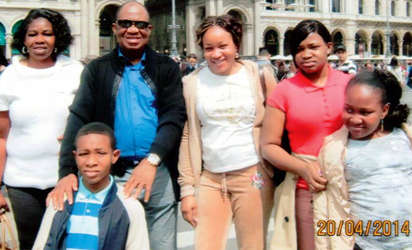
Ikpea and his family
Chief Leemon Agbonjagwe Ikpea, the founder of Lee Group of Companies, has just been conferred with the title of the Odolagbon of Warri Kingdom by the Olu of Warri, HRM Ogiame Ikenwoli.
Ikpea, in this interview, speaks on his grass to grace story, starting with his tough childhood experience in Warri.
What is your link with Warri?
Warri people are amazing, nice and loving people. In those days in Warri, nobody regarded you as a stranger; back then we all belonged to Bendel State from being Midwest State. You wouldn’t know who was Urhobo, Itsekiri, and Esan or from any other tribe, because as long as you are in Warri, you are a Warri boy and all of us youth, who were friends were just like one big family. We had some night clubs, Zeno and Lido, among others where we met regularly on weekends and, when coming back home, we walked freely, because the town was virtually crime-free. There was nothing like armed robbery or kidnaping; you trekked to your home, telling stories with your friends; that was the life we enjoyed in Warri in those days.
What is your relationship with HRM Ogiame Ikenwoli?

Ikpea and his family
I met the present Olu of Warri, HRM Ogiame Ikenwoli at St. John’s Primary School in 1962. We were small boys in our blue shirt on blue shorts uniforms with no shoes. We were all one family. The primary school was directly opposite the palace of the Olu where there was a big building of the CAC. It was the church that we attended and the school was built by CAC. That was how we met but after primary school everybody dispersed but met from time to time. We visited him at the palace and, even at the palace, nobody took any notice of where you were from, because everybody was regarded as belonging to one family. Warri Kingdom is an amazing place and I’m happy I grew up there and the discipline I got from there is what is helping me till today. Long ago, I saw him as a king, because he was very composed, very calm. It was not by accident that he became the Olu; he was very close to his father and the community also loves him.
Can you tell us more about your early education?
After primary education, I was admitted to Baptist High School, Orerokpe, about 30 minutes’ drive from Warri by car and up to two hours by foot. In those days when I was in secondary school, it was compulsory for every student to show proof that he has paid school fees.
An announcement was usually made during assembly that every student in the boarding house should take his teller to the dining hall during lunch. When such an announcement is made, I always knew they were referring to me, because I always defaulted, but it was not my fault, because my parents, they tried, were not able to meet up in most cases. So, when they asked for tellers, you know what it means when students are taking their lunch and the dining hall prefect now demands to see everybody’s teller and out of the multitude in the dining hall, you are the only one without a teller and they will walk me out. That was my experience and each time they walked me out, you could imagine the psychological torture. I will leave the dining hall and trek to Warri.
So, imagine trekking from Orerokpe to Warri; it is not a joke. Then I was still very young, so when I sight a vehicle coming I will hide in the bush until it passes by because I was afraid of being kidnapped. My parents always understood why I was out of school when the term just began. I will then proceed to do menial jobs to raise the school fees; I have pushed truck/cart, sold newspapers, yes, I have been a newspaper vendor, selling Observer newspapers,
Daily Times, among others. I was also working as a tally clerk, doing inventory of what was discharged from ships at the Warri Port. I pushed truck in Warri and my people witnessed it because it is not something you can hide. And, in those days in Warri, you wouldn’t see people stealing, because you must struggle genuinely to survive. Well, I managed to finish school, but I didn’t have the result, because I wasn’t stable in school. Sometimes, I would spend four weeks outside school to work and save money for my school fees; and those days, children were very honest, because if I earned 5 or 10 pounds, I would give everything to my father and he will pray for me and he will save it until we were able to get the total amount we needed as school fees and then I will go back to school. In the midst of this trying period, I lost my mother when I was in class three. I lost my mother 43 years ago. My father died 11 years after my mother’s death.
What was your first job and how did you manage to establish your own company?
After leaving school, I wrote applications to many companies and one of the companies was Whessoe Incorporated from Darlington in the UK. The company was engaged in the construction of the Warri Refinery, which started in 1976. The first phase was commissioned in 1978. There were various phases until we had the petrochemical section. The company I worked for was the major company that built that refinery. I also wrote to the Nigerian Ports Authority (NPA), which was the first company to invite me to start work. I started work in the morning and, the next day, in the evening, somebody, from Whessoe, came to visit me and invited me to their office to work the next day. I sought the opinion of friends on what to do and they me to go to NPA since it was a pensionable job, but I knew I had to discuss it with my father. I did and he told me to go to Whessoe, where I worked for three years and the job ended, which reminded me of what my friends told me. However, one good thing about life is that when you are working, you have to be honest and commit yourself to the job because people are watching you and these were British people, who were watching me and I did not know. When Whessoe completed their work at the refinery; they specialised in tank building, while Snamprogetti, an Italian company, was the major contractor building the refinery. Fortunately for Whessoe, they had a project in Forcados for Shell, so they had to draft me to Forcados and, after doing the entire job they needed to do for Shell, they relocated from Nigeria. When the overall boss in Whessoe Nigeria, Peter Wagner, was to leave, I accompanied him to the airport in Warri, but I never knew this man had written a letter recommending me to Snamprogetti and he did not
let me know. At that time, I did not know what to do, because I was training my younger brothers. So, as they announced that Aero Contractors was boarding to Lagos, I told him and, as he was walking to the boarding gate, he turned and handed an envelope to me and said, ‘Leemon, give this to Mr. Sam Poulo in Snamprojetti tomorrow,’ but didn’t tell me the content of the envelope, this was in 1980. I didn’t open the envelope to check what was inside either. The next morning I went to the office of Snamprojetti inside the refinery and told the receptionist that I needed to see Sam Poulo, the overall boss, but he said I couldn’t if I didn’t have an appointment and advised me to return on Thursday, which was the visiting day. He asked to deliver the letter on my behalf but I refused and I told him Wagner asked me to see Sam Poulo on that day because they might have discussed.
As I turned to leave the reception, Sam Poulo and four expatriates came out of his office and I greeted him and he asked if I had a letter for him and I gave it to him. This was divine intervention. He asked me to follow him and took me to the head of the personnel department and told him I was the one they had been waiting for and told him I was from Whessoe. I was given a position as wages supervisor on the spot. I worked there for eight years and became the personnel manager. Whessoe was building tanks, repairing collapsed tanks because they had the technology, while Snamprojetti built the refinery, the petrochemical plant, also because of their expertise, but Nigerians were the ones doing the job; the expatriates were only supervising and providing equipment; that is where my ‘university’ education came from, because as a personnel manager in those days, I didn’t spend my time sitting in air-conditioned office drinking tea; I went to site, from one section to another to inspect production work.
I come from a very poor home, should I remain there forever? When I closed from work sometimes, I will go to the primary school where I finished- St. John’s- I will kneel down there praying and crying. Snamprojetti had to wind up in 1988 and only three of us were left at this time. But before they left, they needed to build five tanks but this time they awarded the job to ABB-SOIMI. SOIMI was a company that ABB bought over.
When we were about to transit to SOIMI, my boss, Mario Betulli, called me and asked if I was interested in working with SOIMI and I accepted. He said if I didn’t like the pay at SOIMI, then he would look for another job for me. I joined them and, in 1990, I quit because I was getting weak from going to work every day of the week from 7 AM to 6 PM for 14 years without going on leave. I decided to start my company with the contacts I had made on the job. So, I approached my boss, Franco Koroner, and told him I would leave on July 1, 1990 and gave them the letter in June. I now established Agbon-Lee Enterprise and we were located at 120 Okumagba Avenue, Warri. A year after, the enterprise transformed into Lee Engineering Construction Limited. Snamprojetti gave me a VW Beetle and some cash but I didn’t have savings because I was training my brothers.
My wife didn’t like the fact that I quit my job. But shortly after that, SOIMI wrote to say they wanted to send me off. During the party, I told them about my life and admonished them to serve their parents and tell them the truth. After my speech, Koroner told me I would need to support them still even though not as a staff. So, they put me in charge of their casual workers- I didn’t beg for it- and I was charging 18 per cent. If the salary for the casual workers is, for example, a million naira, I will get 18 per cent of that amount for managing them; because there should be no strike, no disturbance and my coming back for that purpose was fantastic.
I was not going to work daily as before, and I bought a 40ft container where I started my business from and, within a year of leaving the company, things improved and I bought a Peugeot 505 and a Mercedes Benz. We grew and had to move to a bungalow at Crystal Palace Estate from where we moved to our own property at NPA expressway, occupying about seven acres of land. It is very big and anything you find in Saipem, you will find there, as well as anything you find in Europe. It was commissioned in 2012 and our major clients are Shell, NNPC and major IOCs. We moved from supplies to having good electromechanical jobs, including welding and we were either paid in Naira or in US Dollars. I used the same people who worked with me when I was personnel manager. I have about 1,300 workers where we are today. We thank God for the recognition by our immediate community.
I am being honoured by the Olu because of the contributions of Lee Group of Companies in Warri and the impact of our companies in the lives of the ordinary people. 85% of our business is in Warri.
When did you come to Lagos and why?
I left Warri in 1995 for Lagos, but that does not mean I relocated because 85 per cent of my business is still in Warri. The operational base of my company is Warri. I had to come to Lagos, because most of the approvals for what we are doing are given from the offices here. For instance, NNPC is here, Mobil and Shell offices are here. So, for us to grow the company well, we had to get close to them; that is why we are in Lagos.
What are your plans for the future?
We know a time is coming, maybe not now, when the oil will dry up, so we are thinking of diversifying into other areas like farming and aviation. We have started with water production.
You are not only a major player in the oil & gas business, you are also a social entreprenuer and a philanthropist. What motivated you to found Agbonjagwe Leemon Ikpea Foundation?
Since God has blessed me, I needed to be a blessing to others. My first priority are orphans, children that are passing the same road I took some years ago, because I know what it means when you cannot pay your school fees and when nobody cares for you. Somebody needs to comfort them and I feel that I should be that person. So, I established a foundation in 2012 called Agbonjagwe Leemon Ikpea Foundation (ALIF). As at today, we have 385 students that have passed through us. We are also taking care of widows, old people who do not have people to care for them and they need to eat. So, every month, my foundation gives them allowance, as we are paying our workers’ salaries. We draw up a scheme for the widows for them to have some trade to enable them care for themselves and their children. We train artisans on welding and electrical works, pipe-fitting and train women in some communities on sewing and hair dressing. We also assist people with serious ailments like liver and kidney problems, and even cancer. We sent about 15 people to India but we lost one and the others are still alive today. One just returned from treatment. I was honoured with Doctorate Degree in Business Administration(Honoris Causa) by Benson Idahosa University; in 2004, Ambrose Alli University,Ekpoma gave me Honorary Doctorate Degree in Business Administration (Honoris Causa) for what we are doing for humanity; we didn’t ask for it but they see what we are doing. Charity begins at home. I never forgot where I came from and, from time to time, I always support the aspiration and progress of my people. As a Catholic, I support the church and, to the glory of God, very soon, Jesuit University is going to be established in my town, Ewatto.
Disclaimer
Comments expressed here do not reflect the opinions of Vanguard newspapers or any employee thereof.