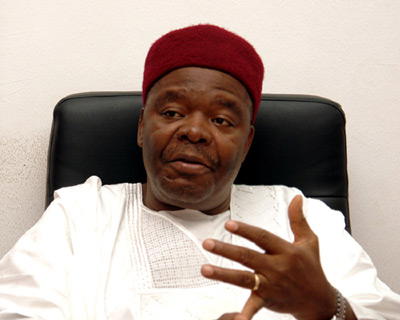
Sen. Jonathan Zwingina
SENATOR Jonathan Silas Zwingina represented Adamawa South Senatorial District on the platform of the Peoples Democratic Party, PDP between 1999 and 2007. While in the National Assembly, the former Senate Leader held various positions such as Chairman committee on Works and Housing, Establishment, Internal Affairs, Information, Special Projects, Privatization and Economic Affairs. In this interview, Zwingina bares his mind on burning national issues such as the crackdown on judges by the Department of State Services, DSS, and the clamour for restructuring of the polity . Excerpts:
By Ben Agande
What is your take on the controversy trailing DSS crackdown on some justices and judges?
Why should there be a reaction, is the judiciary above the law? They are not. How can the judiciary be placed above the law? It is not above the law, check the constitution properly; in fact they should even lead by example because this is their career.
Why should some people feel they are sacred cows that cannot be touched? I think it is a bad example to say that someone is above the law because he sits in judgement over others.
Let the prosecuting authority produce the evidence so that at the end of the day it would end up in court and the court would adjudicate properly. But the idea that some people should be immune from prosecution or arrest, I think, is not proper.

Dr. Zwingina
On the resurgence of militancy in the Niger Delta and agitation for Biafra Republic
The resurgence of militancy did not start with this government to the best of my knowledge. It arose in a very loose set up that President Goodluck created in this country where the entire system had no authority at all or appear to have no authority.
There was so much recklessness, so much loose hands everywhere, so everybody tried to test the system; Boko Haram were testing the system over there, kidnappers were testing the system in their own enclave, other people were testing it, Niger Delta were a bit quiet maybe because they had enough offers or probably bribe to keep them quiet and that was it.
But I would say that the foundation for the testing of the power of the state did not arise with Buhari, he met it there, maybe some aspects became worsened because they were affected by the war against corruption.
But that is also going to come to an end because you can see clearly there is no future for criminal activity anywhere in the world, it is just for a short term; the moment the state concentrates on your enclave it has to stop.
Biafran agitation
The Biafran thing is almost ill fated, I don’t think even the fighters of those who are arguing for Biafra expect that they will get a Biafra. Biafra is not an example that came out of joy, it was a painful experience by those who went through it and those who were even on the other side.
Maybe that is why when you look at the people talking about it, they are young, probably they didn’t have the experience of that time. The old ones who went through it are not talking about it because they saw what it was.
How would you respond to the call by some people for the restructuring of Nigeria?
I have always maintained that Nigeria has been undergoing restructuring gradually. The, simple meaning of restructuring is, distribution of powers and authorities within the setup and this has been going on.
It started with the four regional governors, came around with 12 state governments and from 12 to 19 state governments, then to 30 state government and now to 36 state governments and six informal regions.
So restructuring has been going on and what some people had been asking for is more restructuring in some areas than others and if that can be argued and discussed and passed on to the National Assembly for legislation.
So I don’t dismiss it but I don’t think that we are looking for something that would be abrupt, it is a process and it has been going on, we should admit that we need to make some changes.
For example some of the aspects of the call for restructuring are state police. State police is a form of restructuring of federal authority on security and that looks very reasonable.
Do you support it?
Why not because the more authority we create to combat crime, the better. State police will have their own authority defined by the constitution, so there will be no conflicts. And don’t also forget, part of the restructuring is asking for genuine autonomy of local governments and I would support that because right now they are like a two tier system of government, we have states and then we have federal, local government is like an annexure of the state.
Then if we are going to have a restructuring that will ensure reduction of federal powers which would be accompanied by reduction in resources, why not, that can be discussed and agreed.
It is not a matter to fight or quarrel over, it just sounds reasonable that some of them need to be addressed and some of them may not go the way the people are arguing but all of that can be discussed. So it is not something that someone can come and say it is by force, it has to go to the parliament, don’t forget we have a constitution.
Nigeria’s restructuring
There is no restructuring that is possible outside the constitution and by the constitution any formula for restructuring that you propose has to go to the National Assembly and our representatives have to decide and that is really when restructuring will take place. But some people are talking about restructuring as if it can happen without the National Assembly, it is not possible.
Talking about the National Assembly, you were one of the shining stars from 1999 – 2007, looking back now, what is your impression of the content and the context of the National Assembly?
The National Assembly, like all parliaments all over the world, grow and mature with time and experience and it has happened in our case.
A lot of things have become a lot better in terms of quality of legislation with the knowledge available, experience and a lot of that.
So I have been very happy with the progress made. Issues are different because every generation has its own challenges.
I cannot sit down and use the challenge of 1999 – 2007 to assess a parliament that came after because every generation has its own challenges and respond in its own peculiar ways to the challenges of its kind.
And I would say the parliament over time has responded to its own challenges in its wisdom and creditably. Some of the challenges have been very trying but they have stood up. What is the measure of the credible response to challenge.
The measure is whether the time tested formula of majority decision was applied.
And I would say that in all the decisions that faced the parliament whether Senate or the House of Reps, all of them were answered with time tested formula for resolving them.
You send the matter to a committee, you go to the plenary and you vote and that is the way it is done everywhere in the world, it cannot be different in our case and it has not been different and the moment this formula is applied, the matter is resolved.
And so each time I find so called crisis in the Senate or the House of Reps, I tried to find out how they are going to resolve it and I always find that they use that formula.
Does your satisfaction include the recent case in the House of Reps where a prominent member made some allegations?
I was very disturbed by the kind of allegation that the man made. The man was actually behaving like a soldier about to overthrow the civilian government, virtually running down even things he took part in.
So I wanted to see how the House would respond and they responded very creditably. What did they do? They set up a panel and they invited him but he didn’t go and so the panel took a decision, went to the plenary, debated it and they voted and the majority said that what he stood for was wrong and he needed to be suspended.
And this is the way it is done anywhere in the world and that is why I am saying that the House has matured just like the Senate has also matured. So these are the challenges of their own generation and they have stood up to it. Once a parliament respects the rule of due process in arriving at a decision making, it can overcome any single problem facing it.
What about the suggestion that members of the National Assembly should serve part time?
That is a very thoughtless suggestion. Are we the only parliament in the world? Is there anywhere in the world where parliament is serving part time? Are the US, British and other countries’ parliament serving part time? Why are people making ridiculous suggestions? Is the job of parliament different from their own because maybe some people don’t understand how the parliament operates?
The First Lady raised an alarm saying that a few people, who did not believe in the vision of the APC seems to have taken the President hostage and are implementing policies that do not belong to the core values of APC. What do you think?
I cannot say much about that because I respect the wife of the President and I don’t think those comments were meant for people like me. I think that the fact that she made those comments shows that our President is more broad minded and more accommodating than we were meant to believe and he has accepted it and I am sure he will do something about it since he has heard it.
So, I think we should allow those comments to serve the purpose for which they were intended. It is not for distant people like us to make comment on what the wife of a President is saying. Maybe it has served its purpose and we should leave it at that. She is a very thoughtful women, she is very knowledgeable, there must be a reason why she made the comment and I am sure it would attract the appropriate positive response.
What do you think of the committee headed by Sen. Ken Nnamani on electoral reforms?
It is a wonderful thing and I am happy about it. I have been invited to work with that committee as consultant and I am very proud to do that and I know that committee will definitely go far. I know Sen. Ken Nnamani, he is a very serious person, he was my senate President, I know him to be very thorough, diligent, serious minded and very patriotic and he will not leave anything to chance, he will take care of every aspect that Nigerians are prepared for. He is someone who devotes all his energy to whatever he is given. Once he has accepted it, I know that he and his colleagues will succeed and so I am very happy with it.
What makes me even happier with it is the fact that the President trusts that committee so much that he allowed them to reduce their recommendations to bills, either amendment bills or fresh bills or whatever they will propose. That is an extent of trust that maybe if the former government has known it would have done that with the Mohammed Uwais’ committee.
If you read through the Uwai’s report which I did, you will find out that a government will require another committee to reduce all that to a bill or amendment. And so unless the government is committed and has time, it could be distracted along the way especially when electoral matters begin to come on board.
So the President was wise enough this time to say ‘look don’t just make suggestions, propose amendment and even go and lobby for their passage’. I think that kind of mandate is very unique and I think Sen. Ken Nnamani would do a wonderful job on that and he will go about it most credibly. I should be able to testify for Sen. Ken Nnamani having worked with him as deputy majority leader under his tenure. He does everything thoroughly.
Do you sometimes have fear about the continuous dissolubility of Nigeria having transvered across the country?
How can I have such fear? I don’t have such fear that one day we will wake up and Nigeria will be dissolved, by who? All those are people who don’t know the country very well. I will say that our press has a duty which is to promote values more that bring us together.
Nigerian is so integrated, that the issue of dissolubility no matter what some people may be pushed to think, it is not feasible. You will find people across the board in business relationships, people across the board in political relationship; our party system brings people from all the states together by constitution of the party and of the nation, our National Assembly is the melting point of the whole country.
So the lines where the country will divide, I have not seen the lines; fringe elements calling for it and getting press coverage is that what should disturb us much? It should enable us to address the issues those fringe elements are complaining about. But they are not issues of dissolubility, they are issues of maybe some neglects that some have felt here and there which can be addressed and solved. It is just that when people want to get attention, they cry so loud so that you are able to see that they are crying.
And so they shout along lines of threatening the whole country so that you can actually address the issues they are complaining about. But I think we have come so far that the threat of disintegration in my view is not something I worry about at all.
I have known this country so well, from my own little experience and from the experience from elder citizens I have integrated with, we have become integrated that we can only complain and solve the problems we are complaining about. But I don’t see the complain of dissolution being a very serious and prominent complain that can be realised.
The APC came into power on a crest of popular acceptance but this popular acceptability seems to be waning fast. What do you think is responsible for this?
It is waning because of the coincidence in the international system; it is not weaning away as a result of the policies of the government so to speak. There is no where today in the international system where oil is a factor that what we are going through is not happening there. There is a sharp drop in GDP growth everywhere where the economy is based on oil; they are struggling to find alternatives, struggling to find ways out of it like we are doing.
So the sharp drop is occasioned by those circumstances as I said, it is just that our people obviously are feeling the heat and naturally they should complain and naturally the sitting government should bear responsibility for what is happening and answer questions which they are doing.
But I think very strongly that we cannot say that President Buhari is responsible for the low price of oil, we cannot say he is responsible for the changes in international but we must say that the government he leads has to do something about and that is being done.
I believe that maybe it is a very lucky government because the crisis started very early but by the time we move to 2017, IMF and World Bank have said that our recession should be over by that period and Nigerians would begin to see the dividends. A lot of credible Nigerians are rushing to give suggestions, international communities, big powers, IMF, World Bank, they are all worried about Nigeria and that should make us happy, they are concerned about us and they are bringing wonderful suggestions, offers, even some of them are bringing credits.
So I think that means that the good will is there, we should begin to worry once we don’t have the good will, once we are in a crisis like this and people are not coming or making suggestions, our President is not being received well, we should be worried. But now that we have a crisis and everybody is sitting up to help us, our President is well received everywhere, International financial institutions are rushing here to assist us, it means the good will is in us and that should give us a very good signal that the problem will soon come to an end.
But beyond these factors that are beyond the control of government, what would you point out that this government has done credibly in the last one year?
I will say first and foremost the security. I am from the North East and I can tell you that there is a remarkable difference between then and now. The change of style, the change of strategy, one from international friends and others, the situation has been reversed, life has returned to now at least in my state Adamawa and even in Borno where boko haram had the worst experience, things have shaped up and flights are now going to Maiduguri and people are now going back to school. Even the enemies of government are aware and have spoken that something good has happen here and I think we should commend the President for that. It is not over and even the government has said it that it is not over but the worst period is over, the rest is mopping up operations that the security is doing.
The issue of anti corruption is going on and it is not a very pleasant one because people that were benefitting would be fighting back and some are doing so. But there is no doubt that the war on anti-corruption is going on; people can say it is not going the way they want or only some people are been attacked and not others or something is happening but nobody has said that the war has stopped, it is going on. So that item on the manifesto is going on.
But would you say that the fight against corruption is holistic?
It cannot be holistic. Will you catch all the criminals of Nigeria in one day?
People have alleged that it is targeted at…
It is targeted at those whose evidence is visible, that is how corruption is fought everywhere in the world. No police man can arrest all criminals at the same time; the criminals whose evidences are available to the police are the ones who are prosecuted first, that is how it is done everywhere in the world. It is not just normal because you don’t expect the EFCC to wait until they can catch everybody, they will not be able to prosecute them because of the numbers.
So wherever they are able to do some works and investigations and they can move ahead, they do, it is the practices everywhere. This hypocrisy that we would gather all the criminals first before we start, it means we will do nothing. So wherever efforts has been made, that should be ended before you move to the next and that is the process everywhere in the world.
Is there a country where every criminal has been arrested? None! So why are we expecting Nigeria to be different; it is just an excuse to block the campaign otherwise they are doing their best and let’s encourage them rather than discourage them. Let is encourage them that the people found guilty should be properly prosecuted and the prosecution should come to an end with a court decision, no linger on like cases that started way back in 2007 and still lingering on.
You headed an election campaign in the 1990s that people make reference to as one of the best run. What do you think APC did right and PDP wrong that has now brought about this tremendous transition?
I think what APC did right was to bring together a coalition of so many people that were dissatisfied with the whole order and most of these people are not only from opposition politicians but also from within the ruling party and they came together, formed a massive coalition, made the necessary compromises and gave it the name of APC, with a very promising manifesto, promising constitution and promising leadership; I think on that they did very right.
PDP did wrong in that they took their long stay for granted. Ordinarily the moment you serve two terms, people are already tired of you. In the US you hardly find a government that after two terms of a Democratic Party, it moves over to another Democratic Party government, it may happen this time but it is a rare thing because after 8years, people just want change.
Now PDP had 8years and took another 8years, of course people would be tired, even the name people got fed up with it; but the worst was the impunity that set in and the assumption that well a ruling party cannot be displaced, I think this two things and then other tactical errors made by the leadership, during the campaign, before the campaign, a number of things that were taken for granted and clear errors.
So I would say that we thank God that once there has been the transition that provides an opportunity for the APC to learn from the mistakes of the PDP and for the PDP to learn and also re-strategize itself so that it can be strong. Our democracy would be better if the two leading parties are strong and can replace one another after a certain intervals it doesn’t have to be 4years or 8years or 12years but at least let there be some intervals where people can decide.
Looking back and as one of the prominent figures in the PDP then, do you feel a thing of guilt that the house also contributed to this?
No, those that can feel guilty are those who have the capacity to decide at the top leadership. You may come down the ladder, once your opinion is proffered and it is not taken account of, why would you feel guilty? We made contributions; I ran a credible campaign where we won elections in 2013, so it is not for lack of not knowing what to do.
But if you proffer your suggestions and you table on what should be done and you do not have the right audience or other people who came and claim to have a better knowledge and came with perhaps better company and made a different case and perhaps the persons who were responsible to choose chose the wrong decision, why would you go and feel guilty, you can’t. you will feel guilty only if you sat on the sidelines, you feel guilty if you did nothing, you feel guilty if you did not make suggestions, if you did not make the efforts.
Disclaimer
Comments expressed here do not reflect the opinions of Vanguard newspapers or any employee thereof.