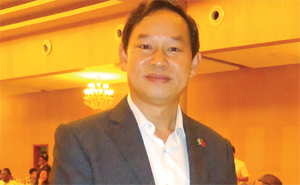
Chao Xiaoliang
Chinese Society celebrated the 45th anniversary of China-Nigeria diplomatic ties, the Moon Festival and National Day Party at the Oriental Hotel, Lagos. In this interview conducted at the occasion, the Chinese Consul General in Lagos, Mr. Chao Xiaoliang, sheds light on the bilateral relationship between China and Nigeria.
How is your experience in Nigeria?
It is my first time in Lagos, Nigeria and second time in Africa. Twenty-six years ago, I worked in the Chinese Embassy in Ethiopia, so I feel I am on a familiar terrain.
What do you think Nigeria and China have in common?

Chao Xiaoliang
I think China and Nigeria share a lot of similarities. First, we have same National Day, October 1. Also China is the most populous country in Asia and the world, and Nigeria the most populous black nation in Africa and the world.
China is the largest economy in Asia while Nigeria is a leading economy in Africa. We share a lot of similarities in culture and strategic knowledge about the international situation and economy. In the trade area, the trade volume between China and Nigeria has grown fast in the past few years.
In 2015, affected by the sluggish world economy, our trade volume reached 14.94 billion dollars, 17.2 per cent less than that of 2014. However, Nigeria remains the largest market for Chinese contracted projects and the second largest market for Chinese exports and the third largest trading partner in Africa.
Looking at the economy situation presently in Nigeria, what can China do to help Nigeria investment wise?
As you can see, there are so many Chinese companies in Nigeria despite the economy downturn and more are willing to come. As the Chinese Consul General in Lagos, I hope these Chinese companies can continue to stay while we ensure more of them come to Nigeria to invest. Also, the drop in the price of crude oil is an opportunity for both countries to explore other areas with present administration’s promise to enact new policies to diversify Nigeria’s economy in sectors such as agriculture, mining and manufacturing.
What lesson can we learn in order that the blossoming relationship between the two countries to become a win-win situation?
As I said earlier, China is the number one economy in Asia and number two in the world while Nigeria is number one economy in Africa. I think if the two countries work closely, both of them can come up with workable plans for economic growth. Nigeria is also a major destiny for Chinese out-bound capital. By the end of 2015, China’s non-financial direct investment to Nigeria was 1.55 billion US dollars, 17.6 per cent more than that of 2014.
Furthermore, Nigeria has seen major projects by Chinese enterprises such as Abuja Light Rail, Lagos Rail Mass Transit System and Abuja-Kaduna railway, which have greatly improved infrastructure in Nigeria and improved the life of the people. Each year, the Chinese government gives about 100 government scholarships while more than 400 Nigerian students are funded by their families to study in China. Over all, the people-to-people and cultural exchange between China and Nigeria have significantly reinforced mutual understanding and friendship. As members of the UN, China and Nigeria have extensive cooperation in many international and regional issues.
The Chinese people will never forget that Nigeria and other developing countries from Asia, Africa and Latin-America stood up to outside pressure on the “One Policy of China”, and fully supported China’s in securing its legitimate seat in the United Nations.
Nigeria is an important partner of China and the biggest economy and most populous country in Africa. China will firmly implement the policy of sincerity, real results, affinity and good faith towards Nigeria and Africa, uphold the correct viewpoint of righteousness and benefit, join hands with Nigeria for win-win cooperation and persist in planning and promoting bilateral relations from a strategic and long-term perspective.
Twice the Nigerian economy has been in recession. What do you have to tell your host government?
Early this year, President Muhammadu Buhari paid a state visit to China. During the visit, the two countries reached far-reaching agreements. As Consul General, I will work together with my Nigeria counterpart to follow up on these agreements. China-Nigeria friendship has stood the test of time and geographical distance.
It is booming with even greater vitality despite the vicissitudes of the changing international situation and has yielded great fruits. The Chinese government supports Ppresident Buhari’s present hard work to make Nigeria a better place.
Disclaimer
Comments expressed here do not reflect the opinions of Vanguard newspapers or any employee thereof.