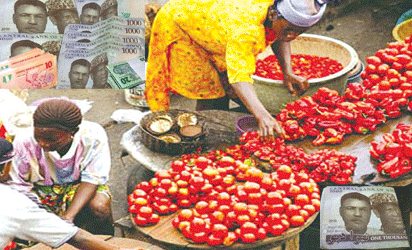
“There is a serious problem as to whether Nigerians will be able to feed themselves, considering the rate at which prices of goods are going up.” says Mrs Ayanu Olatoyinbo, a trader at the Folashade Boundary Market on the Lagos-Abeokuta Expressway.
Mrs. Olatoyibo and other traders, Thursday, lamented the continued drop in daily sales in the last three months due to low patronage from customers, a trend that is the direct result of inflation.
The traders told newsmen in Lagos that the development was a fall-out of the rising cost of food items, which had led to low patronage.
Mrs Ayanu Olatoyinbo, one of the traders, said that a 25-litre gallon of palm oil, hitherto sold for N7, 000, was now going for N17,000.
“Everything is so expensive. The 50kg bag of rice that was sold for N6,000 early in the year is now N18,500.
“The 25-litre measure of vegetable oil, which sold for about N7,000 at the beginning of the year, now goes for N14,000.
“Government should come to our aid; there should be plans to ease the difficulties Nigerians are facing because if there is hunger, the people will not be happy,’’ Olatoyinbo said.
A bulk orange seller, Mrs Abike Yusuf, said the traders were facing the challenge of high cost of transportation of fruits to other markets in the metropolis from the Mile 12 Market.
Yusuf said the transport operators were making a lot of money at the traders’ expense, charging them exorbitantly.
“The cost of fruits has increased tremendously if you compare it to last year.
“Around this time last year, a large basket of medium-sized orange sold for between N1,500 and N2,000; it now goes for N3,500.
“Same goes for watermelon, depending on the size. It ranges from N300 to as high as N600 for sizes that would ordinarily be sold for between N200 and N300.
“Now, the major challenge is that transporters are now charging us too much per trip, from either Mile 12 Market, Oshodi, or from Ifo in Ogun, ” Yusuf said.
NAN checks at the market earlier in the day, indicated that sales were halted as traders were clearing their surroundings, in line with the Lagos State Government’s directive on sanitation.
Markets in the state remain closed every Thursday from 7.00 a.m. to 10.00 a.m., to observe the sanitation at the markets.
The Iyaloja of the market, who simply identified herself as Mrs Ibrahim, said that traders were duly punished if caught selling between those hours of sanitation.
Ibrahim said the wastes generated were promptly cleared by the Lagos Waste Management Authority (LAWMA) twice daily at 10.00 a.m. and 9.00 p.m.
Disclaimer
Comments expressed here do not reflect the opinions of Vanguard newspapers or any employee thereof.