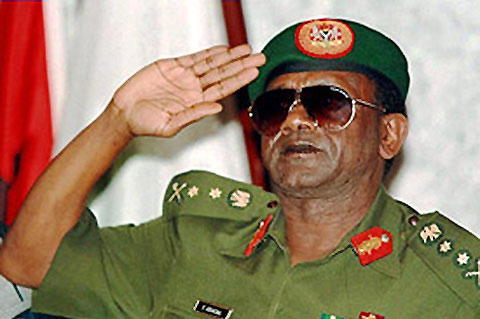
Late Sani Abacha
DOUGLAS ANELE
The concluding part of our marathon series on the pointlessness and folly of the revenge coup of 29 July 1966 published last Sunday needs some improvement. First, it ended a little bit abruptly, and seemed, in the words of the British novelist, Thomas Hardy, like “a fraction looking for its integer.” Aside from brief statements of what eventually happened to some of the key players in coup,
I did not even mention its repercussions on the country as a whole. I hope to fill that lacuna in this essay. Second, I mistakenly asserted that Muhammadu Buhari “had a taste of his own medicine when Babangida, Sani Abacha and others removed him as head of state on the very last day of December, 1983.” Actually, Buhari was overthrown on August 27, 1985.
Again, there is need to give a fuller account of Lieutenant-Colonel (later General) Yakubu Gowon, who not only benefitted directly from the murder of Ironsi by becoming the second military head of state but also led Nigeria during the civil war. Previously, I had noted that although there is no conclusive proof that Gowon was one of the ringleaders of the revenge coup, nevertheless there is strong circumstantial evidence that he was complicit in it.
As reported by Iloegbunam and Siollun in their books cited earlier, Gowon’s conversation with Major Danjuma before the latter went to arrest Ironsi and Fajuyi implies that he endorsed what Danjuma and the northern soldiers with him were doing. This is disgraceful, considering that Ironsi was really fond of Gowon, which was why he appointed the latter his chief of army staff ahead of officers senior to him, such as Commodore J.A. Wey and Colonel Cornelius Adebayo.
Now, one of the core officers who plotted the coup that removed Gowon was Colonel Joseph Nanven Garba, commander of the elite brigade of guards and a trusted friend of Gowon. Just as Ironsi would have doubted any security report of a coup plot against him involving Gowon, Gowon was incredulous that his trusted security chief from the same Benue-Plateau would conspire with others to remove him. Indeed, it was Garba himself, speaking in a tense emotional voice, who announced the overthrow of Gowon in a bloodless military coup. Now, it is believed in certain quarters that the coup of January 15, 1966, was the “original sin,” because it marked the beginning of military takeover of government in Nigeria.
But although it is undeniable that the coup in question was a turning point in our history, its motivation and character are markedly different from the second coup of July 29 the same year. As we argued earlier, the first coup was motivated by nationalistic and idealistic considerations by soldiers from different regions to end gross incompetence, nepotism and corruption in government. In addition, if the coup had succeeded, its prime movers intended to hand over power to a civilian, Chief Obafemi Awolowo. On the other hand, the craving for revenge, ethnic hatred, and desire by northerners to subjugate the Igbo motivated the second coup, which was unnecessarily vicious and bloody. Therefore, the coup of July 29, 1966 opened the legendary Pandora’s Box by laying the foundation for subsequent coups motivated by the love of power and entrenchment of northern hegemony over the entire country.
Now, the same cabal of officers, for selfish reasons, carried out most of the coups that established military regimes between July 29, 1966 and August 27, 1985. And all the subsequent military heads of state, all of whom are northerners – with the exception of Olusegun Obasanjo, who became military leader by default – were connected one way or another to the revenge coup of July 1966.
Max Siollun argues that the coup plotters behind Nigeria’s military regimes were repeat offenders – often with fatal consequences to themselves.That is true in some instances; but several participants in the revenge coupbenefitted from it. In fact, the northern revenge coup established a pernicious trend in military intervention in governance: it served as a model for power-hungry, ambitious and greedy military officers to seize power by force, sometimes through killing their colleagues and trusted friends, because of the access to wealth and influence made possible by a successful coup. As a corollary, it means that a successful coup plotter would never be called to account for his actions. As Lieutenant-General T.Y. Danjuma remarked, “If you carry out a coup you must jolly well succeed. If you don’t, you are a traitor and must be prepared to take the consequences.”
As a purely revenge coup, the July counter-coup was a huge success. The number of Igbo military officers killed was between two hundred and three hundred. Although before the coup majority of the Non-Commissioned Officers (NCOs) were from the north, Igbo soldiers formed about two-thirds of the officer corps in the army. Since the revenge coup, however, northerners have consolidated their stranglehold and numerical superiority at all levels in the military. This has created a northern military dynasty or oligarchy, which has effectively marginalised southern Nigeria, particularly the Igbo. From July 29, 1966 to May 29, 1999, fifteen officers had been appointed chief of army staff;of that number fourteen were northerners: after Ironsi no Igbo man or woman has had the privilege of ruling the country despite the unsurpassed contributionsof Ndigbo to national development.
Has Nigeria made genuine progress since northern soldiers connected one way or another to the revenge coup had been at the helm of affairs? Put differently, how has the country fared under the rulership of Gowon, Muhammed, Buhari, Babangida, Abacha and Abdulsalami Abubakar? The honest answer is that there has been a marked decline in the quality of leadership. Having largely eliminated the Igbo from the military, different subsets of the group of soldiers that masterminded the revenge coup have continuously recycled themselves and their puppets in power for the pursuit of selfish and parochial agenda.
The soldiers who brought Gowon to power through the barrel of the gunmetamorphosed into the Colonels that overthrew him in 1975. According to Siollun, a different but unpunished faction of northern soldiers from the July 1966 mutiny emerged once again and murdered Murtala Mohammed in February 13, 1976. As brigadiers and major-generals, the surviving participants kicked out the elected civilian government of Alhaji Shehu Shagari on the last day of December, 1983, and later overthrew Major-General Muhammadu Buhari in the palace coup of August 1985. Because soldiers involved in successful coups who occupied top government and military positions subsequently have never been brought to justice, they tend to use their access to power and wealth to influence the trajectory of leadership in the country in ways that are detrimental to the national interest. Babangida has remained an influential figure among the ruling elite since he “stepped aside” in 1993, whereas Muhammadu Buhari, the incumbent President, who participated in the coups of July 1966 and July 1975, was the biggest beneficiary of the December 31, 1983 coup.
Given that those who belong to what Pat Utomi described as the “1966 class” have dominated leading positions in politics and political economy of the country in the last five decades, they bear the heaviest burden of responsibility for the sorry state of Nigeria today. Beginning with Gowon: although not a complete disaster, his administration which lasted from August 1966 to July 1975 missed a wonderful opportunity to harness the considerable innovative and intellectual capital of Biafran scientists, engineers and technicians for national development probably because of caustic anti-Igbo sentiment in Nigeria when the Biafran war ended in 1970. Moreover, it set the tone for financial indiscipline and wasteful extravagance that characterised subsequent federal governments in the country.
Babangida embarked on a tortuous, expensive and ultimately futile transition programme that ended withthe annulment of the June 12 1993 presidential election. The military imposed the American presidential system of democracy which is so bastardised to the extent that the cost of governance has increased astronomically and is a burden on the citizens. At the moment,
Buhari’s government is not only repeating the mistakes of the past, it has compounded our problems by continuing the covert policy of punishing the Igbo, this time not necessarily because of the January 15 coup or secession of Biafra but because the south east did not vote for him during the last presidential election. Overall, despite the fact that northerners consolidated their dominance politically and militarily after the bloody revenge coup, the average northerner is still worse off than his southern compatriot. Therefore, those who ignore errors of the past are condemned to repeat them.
Disclaimer
Comments expressed here do not reflect the opinions of Vanguard newspapers or any employee thereof.