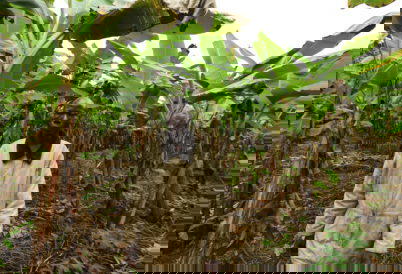
A farmer cultivating
MINISTER of State for Agriculture and Rural Development, Senator Heineken Lokpobiri has called on farmers and food handlers to always carry out periodic examination of their products, to avoid fungal contamination in order to protect public health, and secure good market for Nigeria’s agro-commodities.
The Minister made this call on Thursday at a one-day stakeholders’ sensitization workshop on the effects of mycotoxins on agricultural commodities, health and trade.
The Minister said, “It is imperative for both farmers and governmental agencies to adapt a better method to prevent fungal contamination of agricultural commodities during growing period, storage, handling, processing and transportation.”

This file photo taken on August 30, 2016 shows a farmer walking in his banana plantation at Shofolu village in Ogu State, southwest Nigeria.
He noted that over the years, Nigeria’s agricultural products have been exposed to pesticide residues and mycotoxins producing fungal, resulting in several rejections of some Nigeria’s agricultural produce by some trading partners, particularly the European Union (EU).
Commodity rejection
He noted that the risk of mycotoxins may affect growth performance and could be hazardous to consumers by reducing the quality of products and its market value, thereby resulting in commodity rejection in the international market.
He added that “These poisonous toxins produced by certain species of fungi, have profound adverse effects on the health of animals and humans, as they consume food from crops, poultry products, meat and fish infected by mycotoxins and have resulted in the cause of human and animal illnesses and deaths.”
The Minister called on farmers and other stakeholders along the food value chains to note that Nigeria has a tropical climate with an all year round high temperature and relative high humidity and that this peculiarity provides good conditions for the growth of toxigenic molds. “The only way out from the adverse effects of these climatic factors on agricultural produce is to apply best agricultural practices at all material times”, the Minister stated.
Senator Lokpobiri therefore charged participants at the workshop to convey and spread the information on the negative and detrimental effects of consuming moldy products to the grassroots, adding that “In this regard, the knowledge you will acquire at this workshop would be of immense benefit not only to you but the society at large”.
The Minister assured the workshop that his Ministry would continue to assist farmers and other stakeholders in improving the storage and handling of grains, nuts and other commodities in order to minimize the growth of molds to reduce the risk of contamination.
Disclaimer
Comments expressed here do not reflect the opinions of Vanguard newspapers or any employee thereof.