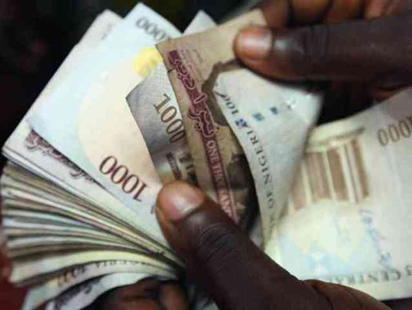
Naira
By Emeka Anaeto, Economy Editor,
Despite the re-admission of the nine suspended banks into the foreign exchange market, parallel market premium at the nation’s foreign exchange market reached all time high last week as inter-bank rate stabilised at N314/USD, while parallel market rate closed at N425/USD.

Naira
Additionally, developments in the Forwards Contract depicted a gloomy future as dealers quoted rates as high as N354/ USD last week, up from N314 previous week.
The parallel market premium defines the gap between inter-bank rate and parallel market rate, which, last week, rose to N111 per USDollar or 35 percent, the highest point so far in the market. The premium was 31.4 percent previous week.
The gap, according to currency dealers, is induced by market distortions arising from forces of demand and supply where, in this case, demand in the inter-bank market outstripped supply and there is a spill-over of the unmet demand into the parallel market, pressuring the rate upwards.
Also, dealers explained that the wide gap was as a result of transactions or demands not supported by Central Bank of Nigeria, CBN, under its extant market rules.
The key rule, according to the dealers, was the ban of 41 items from eligibility product category in the inter-bank market, a development which forced the importers of those items into the parallel market alongside others who are eligible for forex purchases at the inter-bank market but could not get supply due to scarcity.
CBN measures blamed
A fresh pressure had come into the forex market previous week, when the apex bank banned some banks from accessing the market, causing an immediate spike in rates across both inter-bank and parallel segments with the former rising moderately to N318/USD from N308/ USD, while the latter jumped to N423/ USD from N397/ USD.
However, when the apex bank unbanned those banks, they returned to the inter-bank market with exchange rate coming down slightly, but the parallel market rate moved in the opposite direction, thereby raising the parallel market premium.
Analysts at ARM Investments Limited said the renewed pressures at the parallel segment stems from two measures introduced by the apex bank over the month; first, the CBN required mandatory registration of all money transfers unions, MTU, operating in Nigeria, and secondly the ban of banks from the forex market.
The situation appeared worsened in the Foreign Exchange Forwards contract where forex dealers hedge against expected developments in the currency market months ahead.
Last week one-year forwards rate trended as high as N354.70/USD, implying a weaker expectation for future value of the Naira.
The forwards contract at high point, according to forex dealers, also depicts a waning confidence in the capacity of the economy to sustain the market at current demand.
Most foreign investors and Nigerian forex dealers are concerned with the health of the economy which has just gone into recession, while foreign exchange earnings appear gloomy in the horizon.
Forwards contract
The situation appeared worsened in the Foreign Exchange Forwards contract where dealers hedge against expected developments in the currency market months ahead.
Last week one-year forwards rate trended as high as N354.70/USD, implying a weaker expectation for future value of the Naira.
The forwards contract at high point, according dealers, also depicts a waning confidence in the economy’s capacity to sustain the market at current demand.
Most foreign investors and Nigerian forex dealers are concerned with the health of the economy which has just gone into recession, while foreign exchange earnings appear gloomy in the horizon.
Looking ahead
On the fate of the local currency in the days ahead, analysts at ARM said: “Over the rest of the year, CBN reversals and measures to improve forex market liquidity should boost liquidity at the interbank market.
“However, the still bearish outlook on oil prices as well as expected decline in foreign portfolio investments, FPIs, flows to equity market, 78 percent of 2016 FPI flows on average, underpins our bearish outlook on the currency.”
For analysts at Afrinvest West Africa, another Lagos-based investment house, in the immediate term the forex market would be fairly stable during the current week, but the future would depend on the continued intervention of the apex bank to stabilise the market.
They stated: “In the week ahead, we expect activity level at the interbank to stay soft on the back of the general holidays declared by the Federal Government.
“We also opine that the apex bank may continue to intervene at the interbank in the interim in order to clear up rising forex demands.”
Disclaimer
Comments expressed here do not reflect the opinions of Vanguard newspapers or any employee thereof.