ON Monday, August 8, 2016, we were told that the Federal Government had revived the War Against Indiscipline, WAI, a priority programme of Major General Muhammadu Buhari’s 1984/85 military regime. It was under the control of the late Major General Tunde Idiagbon, his Deputy (Chief of Staff, Supreme Headquarters).
Buhari was also conducting the most barbaric war against corruption to deal with politicians who allegedly stole from the public treasury or collected bribes or inflated contracts. The Special Military Tribunals, SMT’s, were set up, and politicians, both the guilty and innocent, were jailed and stripped of their legitimate and illegitimate earnings. Buhari used the SMT’s to impoverish the political class; many of them went to their untimely graves. He damaged the Nigerian political class in the same way that General Murtala Mohammed destroyed the Civil Service.
The immediate import of it was that when politicians came back to the scene under General Ibrahim Babangida’s transition programme, treasury looting became the first incentive for getting involved in politics, and the “bad guys” started having a bazaar. Buhari never told us how much he recovered from the politicians, and what he did with it. The SMT was his unpalatable menu for the “big men”.
For the masses, he unfolded WAI. He felt that the best way to address the general atmosphere of indiscipline and lack of love for the country was to use the military to force people to queue up instead of struggling to outdo one another in a savage demonstration of “might is right”. People were told not to give or take bribes, but no one told us how many bribe-givers and takers were prosecuted and jailed.
Military governors forced civil servants to resume work on time and stay till closure of work, (though this was observed in breach). The famous monthly National Environmental Sanitation Days, which took place every last Saturday of the month ( which is still largely observed in many states) was introduced.
Again, soldiers and other security agencies were on hand to implement it. They did it the only way they knew how. If you were caught violating any of the rules in public, you were “frog-jumped” and beaten to the soldier’s heart’s content. It was later that some states introduced Mobile Courts to try violators of the sanitation exercise.
A unique attribute of WAI was that it was mostly the poor people who walked the streets, markets and open spaces that were caught in the soldiers’ net. They were the ones that the soldiers could beat and kick around.
Don’t get me wrong. WAI did have some salutary effects. When Buhari was toppled, many people went back to their old ways, but a few Nigerians stayed true to it. The Environmental Day has endured, somewhat. WAI was quite effective while it lasted because the officer in charge of implementing it – General Idiagbon – was committed to it.
But when the regime was overthrown, his successor Babangida, scrapped Buhari’s WAI and formed his Mass Mobilisation for Self Reliance, Social Justice and Economic Recovery, MAMSER, which Professor Jerry Gana headed. MAMSER’s efforts produced the best presidential election ever in Nigeria’s history – on June 12, 1993. It was won by Alhaji Moshood Abiola of the Social Democratic Party, SDP. Babangida, in a fit of regional arrogance and abuse of power, annulled the election and scrapped his own MAMSER. He formed the National Orientation Agency which subsists till date. Successive regimes starved the NOA of funds, and Alhaji Idi Faruk, as its Director General, settled for sponsored seminars from state to state to keep the Agency alive.
What am I saying? Buhari’s WAI, enforced with brute military force and impunity, only worked while he was in power, though some of its relics remain. Babangida’s persuasive MAMSER worked by producing the most detribalised election in Nigeria, but the election was annulled and its winner murdered. Nigeria returned to the era when politicians’ supporters killed innocent people when they lost election, and the leader boasted more killing would take place if he lost again. The masses saw that the leaders were not serious with social re-engineering.
Now how do you do it right? How do they do it in other countries we love to go and spend our money? How did our leaders do it before the soldiers came in with their “salvage mission” mentality? The answer is simple: Make the laws and other dos and don’ts (which we have already over-made). Explain them to the people through socialisation or orientation.
The “people” means everybody, from the President to the peasant, no sacred cows. Use every unit of society to spread the message – the families, schools, religious organs, media (especially radio, television and the Internet) and traditional institutions. Let the people know that the law is for their own good, and it is no respecter of person – even the President, Emir, Bishop or Dibia. Lead by example. Don’t tell them: “I feel your pain” when your food bill alone is in billions.
Then organise the law-enforcement agencies to enforce the law. Anyone who does not want to come along willingly will have to come along unwillingly. Pay the law enforcers well. Take care of their welfare. Equip them. Motivate them. But hold them to account by ensuring they work within the same law. This is pretty basic stuff, which our colonial masters left with us and soldiers threw away.
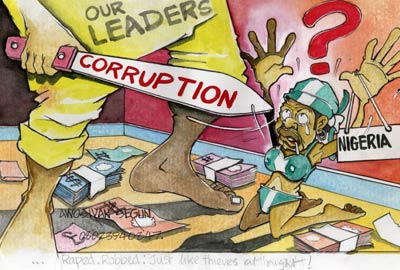
The typical Nigerian has lost faith in government and its agencies because government does not work for them. He faces his hardships, providing light, water, security, education and other things that government should give him. He watches those he elected on the platform of “change” wearing designer shoes and watches, riding in a royal cortege when they return from medical holidays abroad over mundane illnesses such as ear ache, spending our scarce foreign exchange to train their children and relations in elite universities abroad and planting them in the juiciest of our government agencies such as the CBN, NNPC and what have you, when they graduate.
WAI? No!
Disclaimer
Comments expressed here do not reflect the opinions of Vanguard newspapers or any employee thereof.