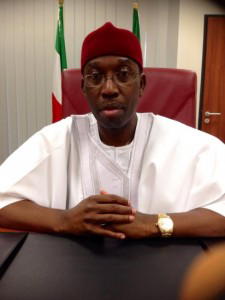
Governor Ifeanyi Okowa of Delta State
By Perez Brisibe
The shortfall in oil receipts and threats to internally generated revenue from forced closures by oil producing companies is forcing the administration in Asaba towards cut saving measures.
Already biometric profiling of civil servants has cut the state’s monthly wage bill by N600 million.

Governor Ifeanyi Okowa of Delta State
IGR to the rescue
Given the situation, it was not surprising that the state had to resort to Internally Generated Revenue, IGR to make up for the excess.Pegging the IGR at about N3 billion, a member of the State Board of Internal Revenue, Barry Gbe said: “Right now we are getting N3 billion from IGR but that too, is being threatened as a result of the renewed activities of militants in parts of the state on our major tax paying companies like Chevron and its sister companies.
“If the IGR goes down the state would be in crisis. Right now we are doing N3 billion but it is threatened. Those on site are now the essential workers, so we still have the PAYE tax of those individuals but the moment it gets worse, they would also be withdrawn by their employers, and no location would pay tax to us”.
Buhari describes situation as disgraceful
President Buhari while speaking with State House workers who gathered at the forecourt of the Presidential Villa to welcome him back from his vacation last month, had lamented the situation.
Delta State in September last year was among states that got bail-out funds from the government to enable it to pay workers salary amidst the financial crunch in the country.
How Delta spent 2015 bail-out funds
Though the state had a total debt value accrued from Staff salaries and emoluments of N36,417,217,601.53 as at September 2015; N10,936,799,299.36 was granted as bailout fund for the state with a balance of N2,806,911,019.50.
Giving details of how the fund was spent while debunking reports that the state government squandered the money, the state commissioner for information, Patrick Ukah said: “The sum of N806, 911,019.50 was used for the payment of primary school teachers’ salaries while N2 billion from the balance of N2, 806,911,019.50 as at December 31, 2015, was used to reduce the state’s liability to pensioners of the State Pension Bureau.”
Govt resorts to staggered payment as an alternative
Meanwhile, the state government has said it is opting for “staggered payment” of public officers in the light of the persisting economic challenges as an alternative to meet up with the upheavals of salary payment.
Confirming the development to newsmen, the Senior Special Assistant to the state governor on Labour and International Relations, Mike Okeme explained that in the face of significant shortfalls in the state government’s receipt from the federation account, the government had to streamline its expenditure to tally with its income.
Painful decision
The payment of public officers, he said, falls under the activities of the government that had to be affected by the new development.
Speaking on how the labour unions in the state would swallow the bitter pill, Okeme stated that the painful decision of the government had already been brought to the attention of the leadership of organised labour movement in the public sector, which had shown great understanding at the decision of the administration he held as workers’ friendly.
Speaking further, he stressed that the strategy of staggered payment would be a transient resort that would be jettisoned as soon as the state’s earnings from the federation account and internal sources were sufficient to simultaneously meet all of the government’s monthly obligations to its employees.
Disclaimer
Comments expressed here do not reflect the opinions of Vanguard newspapers or any employee thereof.